
Jul 28, 2025
7 Tools to Track Brand Mentions in ChatGPT and LLMs in 2026
To track brand mentions across ChatGPT, Gemini, Perplexity, and Claude in one place, you can use an AI visibility tool (the category is called GEO or AEO). This article compares seven options on the same criteria: GetMint (monitoring, source analysis, and optimization recommendations), Profound (enterprise reporting), SEMrush AI Visibility Tracker (AI tracking inside an SEO suite), Ahrefs (AI search features in development), Otterly (scraping-based monitoring), Peec AI (analytics at accessible pricing), and Waikay (knowledge graph and fact-checking). GetMint, Profound, and Peec AI show which sources AI models cite. Waikay lists a free option for basic testing; GetMint publishes no prices and sizes its two plans on a call. The sections below cover features and pricing for each tool, then the questions people most often ask when choosing one.
Each tool below is described from its published features and pricing, using the same headings. Check each vendor's site for current plans and terms before you decide.
AI brand monitoring tools show when, how, and in what context AI models such as ChatGPT, Claude, Gemini, and Perplexity mention your brand, or recommend competitors instead.
What Are AI Brand Monitoring Tools?
AI brand monitoring tools analyze how large language models perceive, reference, and rank your brand across different AI platforms. Unlike traditional SEO tools that track website rankings, these platforms monitor your visibility in AI-generated answers, track sentiment, and report which sources the models rely on.
Why Track Brand Mentions in AI Answers
Users increasingly ask AI assistants to find information, compare products, and discover brands. These LLMs don't just link to your content: they summarize, reinterpret, and sometimes rewrite it, so traditional SEO metrics alone don't show how a brand appears in an AI answer. Measuring that channel means tracking the prompts your buyers actually type.
AI Is Also a Business Workflow
The relevance of AI visibility goes beyond consumer search behavior. Business survey data from the Census Bureau show that about 18 percent of U.S. firms had adopted AI as of year-end 2025. Work-related generative AI adoption reported by individuals stands at about 41 percent as of November 2025, and a survey targeting senior leaders at U.S. firms estimates that 78 percent of the labor force works at firms that have adopted AI, with about 54 percent working at firms that specifically use LLMs.
The gap between firm-level adoption and individual usage suggests that employees query AI models to research suppliers and compare solutions, often before any formal company-wide rollout. At the beginning of 2025, around 9 percent of firms indicated plans to use AI within six months, and over 20 percent of firms expected to use AI in the first half of 2026.
For brands, this means AI-mediated discovery happens in two settings: consumers asking ChatGPT and similar tools, and B2B buyers evaluating vendors through the same LLMs at work.
AI Brand Monitoring Tools Compared
The seven tools below are covered with the same structure: what it does, what it costs, and who it suits.
1. GetMint – Monitoring, Source Analysis, and Optimization
GetMint is an AI visibility platform that covers three uses: monitoring brand mentions in LLM answers, analyzing the sources those models cite, and suggesting actions to optimize your presence.
Key Features:
Monitoring: visibility score and industry share of voice across language models
Source analysis: a sources explorer listing the sources cited in AI responses, with owned versus third-party attribution
Page analysis: web page analysis with GEO recommendations and content suggestions (Page Magic)
Competitive and sentiment analysis: comparison against selected competitors, sentiment scoring, a brand alignment score, and alerts for harmful content from key sources
Multi-LLM coverage: ChatGPT, Claude, Gemini, Google AI Overview, Perplexity, Mistral, and Deepseek
Pricing:
Advanced: for brands that want reliable AI search data and a team that gets them autonomous fast (300+ prompts, 5 topics, unlimited users, 10 contents created or optimized per month, multi-country, 12-month commitment)
Enterprise & Agency: for multi-brand organizations; everything in Advanced, plus custom prompts and topics, API access, a dedicated AI search strategist and role-based access control
Prices: not published; each plan is sized on a call to your brands, markets and goals
Suited to: teams that want monitoring, source analysis, and optimization recommendations in one tool.
2. Profound – Enterprise Reporting
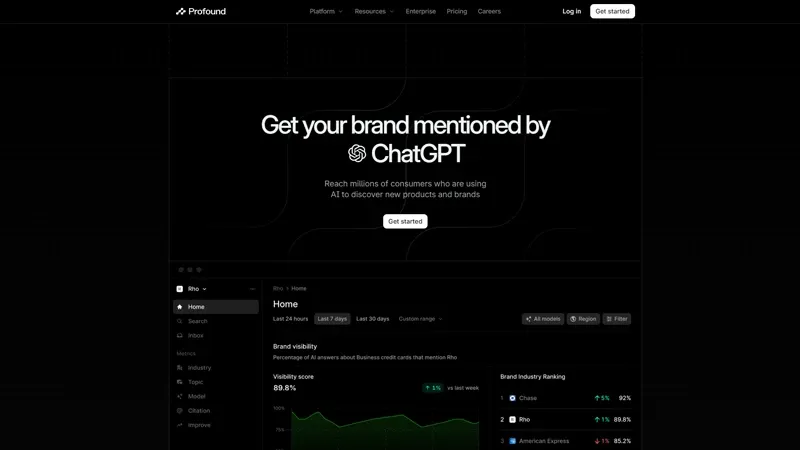
Profound is positioned as an enterprise solution for large brands that need detailed reporting.
Key Features:
Answer engine insights: tracks visibility across ChatGPT, Perplexity, Gemini
Competitive benchmarking: competitor analysis and positioning insights
Source analysis: identifies domains frequently referenced by AI models
ChatGPT Shopping integration: monitors product visibility in e-commerce results
Custom reporting: automated reports tailored for different teams
Pricing:
Lite: $499/month (startup-focused)
Growth: custom pricing (typically $900+/month)
Enterprise: custom pricing (advanced features and priority support)
Suited to: large enterprises focused on reporting and analytics.
3. SEMrush AI Visibility Tracker
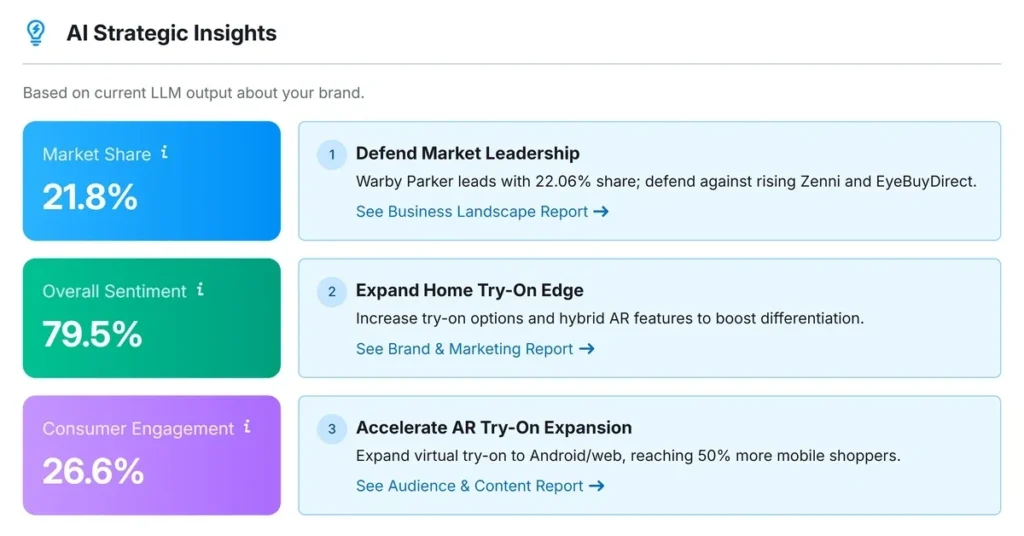
SEMrush has extended its SEO platform with AI monitoring, adding AI visibility tracking to existing SEO workflows.
Key Features:
AI Overview tracking: monitors Google AI Overviews and traditional search
Keyword integration: connects AI visibility with traditional keyword tracking
Competitive analysis: shows how competitors appear in AI responses
Historical data: tracks visibility changes over time
SEO integration: combines AI insights with traditional SEO metrics
Pricing:
Part of existing SEMrush subscriptions (Pro: $139.95/month, Guru: $249.95/month)
AI features available in higher-tier plans
Suited to: SEO teams already using SEMrush who want AI monitoring in their existing workflow.
4. Ahrefs (AI Features in Development)
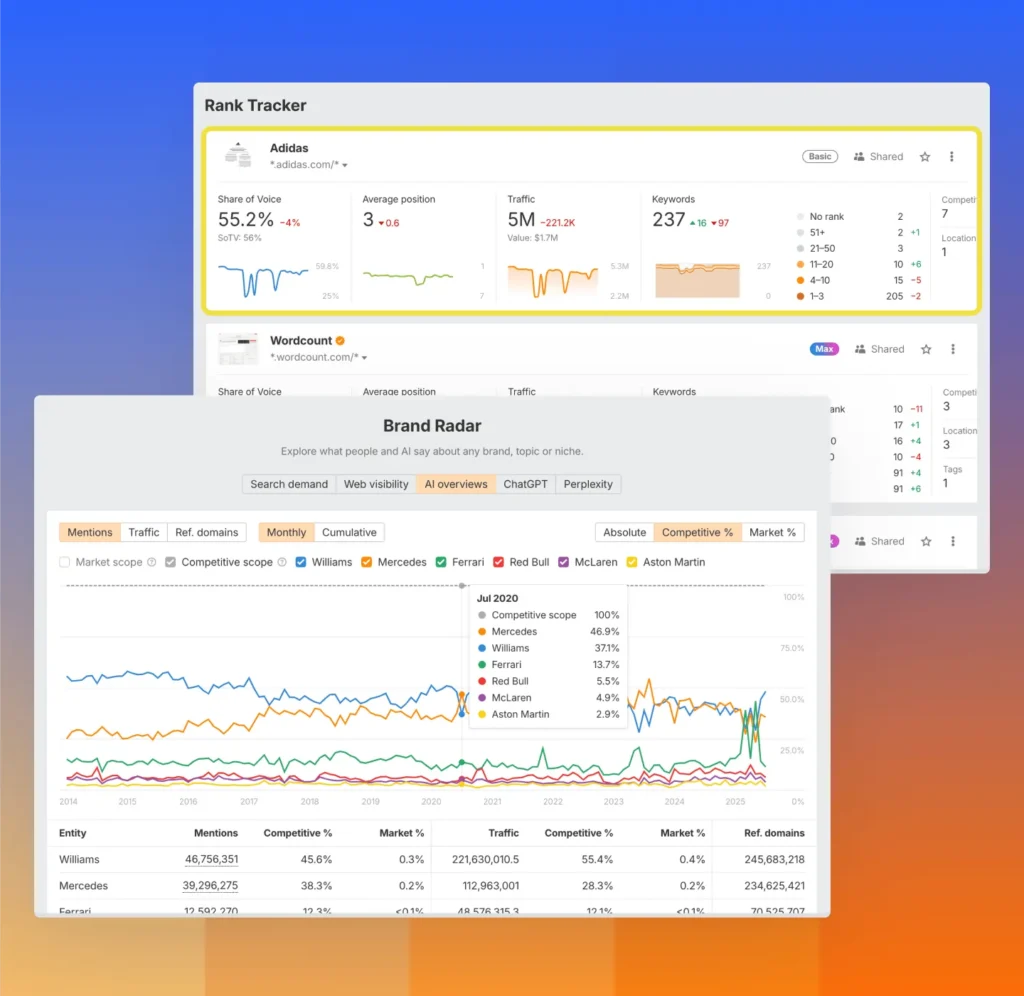
Ahrefs had not fully launched dedicated AI monitoring tools at the time of writing; the platform is developing AI search capabilities to complement its SEO suite.
Expected Features:
AI search tracking: monitor brand mentions in AI-generated content
Content optimization: AI-powered recommendations for visibility
Competitive intelligence: track how competitors perform in AI search
Current Pricing:
Lite: $129/month
Standard: $249/month
Advanced: $449/month
Enterprise: $14,990/month
Suited to: SEO professionals already using Ahrefs who are waiting for AI monitoring features.
5. Otterly – Scraping-Based AI Search Monitoring
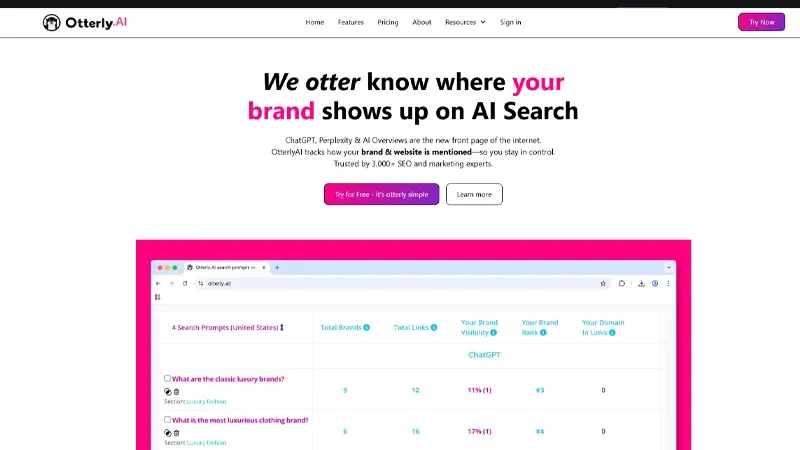
Otterly is an entry point for businesses new to AI brand monitoring. It emphasizes ease of use and collects results through web scraping rather than API access.
Key Features:
Multi-platform support: ChatGPT, Gemini, Perplexity (scrapes the results users see)
Geographic tracking: monitor brand visibility by customer location across 12 countries
Prompt research: discover which queries trigger brand mentions with an AI prompt generator
Link tracking: monitor how often AI responses include links to your content
Search volume estimation: estimated search volumes for AI platforms
Pricing:
Lite: $29/month (10 search prompts, weekly tracking)
Standard: $189/month (100 search prompts)
Pro: $989/month (1,000 search prompts)
Additional keywords available as in-app purchases
Suited to: small and medium businesses that want straightforward monitoring based on scraped results rather than API data, with a limit on the number of keywords tracked.
6. Peec AI – Analytics Platform
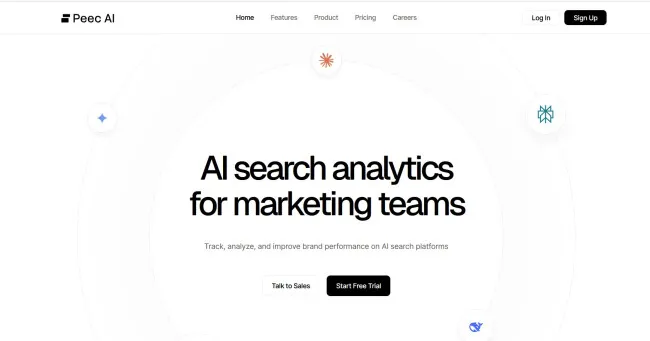
Peec AI offers analytics at accessible pricing, for marketing teams that want detailed insights without enterprise-level costs.
Key Features:
Brand visibility scoring: tracks performance across ChatGPT, Perplexity, AI Overviews
Source analysis: shows which content sources influence AI responses
Sentiment tracking: monitors positive, neutral, and negative brand portrayal
Team collaboration: multi-user support with role-based access
Multi-language support: covers German-language queries
Pricing:
In-house: €120/month (30 prompts, unlimited seats, 2 AI platforms)
Agency: €180/month (3 clients, unlimited seats, 2 AI platforms)
Enterprise: custom pricing
Suited to: marketing teams that need analytics at a lower price, noting that base plans cover 2 AI models.
7. Waikay – Knowledge Graph-Focused Monitoring
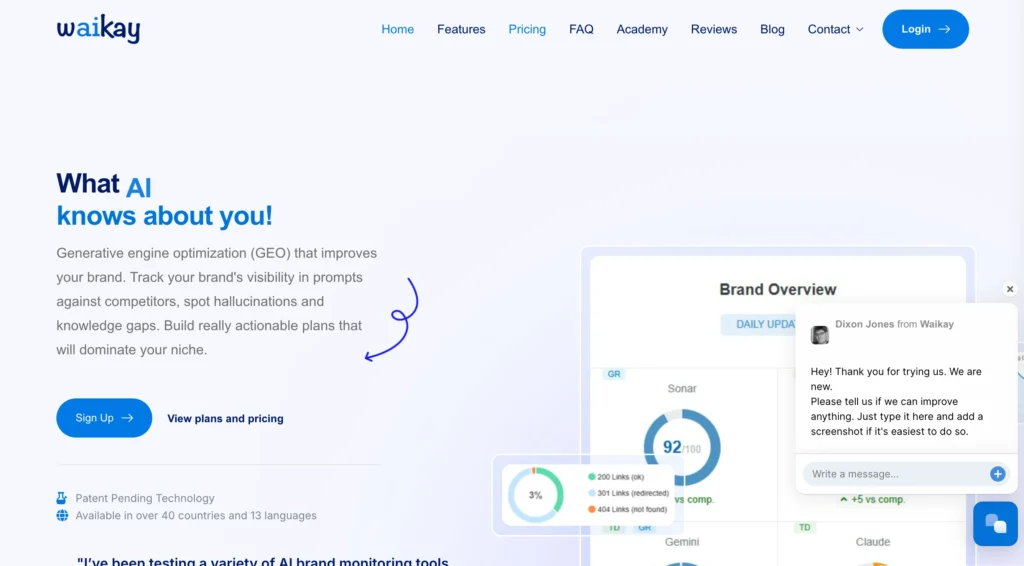
Waikay focuses on entity relationships and knowledge graph optimization for AI visibility, with fact-checking capabilities.
Key Features:
Automatic knowledge graph building: creates entity maps from your website
Fact extraction and verification: identifies and flags incorrect claims AI models make about your brand
Gemini differentiation: separates training data from grounded responses
Entity relationship mapping: maps brand-related topic connections
Multi-language support: available in 9 languages
Pricing:
Single brand: $19.95/month
Multi-brand: $69.95/month (30 reports)
Agency: $199.95/month (90 reports)
Free option: available for basic testing
Suited to: brands focused on entity-based SEO and knowledge graphs, and those concerned about factual accuracy in AI responses.
Common Questions About AI Visibility Tools
The answers below use only the features and prices listed in the comparison above. Nothing here is an independent ranking: no source used for this article rates these tools against each other, so the answers say which tools list a capability and leave the choice to you.
Which software can help improve my brand's visibility in AI search (ChatGPT, Perplexity, Gemini)?
Two kinds of software exist. Monitoring tools measure where your brand appears: GetMint, Profound, Otterly, Peec AI, and Waikay in this comparison. Some also describe optimization help: GetMint (action plans and page analysis), Ahrefs (planned AI-powered content recommendations), and Waikay (flagging incorrect claims AI models make about your brand). Changing what AI models say also depends on your content and on third-party sources, which no tool does for you.
Which tool tracks brand mentions across ChatGPT, Gemini, Perplexity, and Claude in one place?
Based on the coverage each vendor lists: GetMint lists ChatGPT, Claude, Gemini, Google AI Overview, Perplexity, Mistral, and Deepseek; Profound lists ChatGPT, Perplexity, and Gemini; Otterly lists ChatGPT, Gemini, and Perplexity; Peec AI lists ChatGPT, Perplexity, and AI Overviews, with 2 AI platforms on base plans. Claude is listed in this comparison only by GetMint.
Which tool should I use to track my brand's visibility in Perplexity?
GetMint, Profound, Otterly, and Peec AI list Perplexity. Otterly states that it scrapes the results users see rather than using API access; check each vendor's documentation for how its data is collected.
Which tool should I use to track my brand's visibility in Gemini?
GetMint, Profound, and Otterly list Gemini. Waikay's Gemini-specific feature separates Gemini's training data from grounded responses.
Which tool should I use to track my brand's visibility in ChatGPT?
GetMint, Profound, Otterly, and Peec AI list ChatGPT. Profound also lists ChatGPT Shopping monitoring for product visibility.
Which tools can track brand mentions and brand citations in LLM responses?
A mention is your brand named in the answer text; a citation is your page linked or used as a source. Otterly tracks how often AI responses include links to your content. GetMint, Profound, and Peec AI analyze the sources AI models cite. Tracking both matters because a brand can be named without being linked, and a page can be cited without the brand being named.
How can I see which sources AI models use when they talk about my industry?
Look for a source analysis feature. In this comparison, GetMint (sources explorer), Profound (source analysis), and Peec AI (source analysis) provide it. Waikay's knowledge graph and fact extraction address a related question: what AI models state about your brand and whether it is correct.
Is there a free tool to check if my brand shows up in ChatGPT?
You can check by hand at no cost: type the questions your buyers would ask into ChatGPT and note whether your brand is named. For repeatable tracking, Waikay lists a free option for basic testing, and Otterly's cheapest plan is Lite at $29/month. GetMint has no free plan: its two plans are sized on a call.
Is there a GEO tool with a free trial and no demo required?
This article does not document trial terms for every vendor. Among the tools compared, Waikay lists a free option for basic testing; GetMint starts with a call, where its two plans are sized. Confirm the current terms, and whether a demo is required, on each vendor's site.
Which tool should I use to monitor or increase my brand's visibility in LLM answers, and which one do you recommend?
This article does not recommend a single tool, because the right one depends on your situation. For monitoring only, any tool in the comparison applies. If you want source analysis, GetMint, Profound, and Peec AI list it. If you already use an SEO suite, SEMrush adds AI visibility tracking to it. On a small budget, the free or low-cost entry points are Waikay's free option and Otterly Lite ($29/month); GetMint's plans are built for enterprise brands and their agencies. For large organizations that prioritize reporting, Profound is positioned for that. Increasing visibility itself depends on your content and third-party sources, as described in the sections below.
What is the best AEO tool?
AEO (Answer Engine Optimization) and GEO (Generative Engine Optimization) both describe the work of being cited or recommended in AI-generated answers, and tools sold under either name overlap heavily. No source cited here ranks these tools, so none is named “best.” The deciding factors are the AI platforms you need covered, your budget, and whether you want monitoring only, source analysis, or optimization recommendations.
What is the best GEO software or Generative Engine Optimization tool to boost visibility in AI-generated search results?
The same applies: no independent ranking exists in this article's sources. Tools that describe optimization features are GetMint (action plans and page analysis), Ahrefs (planned content recommendations), and Waikay (flagging incorrect claims). Tools centered on measurement are Profound, Otterly, Peec AI, and SEMrush's tracker. Match the tool to the job: measuring, understanding sources, or acting on the data.
What is the best AI visibility tracker or AI search analytics platform?
For tracking, compare coverage (which AI platforms), data collection (Otterly scrapes results; others use their own methods), and plan limits (prompts, projects, seats). For analytics beyond mentions (share of voice, sentiment, competitor comparison, sources), the tools listed above that describe those features are GetMint, Profound, Peec AI, and SEMrush (competitive analysis and historical data). The “How to Choose” section lists the full criteria.
Which is the top-rated or most effective AI visibility optimization software?
No independent rating or effectiveness study of these tools is cited here, so this article does not rank them. Judge each on the same criteria and test with your own prompts before committing to a paid plan.
Where can I find LLM optimization for AI visibility?
LLM optimization has two parts: the tools above, and the practices described in “Getting Started with AI Brand Monitoring” below (structured content, strong owned pages, and presence on the third-party sources AI models cite).
Industry Research: AI Brand Visibility Insights
According to research conducted by Mint and published in Les Echos, an analysis of French Next 40 startups revealed patterns in AI brand visibility. The study examined 4,500 LLM responses across GPT-4o, Gemini Flash 2.0, Mistral Medium, and Perplexity Sonar Pro.
Key findings include:
B2C brands achieve higher visibility but face perception challenges due to greater exposure to negative feedback
Authority sources matter: AI models heavily consult Wikipedia, Reuters, Gartner, and YouTube for international queries
Sector leaders stand out: companies like Brevo (B2B) and Ekwateur (B2C) achieve visibility scores above 80%
As noted in the research: “Companies must be recognized as having authority on a subject, particularly through content that is difficult to copy and frequently distributed within sources that AIs consult to formulate their responses.”
Why Monitoring Alone Isn't Always Enough
Most AI brand monitoring tools show data: how often you're mentioned, sentiment scores, and competitive comparisons. Turning that data into improvements requires:
Understanding why certain sources influence AI responses
Knowing which content changes could improve visibility
Having a way to create content suited to LLMs
Tracking whether your changes make a difference
Whether you do this inside a tool or with your own team and processes is a choice that depends on your resources.
Regulatory Context: How the EU AI Act and NIST AI RMF Relate to Brand Monitoring
Most discussions of AI brand monitoring focus on tools, dashboards, and share-of-voice metrics. Fewer address the regulatory environment that shapes how AI platforms handle the content they generate, including the brand mentions inside it.
The EU AI Act: Transparency Obligations
The EU AI Act entered into force on 1 August 2024. One of its central pillars is transparency around AI-generated content. The Act obliges deployers and providers of generative AI to inform people when they are interacting with an AI system, as well as when they are exposed to content generated or manipulated by an AI system.
More specifically, providers must design AI systems that interact directly with people, such as chatbots, AI agents, and avatars, so that people are informed they are interacting with AI. Providers must also ensure that the outputs of their generative AI systems are marked with machine-readable marks that enable the outputs to be detected as generated or manipulated by AI systems.
For brand monitoring, this means the way brand information is surfaced, attributed, and presented inside AI outputs may increasingly come under scrutiny as disclosure norms evolve.
NIST AI RMF: A Voluntary Framework for Generative AI Risk
In the United States, the NIST AI Risk Management Framework and its Generative AI Profile (NIST AI 600-1, released July 2024) offer a voluntary approach to identifying and managing risks specific to generative AI systems. Organized around four core functions (Govern, Map, Measure, and Manage), the framework helps organizations assess the reliability, accuracy, and potential harms of AI-generated content.
The Measure and Manage functions are relevant to brands: they provide a methodology for evaluating how consistently and accurately an LLM represents a brand. The Generative AI Profile addresses risks like confabulation (AI “hallucinating” brand facts) and information integrity.
How to Choose an AI Monitoring Tool
Consider Your Business Size and Needs
Using the plans listed above:
Small businesses and startups: entry-level or free options include Waikay's free option and Otterly Lite ($29/month). A paid starting point is Waikay Single brand ($19.95/month).
Medium businesses (50-500 employees): Peec AI (from €120/month) and Otterly Standard ($189/month) are mid-priced options.
Large enterprises (500+ employees): Profound (reporting-focused) or GetMint, whose Advanced and Enterprise & Agency plans are sized on a call for enterprise brands and their agencies.
Criteria to Evaluate for Any Tool
Platform coverage: does the tool monitor all AI platforms relevant to your audience (ChatGPT, Claude, Gemini, Perplexity…)?
Competitive analysis: does it benchmark your performance against competitors and identify visibility gaps?
Source attribution: does it reveal which content sources influence AI responses about your brand?
Sentiment analysis: does it track not just mentions but how AI models portray your brand?
Actionable recommendations: does it identify specific actions rather than only provide data?
Content optimization: does it include content adaptation or creation features, or will you do that elsewhere?
Regulatory awareness: does it account for developments such as the EU AI Act's transparency obligations (in force since 1 August 2024, with transparency duties applicable from August 2026)?
Price and plan limits: seats, projects, prompts, and the number of AI models covered.
Getting Started with AI Brand Monitoring
Step 1: Place Your Sensors Early
Begin by setting up visibility prompts and launching analysis as early as possible. This means:
Monitor your current AI visibility: track spontaneous brand mentions and industry share of voice across the relevant AI platforms.
Analyze sources consulted by LLMs: identify which websites and content sources influence AI responses in your industry. This shows the external sources that shape how AI answers describe your market.
Map your competitive environment: understand which competitors appear, which sources they benefit from, and what content gaps exist.
Step 2: Understand the AI Search Paradigm Shift
AI search works differently from traditional search through five steps: query analysis, query fan-out, source retrieval, retrieval scoring, and answer synthesis with citations. The goal is to become a source the AI cites in its response.
Three changes matter:
From keywords to context: AI models understand meaning and semantic relationships, which calls for topical authority and comprehensive coverage
From traffic to authority: success includes being cited in AI responses, not only driving clicks
From ranking to references: focus on content that AI systems can extract and reference with confidence
Step 3: Apply a GEO Framework
A three-pillar approach is common:
Own Your Concept: become a reference for specific topics in your industry through a distinct perspective, internal data, regular publishing, and an expert educational approach.
Optimize External Sources: build authority through partnerships, guest content, community engagement, PR coverage, and review management on platforms AI systems rely on.
Perfect Owned Sources: keep content fresh, use structured data, use rich formats (tables, FAQs, tutorials), and maintain a clean technical implementation.
Step 4: Track GEO-Specific Success Metrics
Adapt your KPIs to what matters for AI visibility:
Visibility metrics: spontaneous brand mentions and industry share of voice
Sentiment scores: brand sentiment, comparable to a generative NPS
Brand alignment: consistent messaging across AI-generated content
Source analytics: ranking of the most influential sources in your market
Content performance: site optimization for AI extraction and understanding
Traffic attribution: conversion tracking from AI traffic sources
Keep reading: AI Search Visibility GetMint Framework – Strategic Overview and Step 1: Understanding How Generative Engine Optimization (GEO) Works.
BUILT FOR ENTERPRISE BRANDS
Your competitors are already visible in AI. Are you?
See what ChatGPT, Gemini and Perplexity say about your brand. Set up in 5 minutes.

