


The market is flooded with “AI SEO tools,” but most of them are designed to help you do the old job faster, and a handful are built to do a brand new job.
Choosing the wrong one is the most expensive mistake you can make in 2025.
Over 56% of marketers are now using generative AI in their workflows, but many are buying a faster horse when they really need a car: a tool that fundamentally misunderstands the new landscape of AI search.
Instead of adding to the noise with another tool review, our evaluation framework will teach you how to compare AI search optimization tools and give you the criteria you need to choose a partner for your Generative Engine Optimization (GEO) strategy.
What Is AI Search?
Before comparing tools, it’s important to understand the new landscape they operate in.
Traditional search gives you a list of links that are essentially a “menu” of options you have to click and research yourself.

AI search is different.
It uses platforms like ChatGPT, Perplexity, and Google’s AI Overviews (AIO) to synthesize information from multiple sources and give you a single, conversational answer that addresses your question.
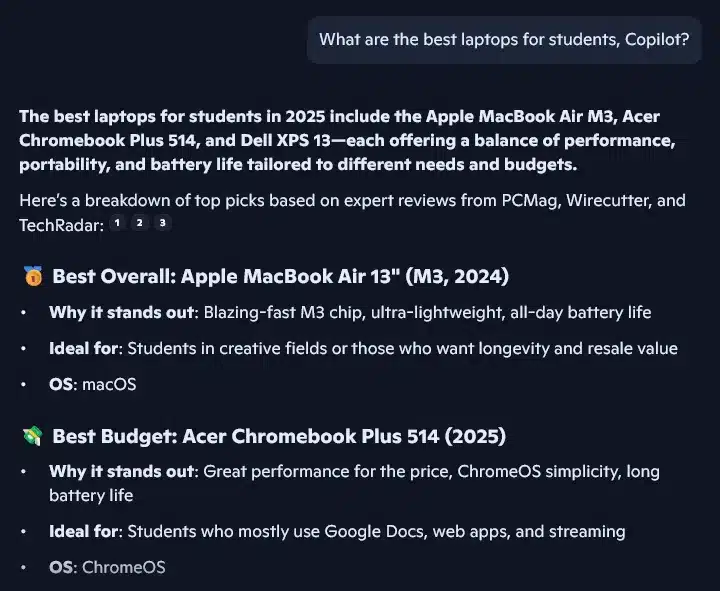
Instead of getting ten blue links, you get one definitive response. This changes everything for businesses, as they must also factor in Answer Engine Optimization (AEO), not just optimize for search engines.
What Makes AI Search Visibility Important?
With Search Engine Optimization (SEO), success is measured by clicks and traffic. With AI search, the most important metric is AI search visibility. This is your brand’s ability to be mentioned, cited, and positively represented within these AI-generated answers.
The reason this matters comes down to one noteworthy statistic: AI traffic converts at 3x higher rates than traditional channels.
These are your most valuable potential customers, and they’re making decisions before they even click a link. They ask an AI for a recommendation, the AI gives them an answer, and they go directly to the brand that was recommended.
If your brand isn’t in that answer, you’re invisible to them at the most critical moment of their journey. Your traditional analytics, focused on website traffic, will never even show you this happened.
Are You Optimizing for SEO or for Visibility?
Before you look at any tool, you must answer one question: What problem are you actually trying to solve?
The current market confusion exists because two very different types of tools are being bundled under the same “AI SEO” umbrella. You can’t compare them against each other because they solve completely different problems.
AI-Powered SEO Tools
These tools use artificial intelligence to make the work of traditional SEO faster and more efficient.
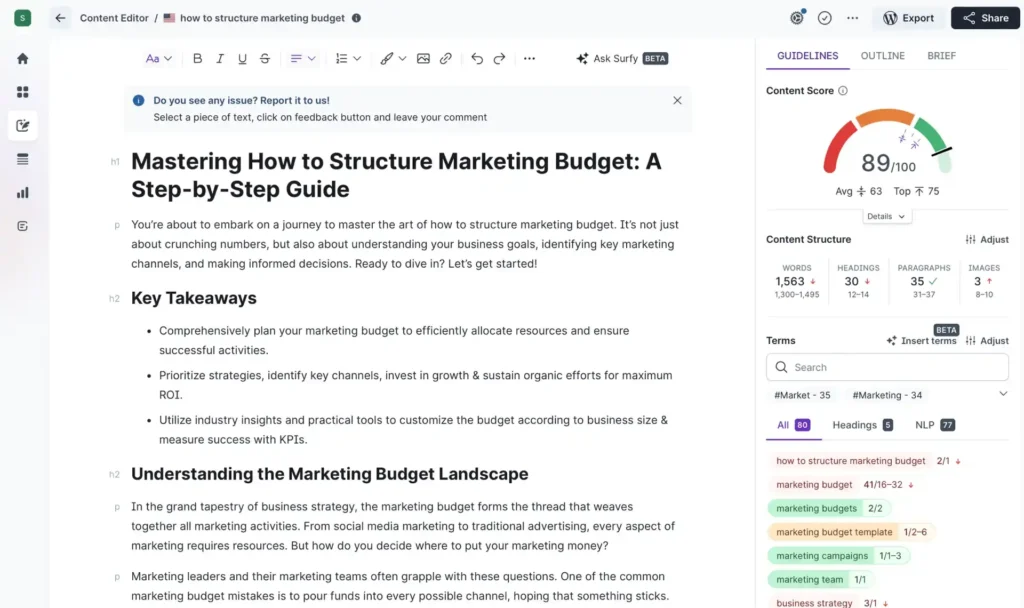
Their job is to help you create content that ranks higher in the traditional blue links on Google. They’re excellent at things like
- Generating blog post drafts and outlines
- Analyzing top-ranking content to find topics you should cover.
- Clustering keywords to build topical authority.
Tools like SurferSEO or NeuronWriter fit in this category. They’re an upgrade for the old way of doing things.
AI Search Visibility Platforms
These platforms are built to measure and optimize your brand’s presence inside the answers of generative AI engines.
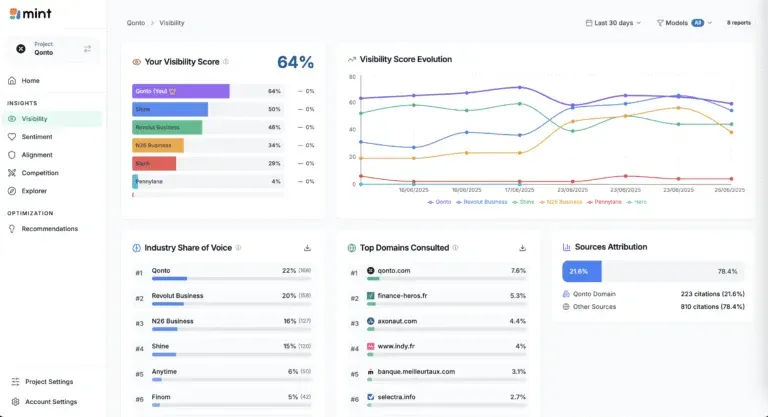
Their goal isn’t to get you on a list of links. Rather, they help to make your brand the answer. They’re designed to tell you:
- If your brand is mentioned in AI recommendations.
- What your share of voice is for commercial questions.
- What the sentiment is when an AI describes your products.
This is the work of true GEO.
Before you evaluate a single feature, you must decide which of these two problems you need to solve. If your goal is to win AI answers, you need a GEO platform. You can see a direct comparison in our guide to the best tools for GEO.
The rest of the article focuses on AI search visibility platforms, not AI-powered SEO tools.
7 Criteria to Compare AI Search Optimization Tools
Once you know you’re shopping for a true visibility platform, the sales pitches can still be confusing. They all promise to track your “AI visibility,” but what does that actually mean? Use these 7 criteria to evaluate which tool is genuinely built for AI search optimization.
1. Is the tool built for SEO or GEO?
A tool with a traditional SEO philosophy will always see the world through the lens of keywords and backlinks. A tool with a GEO philosophy understands that AI search is about entities, authority, and brand reputation across the entire web.
GEO-native tools are built on the understanding that you need a strategy for how to optimize for AI search, which involves managing your presence on authoritative third-party sites, not just your own blogs.
→ This is important because many traditional SEO tools, such as Semrush, Ahrefs, and Moz, are integrating AI features without yet optimizing for generative engine behaviors like citation targeting or large language model (LLM) prompt shaping.
2. How many platforms does the tool cover?
Tracking Google’s AI Overviews is important, but it’s only one piece of the puzzle.

High-intent, commercial questions are being asked every second on platforms like ChatGPT and Perplexity. A tool that only tracks Google, like Morningscore’s AI Overviews Tracker, leaves you blind to the places where your customers are making purchase decisions.
3. Does the tool measure what matters?
Getting an alert that you received an AI mention isn’t enough. That’s a data point, not an insight.
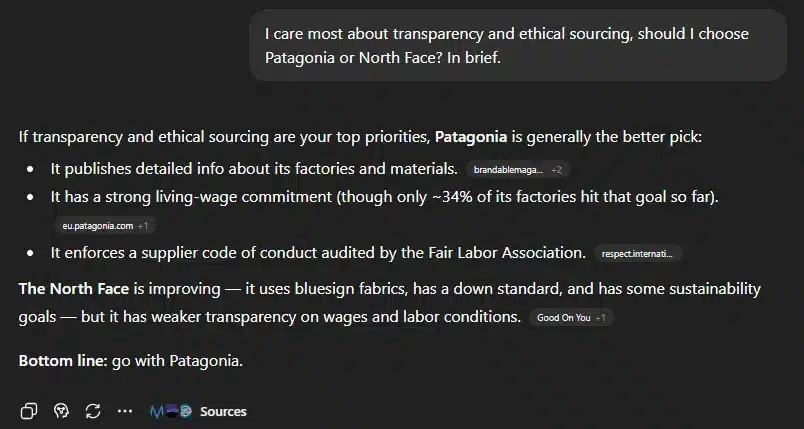
A strategic platform measures what actually influences customer perception and business outcomes.
Look for tools that, beyond AI mentions, track these important KPIs:
- Share of voice: What percentage of the AI answers for your most important keywords do you own compared to your competitors?
- Sentiment: When the AI mentions your brand, is the description positive, neutral, or negative?
- Brand alignment: Does the AI’s description of your company match your actual brand messaging?
- Citation quality: When the tool provides an AI citation, are the sources high-quality and authoritative? (Learn the difference in our guide to an AI mention vs. citation.)
4. Does the tool give you a dashboard or a strategy?
A dashboard full of charts is useless if it doesn’t tell you what to do next. The platform should move you from data to decision. It shouldn’t just show you that a competitor is winning a mention; it should help you understand why by showing you the sources AI is using.
This allows you to identify specific content gaps and build a solid plan to earn that visibility yourself.
→ GetMint, for example, reveals the exact sources behind AI citations and includes a Content Studio that helps you close the gap.
5. How easily can your team adopt the tool?
The most powerful tool is worthless if it’s too complex for your team to use.
The insights must be easily accessible to the people who need them (brand managers, content strategists, and marketing leaders) without requiring a data science degree to understand. Prioritize tools with minimal onboarding and functional interfaces.
6. Does the tool fit your existing stack?
A visibility platform shouldn’t be a data island. You need to be able to get the insights out of the tool and into the systems your organization already uses for reporting and analysis, whether that’s a simple spreadsheet, a Google Looker Studio dashboard, or a complex internal business intelligence tool.
Many enterprise-level traditional SEO platforms have begun introducing GEO features to become the all-in-one solution you need. Meanwhile, dedicated GEO platforms, such as GetMint, integrate seamlessly with platforms such as Google Search Console and Slack to support your workflow.
7. What is the tool’s true cost of ownership?
Finally, evaluate the total cost of ownership, not just the sticker price. A cheap tool that only tracks Google AIOs and leaves you blind to the rest of the AI ecosystem is far more expensive in the long run due to the missed opportunities it creates.
Be wary of pricing models that charge extra for essential features like adding team members, exporting your own data, or accessing support.
On a final note, make sure the product fits your team’s workflow and your company’s budget. Some platforms (like seoClarity, which starts at $2,500/month) are built for enterprise-scale operations. If you’re a lean team focused on actionable GEO insights, that level of complexity may be overkill and will only inflate your spending.
Common Mistakes to Avoid
Before you make your final decision, be aware of these common traps. They’re the primary reasons businesses end up with an expensive tool that doesn’t deliver expected value.
1. Focusing on features instead of effectiveness
The biggest mistake is getting dazzled by a long list of features. Many vendors will showcase AI-powered content writers or keyword generators. These features are designed to improve traditional SEO, not measure AI search visibility.
2. Underestimating the total cost of ownership
Don’t just look at the monthly subscription fee. A tool that seems cheap upfront can become expensive quickly if there are strict limits on the number of users, tracked keywords, or data exports.
There are many tools that force you to “upgrade” or “buy credits” to add new team members or do more keyword research. Always ask about these hidden costs and prioritize platforms with transparent, all-inclusive pricing. They’re better long-term partners than on that nickels and dimes you for essential functions.
3. Buying a tool without a strategy
An AI search visibility platform is a compass. It tells you where you are and which direction you need to go. The most powerful tool in the world won’t deliver an ROI if you don’t have a strategy for using its insights.
Before you buy, have a clear plan for who on your team will own the data and how you’ll use it to guide your content creation and authority-building efforts.
Final Thoughts: How to Choose with Confidence
Choosing the right AI search optimization tool comes down to clarity. Don’t get lost comparing feature lists; the right choice is about finding a partner with the right philosophy for this new era of search.
First, be clear about the problem you need to solve. Decide if you need a tool to make your traditional SEO work more efficient or if you need a platform to measure and manage your brand’s visibility inside AI answers.
Once you’re focused on finding a true GEO platform, use the 7-point framework to guide your evaluation. Prioritize platforms built on a GEO philosophy, with comprehensive coverage across all major AI engines, and the depth of metrics needed to measure what actually matters.
GetMint was built from the ground up to address these exact criteria. Ready to see the full picture? Get your free, comprehensive AI brand analysis and start measuring your influence across the AI engines your customers are using.
Frequently Asked Questions (FAQs)
What’s the main difference between an AI-powered SEO tool and an AI search visibility platform?
The difference is their fundamental goal. An AI-powered SEO tool (like SurferSEO) uses AI to help you do traditional SEO faster. It lets you create content that ranks higher in Google’s blue links.
An AI Search Visibility platform (like GetMint) is designed for the new job of Generative Engine Optimization (GEO). Its goal is to measure and improve your brand’s presence inside the AI-generated answers on platforms like ChatGPT and Perplexity.
Do I need both a traditional SEO tool and an AI visibility platform?
For now, yes. The two types of tools perform different, complementary jobs. Traditional SEO platforms like Semrush or Ahrefs are essential for managing your performance in the “blue link economy,” which still drives significant traffic.
AI visibility platforms are essential for managing your brand reputation and influence in the new “answer economy,” where your most valuable customers are making decisions.
Some traditional SEO tools are breaking into the GEO field, but we still don’t have a truly comprehensive, all-in-one SEO and GEO platform.
Which AI search optimization tool is the best?
The “best” tool is the one that aligns with your primary business objective. There’s no single best platform for everyone. If your goal is to win AI-generated answers, the best tool is a GEO platform.
Use the 7-point framework in this guide to evaluate your options based on your specific needs for platform coverage, metrics, and strategic insights.
How much do AI search optimization tools cost?
Pricing for AI search visibility platforms varies. Entry-level plans designed for smaller businesses or specific projects typically start in the $100 to $250 per month range. Mid-tier platforms with more comprehensive data and features often range from $250 to $500 per month. Enterprise-level solutions with extensive data, API access, and dedicated support can cost $1,000 per month or more.

