
Nov 6, 2025
What Is Generative Engine Optimization (GEO)?
Is your content structured for AI? Even authoritative brands can be overlooked by generative engines if their content isn't machine-readable. Generative Engine Optimization (GEO) moves beyond keywords to focus on structure, clarity, and authority. This guide outlines a five-step playbook for adapting your strategy, from researching conversational prompts to implementing E-E-A-T signals, to ensure you earn high-value citations and mentions in the new search landscape.
What Is the Difference Between GEO and SEO?
Nowadays, we hear that GEO will replace SEO entirely. This is a common misconception that overlooks the foundational role SEO continues to hold.
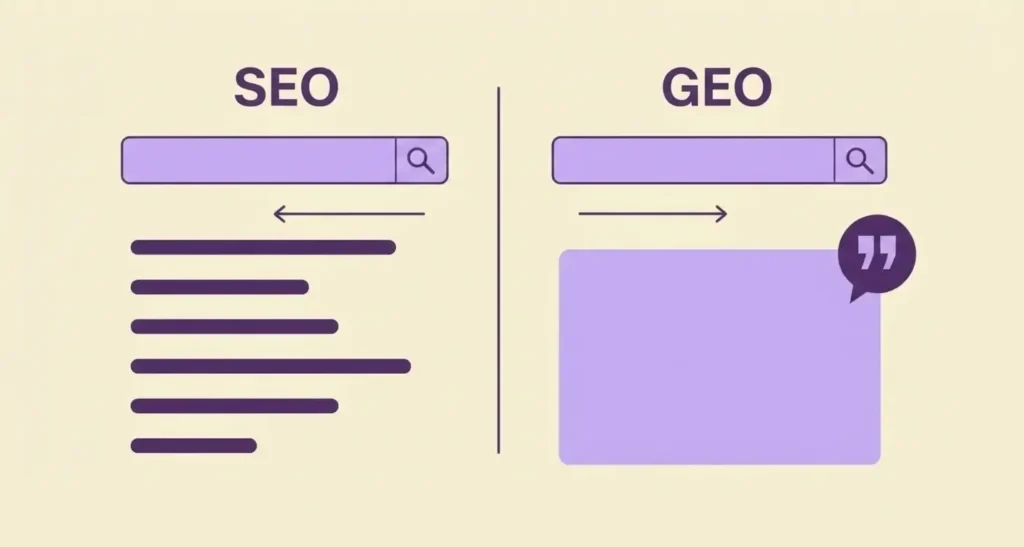
GEO is an evolution that doesn’t erase your hard-won authority; rather, it amplifies it. The difference between the two is the end goal:
Traditional SEO seeks to win a click. The entire game is structured around getting your webpage to rank high in a list of blue links.
GEO focuses on earning AI citations and building AI mentions. The goal is for an AI to either directly cite your content as a verifiable source or to mention your brand as a relevant player in the conversation.
This shift occurred due to a change in user behavior.
Your audience is no longer just typing in keywords into Google search. They’re asking detailed, conversational questions. In fact, some research shows the average AI query is 23 words long. That’s a huge leap from the four-word average in traditional research.
This fundamentally changes how you need to structure content and measure success. Now, expanding from clicks and traffic to influence and authority is a necessity.
Factor | GEO | SEO |
|---|---|---|
Primary Goal | To be cited or referenced in an AI answer | To rank high in a list of search result |
Success Metrics | AI citations and mentions, share of voice, brand mentions | Organic traffic, rankings, click-through rate |
Optimization Target | AI models (ChatGPT, Gemini, Perplexity) | Search engine crawlers (Googlebot) |
User Query Style | Conversational, question-based prompts | Shorter, keyword-based searches |
Output Format | A single, synthesized narrative answer | A ranked list of links to webpages |
Essentially, building a great webpage isn’t enough. You have to build a citable one. SEO is still important, but GEO is how you broadcast that authority into AI answers that are influencing your customer’s decisions before they ever click to achieve visibility in AI platforms.
How Generative Engines Choose What to Cite
To win in this new environment, your team needs to understand how the AI “thinks.”
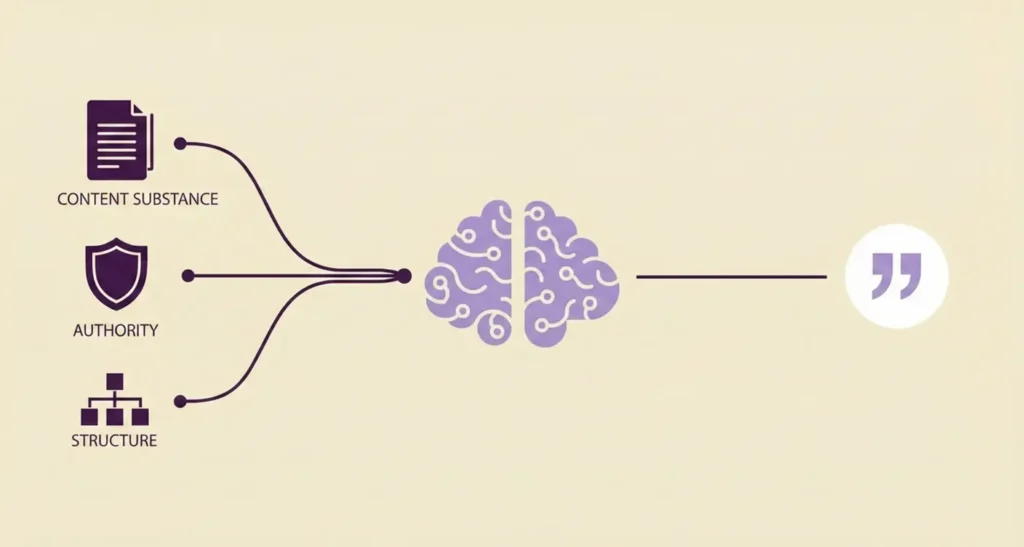
Generative models are massive pattern-recognition systems trained to find and synthesize the most reliable information available. Their process isn’t haphazard; there are specific signals of quality and trust they look for.
The problem is that many of these signals are different from what traditional SEO has prioritized. The solution is to build content that performs well in three areas: the substance of your writing, the information’s authority, and your structure’s clarity.
1. It Looks for Comprehensive and Conversational Content
First, AI engines ignore shallow content. A 500-word blog post that only scratches the surface is usually not cited.
The models are built to answer a user’s initial question and anticipate their next one, so they prioritize resources that cover a topic exhaustively. If your content is the most thorough and helpful resource on the web for a given topic, you’re halfway there.
The AI also thinks in terms of entities and relationships. Your content needs to define concepts clearly and explain how they connect to one another (e.g., “GEO is a discipline that builds on the foundations of SEO.”).
The tone also matters.
Since people ask questions in a natural, conversational style, mirroring that style makes your content a better match for user prompts, especially in headings (e.g., “What is GEO?” vs. “Unpacking the Myth of GEO”). Avoid jargon and try to write like you’re an expert explaining to an intelligent colleague.
2. It Cross-References for Verifiable Authority and Trust
Second, AI models are skeptical by nature. They cross-reference claims and favor factual, well-sourced content that they can verify.
This is where data comes in. Vague claims are ignored, but concrete facts are citable. In fact, a study about GEO has shown that pages including specific statistics and expert quotes see 30% to 40% higher visibility in AI answers.
To build this kind of trust, your team should focus on:
Including verifiable data, such as specific numbers and statistics instead of broad statements.
Citing primary sources by linking directly to the original study, report, or data source to establish a chain of credibility.
Keeping content fresh by frequently updating dated articles and displaying a "Last Update" date. AI engines like Perplexity favor timelines and recency, especially for fast-moving topics, as major authority signals. Whether that freshness pays off only shows up once you start tracking Perplexity visibility and its citations over time.
3. It Requires a Structured and Scannable Format
Finally, even the most authoritative content will be invisible if AI can’t “read” it.
The structure of your page is the AI’s roadmap, and a clean, logical format is what allows the model to extract information accurately and confidently.
The most important element is a strict heading hierarchy.
Every article needs a single H1, with major areas organized under H2s and supporting points nested as H3s, H4s, etc. Never skip levels (e.g., jumping from an H2 to an H4), as this can confuse the AI’s understanding of your content’s structure.
Here’s an example:
H1: Why Do Dogs Tilt Their Heads?
H2: The Science Behind the Head Tilt
H3: How Breed and Skull Shape Affect the Behavior
H2: What It Might Mean Emotionally
H2: So, Should You Tilt Your Head Back?
AI models often cite just one paragraph/section of an article, so treat each section as standalone. Skip phrases like “as mentioned earlier” and make every block self-contained and citable. This is an important principle in Answer Engine Optimization (AEO).
Using scannable formats like bullet points, numbered lists, tables, and bold text also helps the AI identify the most important information on the page.
How to Optimize Content for Generative Engines in 5 Steps
Getting your brand cited is a result of a systematic workflow. Follow this five-step playbook to create citable content and build a durable advantage in AI search visibility.
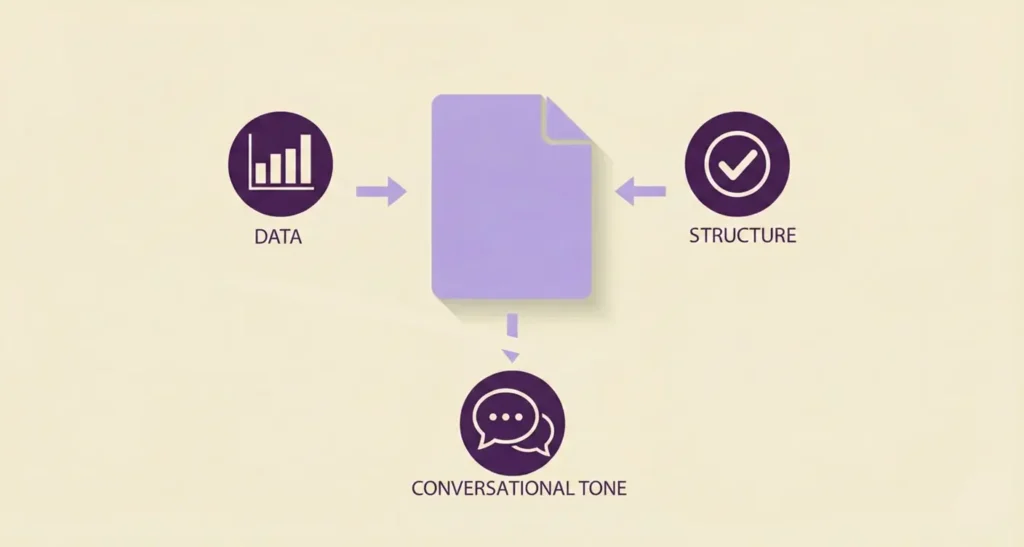
Step 1: Start with Prompts
Every effective GEO strategy begins with understanding user intent.
For years, this meant keyword research with tools such as Semrush. Today, it means prompt research. Your goal is to uncover the conversational questions your audience is asking AI.
→ Instead of searching for “project management software” on Google, a user now asks ChatGPT, “What’s the best project management tool for a remote marketing team of 15 people?”
This level of detail reveals a user’s specific pain points and context. They want an excellent tool fit for small remote teams. The best way to find these prompts is to listen.
Talk to your customer-facing teams: Your sales and support staff know the exact questions customers ask every day.
Analyze community platforms: Forums like Reddit and Quora contain unfiltered, conversational queries related to your industry.
Test AI engines directly: Go to ChatGPT and Perplexity and ask the questions you believe your customers are asking. See what answers come up and which competitors get cited.
Pro Tip: Getmint can help you audit AI visibility and show which prompts cite your content, where competitors win, and what questions you should be answering.
Step 2: Build a Definitive, Authoritative Resource
Once you know your questions, your objective is to create the single best answer on the internet, because that’s what AI models are looking for.
The good news is that although strong SEO fundamentals are a great start, the data shows that simply ranking high isn’t enough.
→ 40.58% of citations in AI-generated overviews come from Google’s Top 10 results, according to a large-scale analysis of over 1 million samples. That means nearly 60% originate beyond the first page,
This is a huge opportunity.
The takeaway is that the best answer can win even if it isn’t the highest-ranked page. As long as you create a resource so thorough and well-researched that the AI sees it as the most reliable source of information, it’ll synthesize its answer from it.
Step 3: Structure Your Content for Machine Readability
The most insightful content is worthless if an AI can’t parse it. Make sure your content’s format is clean and readable by focusing on these three technical elements:
Lead with the answer: Use the “Bottom Line Up Front” (BLUF) or Inverted Pyramid principle. State the main point or answer directly under your heading, then use the rest of the section for elaboration or supporting information.
Use a strict hierarchy: A single H1, followed by a logical flow of H2s and H3s, helps the AI understand the relationship between concepts.
Don’t hide important content behind JavaScript: Many generative engines and search crawlers don’t execute it, which means dynamically injected content (like product descriptions, reviews, or FAQs) are invisible to them. Use plain HTML and JSON-LD for structured data.
Implement schema markup: Schema is a form of code that acts like a descriptive label for search engines. At minimum, use the FAQ and HowTo Schema to tell the AI the purpose of your content.
Pro Tip: You can use Google’s Rich Results Test or Lighthouse to see what’s actually visible to crawlers.
Step 4: Build Authority with Mentions and E-E-A-T
AI models build a “reputation score” for your brand by analyzing signals across the entire web. Traditional backlinks are still a piece of this puzzle, but the scope of authority now is much broader.
→ Unlinked brand mentions on reputable, industry-relevant sites are a great signal. The AI understands that if an authority like Forbes or a popular industry blog mentions your brand positively, you’re likely a credible player. Learn more about these principles in our AI brand monitoring guide.
This directly ties into the concept of E-E-A-T (Experience, Expertise, Authoritativeness, and Trustworthiness). To an AI, this is a checklist:
Use phrases like “we tested” or “our data shows” and include original images and data to demonstrate experience.
Create detailed author biographies that the AI can verify to prove expertise.
Cite your sources and maintain factual accuracy across all content to build trust.
Pro Tip: A simple first step is to get your brand active in relevant communities. AI Overviews and Perplexity usually cite platforms like Reddit and Quora, so provide genuinely helpful answers in these forums to build visibility and get AI mentions.
Step 5: Monitor, Measure, and Refine
GEO isn’t a “set it and forget it” project. It’s a performance channel, just like SEO or PPC (Pay-Per-Click).
AI models are constantly updating, and your AI visibility can quickly change. You have to track what’s working and refine your approach over time.
Traditional analytics tools are built for SEO. You can’t measure citations effectively if your dashboard is made for site visits.
GEO needs a new set of sales metrics (like citation frequency and share of voice), which specialized tools like, called AI visibility platforms, can track.
How to Measure Your AI Search Visibility
You can’t improve what you don’t measure, but existing analytics platforms like Google Analytics are the wrong tool for this new job. They were built to measure clicks and web traffic.
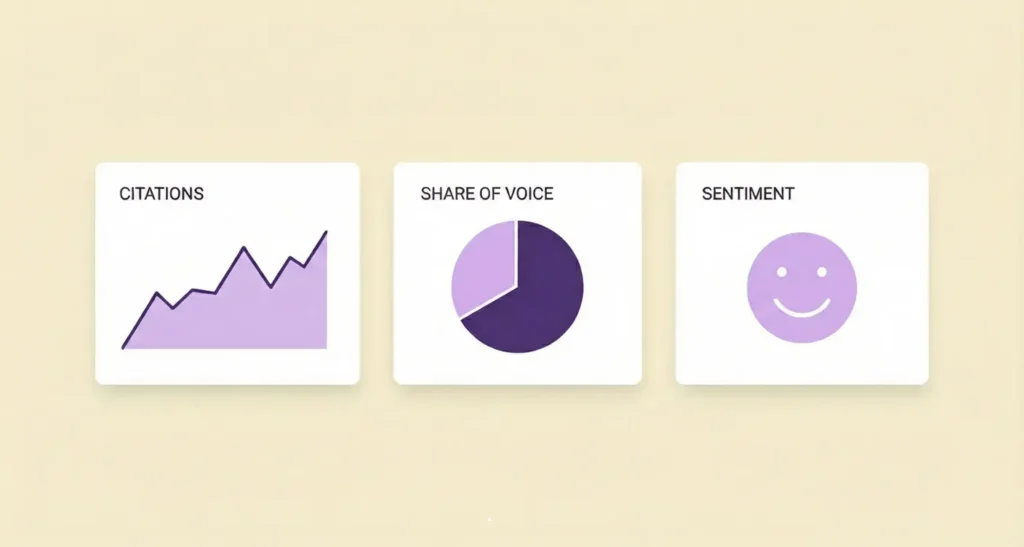
There are three indicators that matter for AI search performance:
Citation frequency: A citation is a direct, formal attribution where an AI uses your content as a verifiable source for its answer. It usually includes a link or a phrase like, “According to [Your Brand]…” This metric tracks how often you earn these high-value citations. It’s the generative equivalent of a backlink and the clearest signal that your content is seen as authoritative.
Share of AI Voice (SAIV/SV): This metric puts your performance in context. It combines both your citations and mentions to calculate your market share in the AI conversation compared to your competitors. A high SAIV shows that you’re the dominant authority in your space.
Brand Sentiment and Context: A mention is an informal reference to your brand, product, or concept within an answer (usually without a direct link). This metric analyzes the context of those mentions. Is the AI positioning your brand as a premium solution, a budget-friendly option, or a trusted industry leader? Tracking sentiment reveals how AI models see your brand (negative/neutral/positive), which directly influences how users see it.
To track these metrics, a new category of tools has become essential for any serious marketing team: GEO platforms.
Start Optimizing for AI Search Today
The most radical change in how people find information in over a decade is the shift to AI-driven search. The brands that act now to build visibility will own the citation economy for years to come and become the authoritative sources that AI models trust and recommend.
Success is no longer a matter of simply having a website that ranks. Now, you have to create comprehensive, authoritative, and well-structured content that AIs want to cite.
Your competitors are already optimizing for this new reality. Every day you wait, they strengthen their position in your industry and make it harder for you to catch up. The first step is to know where you stand.
GetMint shows you exactly that. You can see which AI platforms cite or mention your brand and identify visibility gaps to gain a clear, data-backed strategy to improve performance.
Run your free AI visibility audit with GetMint today and find out what the world’s most powerful AI search engines see when users ask about your industry.
START FREE. NO CREDIT CARD REQUIRED.
Your competitors are already visible in AI. Are you?
See what ChatGPT, Gemini and Perplexity say about your brand. Set up in 5 minutes.

