


50% of consumers now intentionally use AI search engines to guide their purchase decisions. These buyers bypass the traditional search engine results page (SERP) and trust the AI’s direct recommendation.
If you aren’t in that recommendation, you’re invisible to half your market.
This exclusion isn’t random. Large Language Models (LLMs) select sources based on specific engineering criteria. We go beyond what is AI search visibility to provide a practical, 4-step framework for building visibility in AI platforms across the entire ecosystem.
What Is Visibility in AI Platforms?
AI visibility refers to how often your brand is mentioned, cited, or recommended in AI-generated responses. It measures whether an AI model, like ChatGPT or Google’s AI Overview, recognizes your brand as a trusted authority worth referencing.
This visibility appears in two forms:
- AI mentions: The model mentions your brand or product directly in the text (e.g., “GetMint is a leading GEO platform…”).
- AI citations: The model links to your content as a verified source (e.g., a footnote in ChatGPT or a source card in Perplexity).
Why You Need a New Strategy for AI Platform Visibility
For years, digital visibility just meant ranking on Google. Today, it’s much more complicated because every AI platform looks for different things:
- ChatGPT favors helpful, conversational explanations.
- Perplexity prioritizes hard data and academic-style citations.
- Google SGE leans heavily on Reddit threads and traditional rankings.
- Claude prefers technical, highly safe, and first-party research.
This shift marks the move from traditional Search Engine Optimization (SEO) to Answer Engine Optimization (AEO). While SEO focuses on ranking links to get clicks, AEO focuses on getting your content included directly in the answer.
You can’t just “optimize for AI” as one single channel. ChatGPT and Google AI Mode agree on sources only 30% of the time. A strategy that wins on one engine often fails on the other.
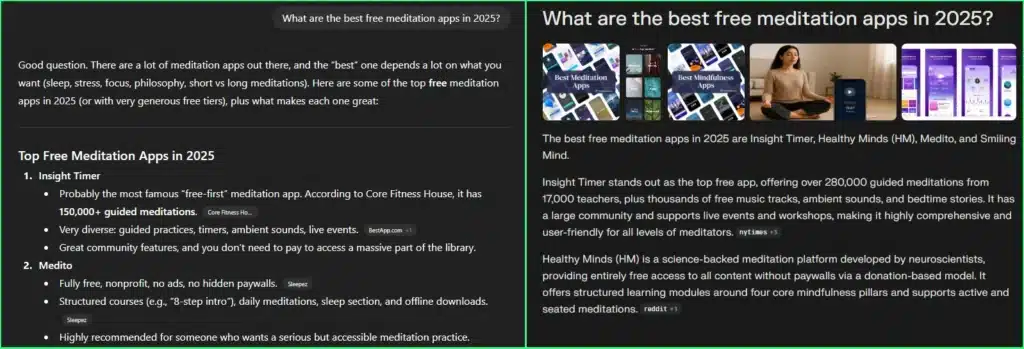
To fix this, you need a tiered strategy that covers the basics everyone respects while allowing for platform-specific differences. We call this the AI visibility ladder.
4 Steps to Achieve Visibility in AI Platforms
Building visibility is a sequential process. You must establish access, build understanding, earn trust, and finally, drive influence. Skipping steps leads to wasted effort.
Step 1: Make Your Site Visible to AI Crawlers
You can’t be cited if you can’t be read. The most common reason for low AI visibility isn’t poor content; it’s a firewall setting.
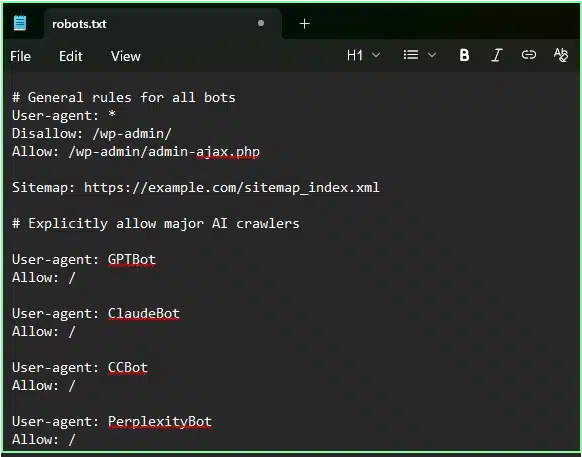
Many security providers and CDNs (like Cloudflare) now block AI scrapers by default. Your first move is to check your robots.txt file and Web Application Firewall (WAF) settings to explicitly allow the primary crawlers:
- GPTBot and OAI-SearchBot (OpenAI)
- ClaudeBot (Anthropic)
- CCBot (Common Crawl)
- PerplexityBot (Perplexity)
Pro Tip: AI crawlers don’t execute JavaScript. If your content is hidden behind JS rendering (like dynamic tabs or lazy-loaded text), it may not be indexed or cited. Always make sure your important content is visible in raw HTML.
It also helps to keep your website fast, text-heavy, and clean to make it more efficient for AIs, as AI companies prioritize data efficiency.
Step 2: Define Your Entity in the Knowledge Graph
Search engines matched keywords; AI models match entities (people, places, and things). To optimize for AI search, you must train the model to understand exactly what your brand is.
Start by standardizing your brand definition. AI learns from patterns, so if your homepage, LinkedIn, and press releases describe your product differently, the model gets confused.
Use identical, definitional language across all channels (e.g., “GetMint is an AI visibility platform,” not “We empower synergy”). Avoid vague language and jargon.
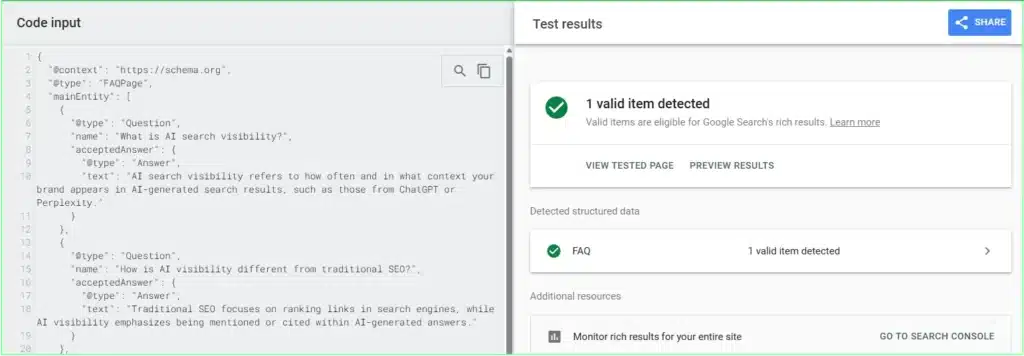
Next, use Schema markup to explicitly label your data:
- Organization Schema defines who you are (logo, social profiles, and founders).
- Product Schema defines exactly what you sell, your price, and your rating.
- FAQ Schema formats your content in a Q&A style that LLMs prioritize for answering user queries.
Pro Tip: Use Google’s Rich Results Test to confirm your schema is valid and AI-ready. Even one line of clean markup can boost your visibility.
Step 3: Create Content that AIs Want to Cite
AI models are designed to be risk-averse. To minimize hallucinations, they prioritize content that looks verifiable, factual, and structured for easy extraction.
Never bury the lead. Structure your content using the “Inverted Pyramid” to give the AI exactly what it needs:
- The answer: State the direct answer to the user’s question in the first sentence. Providing a short, clear answer (about 40 to 60 words) right after a heading is best.
- The evidence: Follow up immediately with data, specs, or examples.
- The context: Add background information and nuance last.
Increase your information density. AIs ignore fluff. Replace vague claims with specific statistics, original research, and direct expert quotes that aren’t paraphrased elsewhere. Hard data acts as a “grounding” for the model and makes your content the safest option to cite.
Finally, remember that AIs are biased towards recency, especially for commercial queries. Regularly update your most important pages with the current year, new statistics, and recent product updates to show that you’re relevant.
Step 4: Influence the AI Through Third-Party Sources
You can’t optimize your way to visibility using only your own website. AI models operate on a consensus model. If your website claims that you’re the best, it’s marketing. If Reddit, G2, and TechCrunch also say you’re the best, it’s a fact.
This requires a Generative Engine Optimization (GEO) strategy that looks beyond your domain:
- For Google (SGE): You need community. Google leans heavily on Reddit threads and Quora discussions.
- For ChatGPT: You need authoritative validation. ChatGPT favors editorial content from high-trust news sites and industry publications.
Aim for contextual mentions. When an authoritative site mentions your brand name in the same sentence as your target keyword (e.g., “GetMint, the AI visibility tool…”), it triangulates your authority and trains the model to associate your entity with that topic.
How to Optimize for Each AI Platform
Since engines prioritize different signals, you can’t use a single tactic for the entire ecosystem.
When you confirm that your content is comprehensive, machine-readable, data-backed, and SEO-optimized, use this checklist to tailor your strategy for the four major AI engines.
1. ChatGPT
ChatGPT is a generalist. It’s conversational, authoritative, and consensus-driven. Since it’s moving away from Reddit and toward established media, try to
→ Earn editorial mentions through securing features in high-authority industry publications.
→ Target “definitional” keywords by ranking for “What is [Brand]?” queries to feed its Knowledge Graph.
→ Publish long-form “ultimate” guides that cover a topic exhaustively.
2. Perplexity
Perplexity functions as a real-time “answer engine” that values transparency and precision. It uses a reranking system that prioritizes short, answer-first passages and numeric data over long-form storytelling. To optimize for it:
→ Include data-driven content like specs and comparisons in clear HTML tables that are easy to parse.
→ Include concise definitions and step-by-step lists to align with its entity disambiguation and retrieval logic.
→ Prioritize freshness by regularly updating your statistics and facts (Perplexity applies a time-decay model where it favors more recent sources).
3. Google SGE/Gemini
Google’s engines combine traditional SEO with community consensus. They still lean on Reddit and top-ranking organic pages. To optimize for them
→ Make sure your important pages rank in the organic top 10.
→ Actively participate in Reddit threads ranking for your target keywords.
→ Mark up your content with Schema (especially FAQ) to make it easy for the snapshot to extract answers.
4. Claude
Claude is excellent at analyzing documents and complex text and tends to be more technical and safe compared to the other AI engines.
It’s biased towards “first-party” research and high-safety content (avoiding promotional fluff). To be part of Claude’s mentions and citations,
→ Make sure your technical documentation is indexable (Claude processes document-heavy corpuses well).
→ Avoid hyperbolic marketing claims, as Claude is tuned to reject “salesy” or unverifiable text.
→ Prioritize deep, technical explanations over surface-level summaries.
How to Measure Visibility in AI Platforms
In the “traffic economy,” you looked at Google Analytics to measure success. In the “citation economy,” your biggest wins often result in zero clicks.
When an AI answers a user’s question directly using your data, that user may never visit your website. Yet, they’ve been influenced by your brand’s expertise.
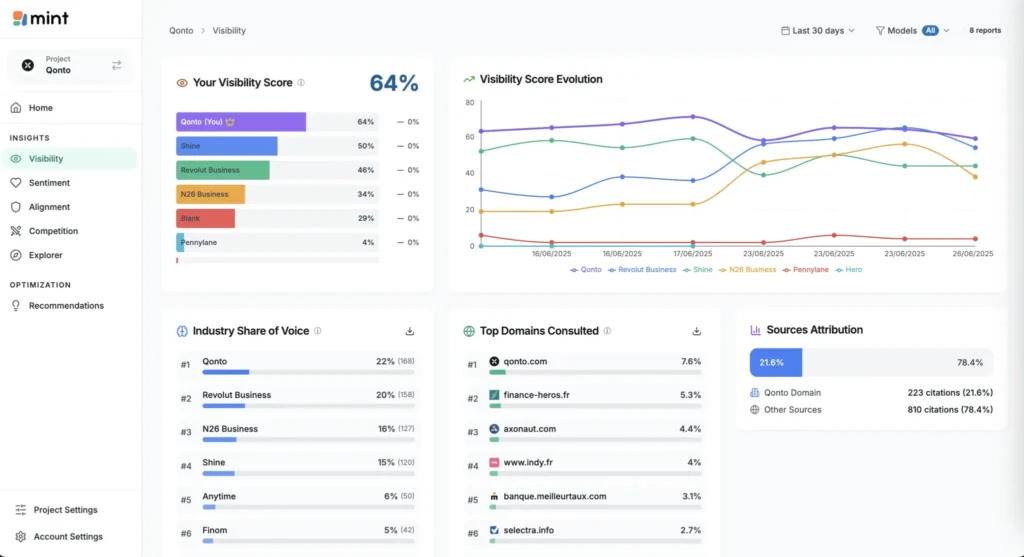
Traditional analytics tools are blind to this interaction. To track AI search visibility, you need to track the behavior of the AI models themselves.
- Mention rate: This is the most important signal. How often does the AI recommend or name your brand in response to a relevant query? Even without a link, a mention drives brand recall and purchase intent.
- Share of voice (SOV): In a set of 100 commercial queries for your category (e.g., “best CRM for startups”), how many times is your brand cited compared to your top competitor?
- Sentiment analysis: Quantity is not enough. Is the AI describing your product as “expensive and complex” or “user-friendly and robust”? Is it talking about your brand neutrally, positively, or negatively?
- Platform spread: Are you winning on Google SGE but invisible on Perplexity? Tracking the divergence helps you identify which part of your strategy needs work.
You can’t track these metrics manually. AI models are non-deterministic; their answers change based on random variance, location, and user history.
To get a reliable baseline, you need to test hundreds of prompts repeatedly over time. That’s exactly what GEO tools are designed to do.
Build a Future-Proof Strategy with GetMint
Visibility in AI platforms isn’t a trend. It’s the new standard for digital discovery, and consumers are already treating AI as a trusted purchase advisor. The brands that win this shift won’t be the ones who “hack” the algorithm, but the ones who build a systematic foundation.
You can move from being invisible to being the recommended answer by following our 4-step framework, but you can’t improve what you don’t measure.
GetMint was built to be the definitive GEO platform for this new era. It automates the monitoring of the entire AI ecosystem to help you turn the black box of AI visibility into a clear, actionable dashboard.
Don’t guess where you stand. Get your free AI brand analysis today to establish your baseline and see exactly how the world’s most powerful AI models perceive your brand.
Frequently Asked Questions (FAQs)
How do I get my brand mentioned in ChatGPT?
To get mentioned in ChatGPT, you need to build authority in the sources it trusts. Unlike Google, which crawls the whole web, ChatGPT relies heavily on established data sources.
Strategies include getting cited in top-tier industry publications (Digital PR), having a clear Wikipedia or Crunchbase presence (Entity Optimization), and ensuring your brand is consistently described across the web so the AI can form a clear “memory” of who you are.
Why isn’t my website showing up in AI search results?
If you’re invisible to AI, it’s usually due to one of three reasons:
1. Technical blocking: Your robots.txt file or CDN is blocking AI crawlers like GPTBot.
2. Low authority: Your content lacks the high-quality backlinks and external citations that signal trust to the model.
3. Lack of relevance: You’re optimizing for keywords instead of entities, meaning the AI doesn’t understand who you are or what you do.
Does social media activity help with AI visibility?
Yes, but it depends on the platform. Reddit is extremely powerful for visibility in Google SGE and Gemini, as these engines prioritize community discussions.
However, platforms like Instagram or TikTok have less direct impact on text-based LLMs like ChatGPT or Claude, which prioritize text-heavy, authoritative articles and documentation.
Can I pay to be listed in AI answers?
Currently, no. Unlike Google Ads, there’s no “sponsored slot” inside a standard ChatGPT or Claude answer (though this is evolving with SearchGPT prototypes). For now, AI visibility must be earned through Generative Engine Optimization. You can’t buy your way to a citation; you must build the authority that demands it.
Is AI visibility the same as SEO?
No, but they’re related. SEO focuses on ranking your website in a list of links to drive traffic. AI Search Visibility focuses on getting your brand mentioned or cited inside an AI-generated answer to drive influence. SEO is about the “where” (position #1); AI visibility is about the “who” (being the recommended exper

