


According to a 2024 poll, Americans trust generative AI companies about 29% more than social media platforms. That means a single hallucination from ChatGPT can damage your reputation faster than a negative tweet, and you likely won’t even know it happened.
To fix this, you need software designed for the generative age. We tested the market to find the best tools for AI brand monitoring that specifically detect hallucinations, track sentiment, and measure your share of voice.
What Is AI Brand Monitoring?
AI brand monitoring tracks how Large Language Models (LLMs) like ChatGPT, Claude, and Google Gemini describe your brand. It measures the frequency, sentiment, and accuracy of the answers these models generate when users ask about your company or category.
To protect your reputation in 2026, you must monitor two layers of the ecosystem:
- The inputs (social listening): Tracking the high-volume human conversations on social media (Reddit, X, etc.) and other websites (blogs, news pages, etc.). This is the training data that teaches AI models what to think about you.
- The outputs (AI monitoring): Tracking the actual answers generated by answer engines. This is the final result that your customers see.
The tools in this guide cover both sides of this equation. Some track the social sources that feed the AI, while others track the generative answers themselves. You need visibility into both for a complete strategy.
What Makes a Tool Good for AI Brand Monitoring?
When evaluating software for this list, we ignored standard vanity metrics like “likes” or “shares.” To protect your reputation in the generative age, a tool needs to be excellent in these areas:
- AI output monitoring: Can the tool track what LLMs are actually generating? This is important for detecting hallucinations and measuring your generative share of voice.
- Source monitoring: Can the tool track the high-authority web sources (news, Reddit, and forums) that feed the AI models? You need this capability to spot a crisis before it becomes part of the AI’s long-term memory.
- Sentiment nuance: Simple “positive vs. negative” tagging isn’t enough. You need a tool that understands context. It should be able to distinguish between a “neutral” mention (listing features) and a “damaging” comparison (recommending a competitor).
The Top 7 Best Tools for AI Brand Monitoring
Before you choose, you need to know which type of monitoring you’re buying. The market is split into two categories:
- AI search monitors (downstream): These tools (like GetMint) track what the AI says. They query models like ChatGPT and Perplexity to see if you’re being recommended.
- Social intelligence suites (upstream): These tools (like Brandwatch) track what people say. They monitor the social media and web conversations that train the AI models.
To have a complete strategy, you often need visibility into both. Here’s how the top tools stack up. We grouped them into AI search monitoring tools (Table 1) and AI-powered social and web listening tools (Table 2).
| Tool | Starting Price | Starting AI Platforms Covered | Starting Number of Prompts | Mention Tracking | Sentiment Tracking | Share of Voice Tracking | Content Optimization | Best For |
|---|---|---|---|---|---|---|---|---|
| GetMint | €99/mo | 3 (ChatGPT, Perplexity, AI Overviews) | 50 | ✅ Advanced (AI + SEO blended tracking) | ✅ Moderate (tone and context flags) | ✅ (AI + SEO share of voice blend) | ✅ (content studio, expertise library, personas) | Teams that want to monitor and fix their AI narrative |
| Profound | $99/mo | 1 (ChatGPT only) | 50 | ✅ Advanced (AI + SEO + media mentions, historical replay) | ✅ Advanced (multi-layer sentiment) | ✅ (Granular segmentations, industry narratives) | ❌ | C-Suite teams needing compliance and audit-level data |
| Otterly | $29/mo | 4 (ChatGPT, Perplexity, AI Overviews, MS Copilot) | 15 | ⚠️ Basic (AI search mentions only, capped prompt tracking) | ⚠️ Basic (positive/negative framing) | ✅ (AI search share of voice only) | ❌ | Small teams needing a quick, affordable “pulse check.” |
| Semrush | $199/mo | 3 (ChatGPT, AI Overviews, Perplexity) | 50 | ✅ Advanced (AI + SEO mentions, competitor benchmarking) | ⚠️ Basic (positive/negative framing) | ✅ (AI visibility share of voice vs competitors) | ⚠️ (SEO-focused) | Large agencies already using Semrush’s SEO features |
| Omnia | €99/mo | 4 (ChatGPT, AI Overviews, AI Mode, Perplexity) | 25 | ✅ Advanced (AI + SEO mentions, competitor benchmarking | ⚠️ Not available in this plan | ✅ (AI visibility share of voice vs competitors) | ❌ | Best for Teams That Want AI Visibility + Actionable Recommendations |
| Tool | Starting Price | Mention Tracking | Sentiment Tracking | Share of Voice Tracking | Free Trial | Best For |
|---|---|---|---|---|---|---|
| Brandwatch | Quote-based | ✅ Advanced (social forums, reviews, blogs, etc.) | ✅ Advanced (real-time sentiment, trend spotting, influencer analysis) | ✅ (competitive benchmarking, campaign impact measurement) | ❌ | Enterprise-scale monitoring with a focus on sentiment depth and share of voice |
| Mention | $599 | ✅ Good (real-time monitoring, keyword/page alerts) | ⚠️ Basic (positive/negative indicators) | ✅ (visibility dashboards, auto-updating reports) | ✅ (30 days) | Small teams looking for a lightweight tool with strong mention tracking |
1. GetMint – Best for Holistic Reputation Management
GetMint is built for the new reality where search engines answer questions instead of just listing links. While most tools force you to choose between “SEO tracking” and “social listening,” GetMint acts as a reputation command center specifically for the AI ecosystem.
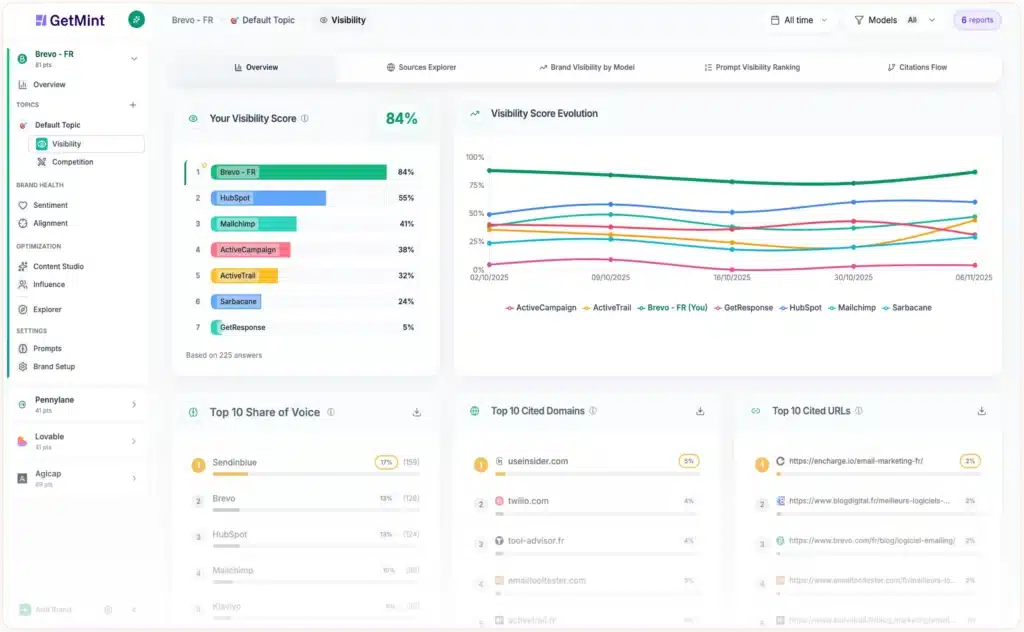
It stands out because it focuses on provenance. When an AI model mentions your brand, GetMint traces the output back to the specific source URLs feeding that information.
If Perplexity claims your product is “expensive,” GetMint identifies exactly which third-party review or blog post taught it that opinion, giving your PR team a specific target to fix.
Brand Monitoring Features
- Generative share of voice: Unlike SEO tools that track rankings, this tracks your presence in the “consideration set.” It aggregates your mentions (brand awareness) and citations (linked authority) to show how often you appear in answers compared to your competitors.
- Brand alignment capabilities: It monitors whether AI descriptions match your internal brand guidelines. For example, it can lag if LLMs are positioning you as an “SMB solution” when your strategy is focused on “Enterprise,” allowing you to adjust your messaging.
- Source diagnosis: A forensic view that lists the exact domains feeding the AI its information. This is important for spotting “zombie sources” (old, outdated articles that are still influencing modern AI answers).
Pros
- ✅ Tracks actual outputs from ChatGPT, Perplexity, Claude, Gemini, Google AI, and several other less mainstream AI engines.
- ✅ Moves beyond reporting to provide “optimization” workflows (GEO) to improve your standing.
- ✅ Provides a deep comparison of why an AI prefers your competitor (e.g., better source coverage).
Cons
- ❌ GetMint is strictly for AI and search. It doesn’t track X (Twitter) or TikTok streams.
- ❌ GetMint is a strategic platform, not a simple alert gadget. Teams used to basic “mention counting” tools may find the depth of data requires a shift in strategy.
Pricing
- Starter: €99/month (1 brand, 50 prompts, 1 country analysis)
- Growth: €299/month (1 brand, 200 prompts, 2 country analyses)
- Enterprise: €549/month (custom number of brands, prompts, and countries)
2. Semrush – Best for Market Share and Competitor Benchmarking
Semrush has successfully pivoted into the AI era with its AI visibility toolkit. This tool creates real queries to track your brand visibility across ChatGPT, Google AI Overviews, and Perplexity.
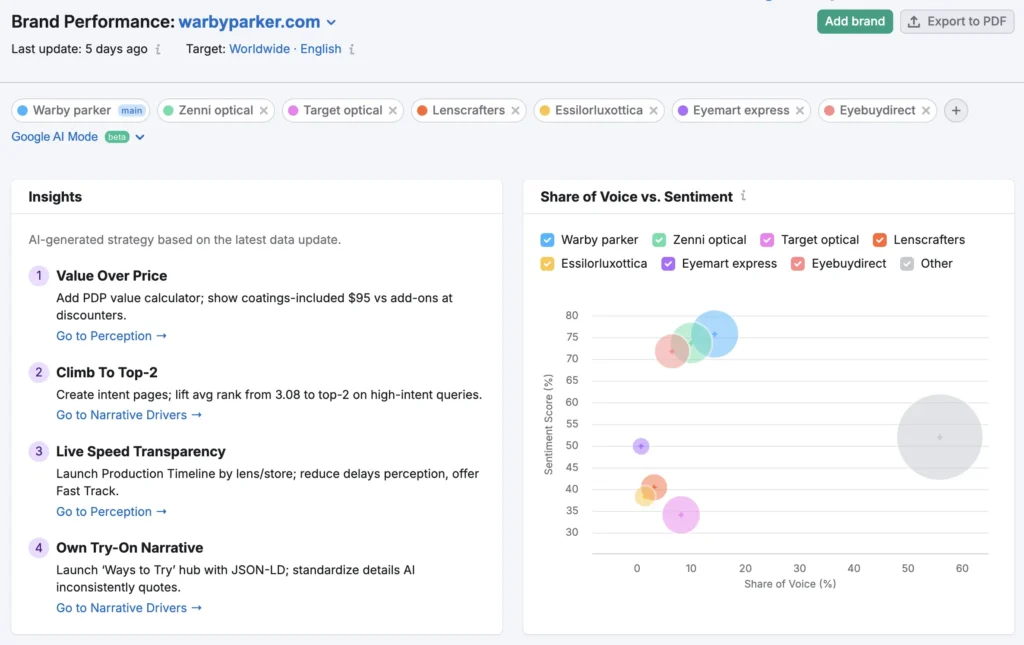
Its standout feature is the Brand Performance section. It includes a Key Business Drivers report that analyzes the attributes associated with your brand. It uses AI to categorize mentions into buckets like “support,” “price,” or “innovation.”
This allows you to see whether your brand messaging is actually sticking with LLMs or if competitors are owning those terms.
Brand Monitoring Features
- Key business drivers: This heatmap shows which attributes the AI associates with your brand vs. your competitors (e.g., winning on “Support” but losing on “Price”).
- Narrative drivers: Breaks down your mentions into Branded (people asking for you by name) vs. Non-Branded (people finding you via category search). This helps you understand if you have a “Brand Awareness” problem or a “Category Authority” problem.
- Sentiment tracking: Visualizes the trend of positive, neutral, and negative mentions over time so you can correlate spikes with your marketing campaigns.
Pros
- ✅ The brand monitoring features integrate seamlessly if you already use Semrush for SEO. It keeps data in one ecosystem.
- ✅ It actively queries AI engines to track visibility.
- ✅ The visual breakdowns are top-notch and ideal for executive reporting.
Cons
- ❌ Semrush is strongest on ChatGPT and Google. Support for Claude and emerging models is still catching up compared to specialist tools.
- ❌ The add-on costs, specifically for extra domains and prompts, can push the price well above the entry level.
- ❌ Some users find the AI-generated recommendations (like “offer partner bundles”) generic compared to specialized GEO workflows.
Pricing
- Starter: $199/month (5 websites, 50 prompts, 500 keywords)
- Pro+: $299/month (15 websites, 100 prompts, 1,500 keywords, multi-location tracking)
- Advanced: $549/month (40 websites, 200 prompts, 5,000 keywords, share of voice tracking)
3. Brandwatch – Best for Enterprise Social and AI Listening
Brandwatch is the industry standard for social intelligence, not AI search monitoring. It excels at ingesting millions of human conversations from Reddit, X, blogs, and news sites.
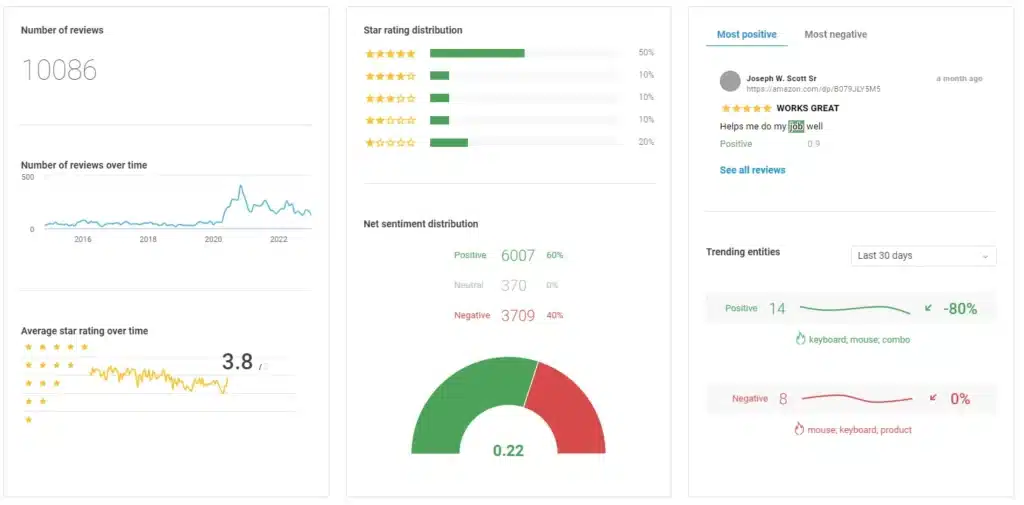
It uses AI (specifically its Iris assistant) to summarize these human conversations, but it doesn’t monitor what AI engines are saying.
You use this platform to understand the “human” conversation that feeds the AI models. If a crisis goes viral on X, Brandwatch is the best tool to catch it before it becomes training data for the next GPT or Gemini update.
Brand Monitoring Features
- Iris AI analyst: This AI assistant automatically summarizes thousands of social posts to explain why a spike is happening (e.g., “Viral meme regarding shipping delays”).
- Visual listening: Its AI image recognition can identify your logo in images across the web. It captures “visual mentions” (like a product appearing in a viral meme) that text-based tools miss.
- Crisis management: Its monitoring system flags sudden spikes in conversation volume or negative sentiment to help you assess which issues pose the greatest risk. These real-time alerts are reputation health checks. It lets you prioritize urgent conversations before they escalate.
Pros
- ✅ Unrivaled data depth across social media (Reddit, X, TikTok) and news.
- ✅ Enterprise-grade crisis management and alert systems.
- ✅ Advanced AI summarization for large datasets.
- ✅ Visual listening capabilities that text-only tools miss.
Cons
- ❌ Extremely expensive. Contracts start in the thousands.
- ❌ Complex. Users often report a steep learning curve and sluggish performance with massive datasets.
- ❌ The “AI monitoring” focuses on analyzing human conversations, not monitoring LLM outputs (ChatGPT answers, for example). It can’t tell you what AI engines are saying about your brand.
Pricing
Brandwatch’s pricing isn’t public. You need to book a demo and receive a quote based on your needs. All plans are paid annually, with no monthly options, and usually start at four figures.
4. Mention – Best for Real-Time Alerts and Crisis Prevention
Mention is a lightweight crawler that monitors the web and social media. Like Brandwatch, it doesn’t track AI search outputs directly.
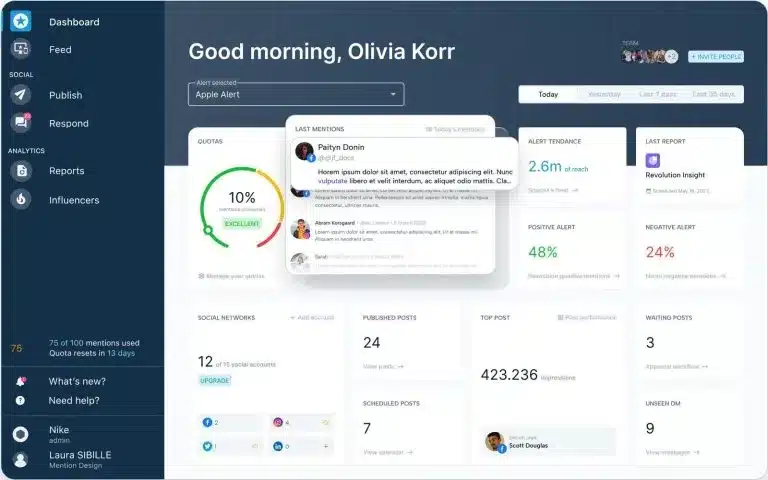
Its value lies in speed. It’s an “always-on” listening tool that tracks news, blogs, and social feeds. Its Pulse feature is invaluable for crisis prevention. It learns your baseline volume and instantly alerts you if activity spikes.
This is often the leading indicator of a PR crisis that will eventually feed into the AI training data if left unchecked.
Brand Monitoring Features
- Pulse alerts: Anomaly detection that notifies you when mention volume deviates from the norm (e.g., a sudden 200% spike).
- Cross-platform feed: Aggregates mentions from X, Facebook, Instagram, and the web into a single, easy-to-read inbox.
- Influencer scoring: Rates the “influence” of the person or site mentioning you, helping you ignore low-impact bots and prioritize high-authority accounts.
Pros
- ✅ Zero setup time. It functions immediately as an “alarm bell.”
- ✅ Covers the broad web sources that feed AI training data.
- ✅ Excellent real-time alerting for crisis prevention.
Cons
- ❌ Sentiment analysis lacks nuance (mostly binary positive/negative). The sentiment tagging also struggles with sarcasm or mixed reviews.
- ❌ Doesn’t track generative outputs (it won’t tell you what ChatGPT said, only that people are talking).
- ❌ Lower tiers were deprecated for a $599/mo enterprise solution.
Pricing
Mention starts at $599. It’s an enterprise-grade social intelligence tool. You must first schedule a demo with the sales team and discuss your specific needs before receiving a quote.
5. Omnia – Best for Teams That Want AI Visibility + Actionable Recommendations
Omnia is an AI visibility platform that tracks brand presence across Google AI Mode, Google AI Overviews, ChatGPT, and Perplexity. The platform is designed for marketing and SEO teams that want visibility tracking combined with practical optimization recommendations.

Omnia dashboard tracking AI visibility, citations, and competitor share of voice across AI engines
What makes Omnia stand out is its focus on turning visibility data into actionable next steps. The platform analyzes citation gaps, tracks competitor mentions, and recommends what content should be updated, expanded, or created to improve AI visibility.
Omnia also uses real browser simulations rather than relying only on APIs, helping teams see AI responses closer to how actual users experience them.
AIO Features
- AI visibility tracking: Monitors brand visibility across Google AI Mode, Google AI Overviews, ChatGPT, and Perplexity.
- Citation analysis: Tracks which sources AI engines rely on and where competitors are being cited.
- AI Prompt Discovery: Finds real AI search prompts and customer questions.
- Competitor benchmarking: Compares share of voice and citation frequency across competitors.
- Action recommendations: Suggests content improvements and new content opportunities.
Pros
✅ Covers multiple AI engines in one platform.
✅ Includes practical optimization recommendations, not just monitoring.
✅ AI Prompt Discovery helps uncover real AI search behavior.
✅ Unlimited countries and brands across plans.
Cons
❌ Better suited for dedicated marketing teams than solo creators.
❌ Some advanced features are still rolling out.
Pricing
- Growth: €99/month
- Pro: €299/month
- Enterprise: Custom pricing
6. Profound – Best for Enterprise Reporting and Auditing
Profound is a true LLM monitor. It tracks visibility across 10+ engines, including ChatGPT, Perplexity, Copilot, and Gemini.
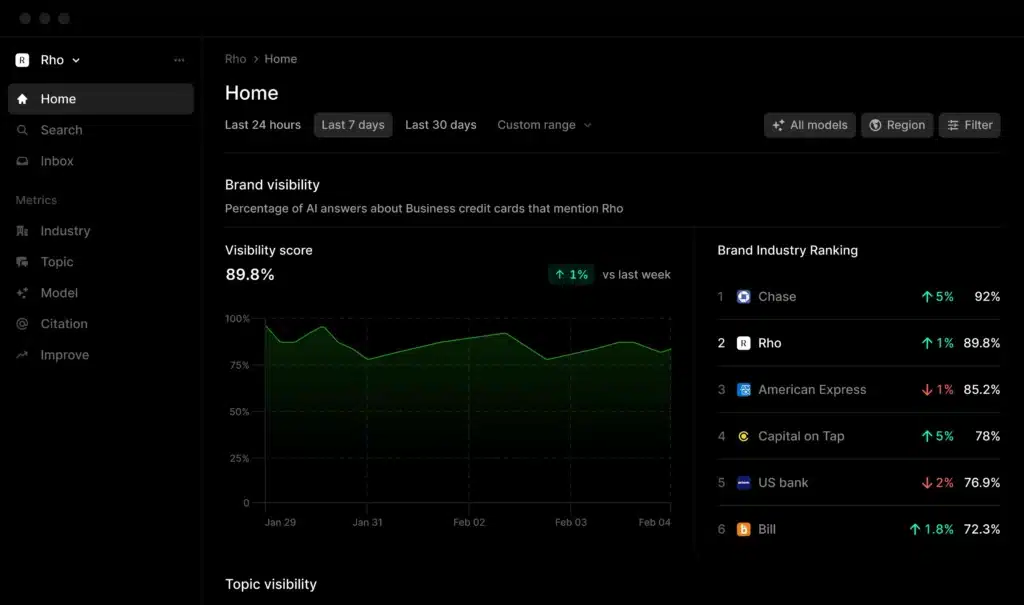
It focuses heavily on measurement rather than optimization. Its standout feature is prompt volumes, which estimate AI search volume for specific topics (a rare metric in this industry).
It’s designed for the C-suite who needs a polished audit of their AI footprint for board reporting, rather than the marketer trying to fix the content day-to-day.
Brand Monitoring Features
- AI search volume: Estimates how often users are actually asking about your brand in AI.
- Geographic segmentation: Breaks down reputation metrics by country. This is essential for global brands managing regional sentiment.
- Share of voice: Tracks visibility against competitors across a curated list of enterprise-relevant keywords.
Pros
- ✅ Provides rare metrics (prompt volumes) unavailable in most tools.
- ✅ Designed for enterprise security and compliance standards.
- ✅ Tracks 10+ engines, more than most competitors.
Cons
- ❌ The plans are expensive for the number of prompts and answer engines they track.
- ❌ Most reviews note that the tool is complex. There’s a steep learning curve for the dashboard.
Pricing
- Starter: $99/month (ChatGPT only, 50 prompts tracked)
- Growth: $399/month (3 answer engines, 100 prompts, 6 optimized articles per month)
- Enterprise: Custom, quote-based (10 answer engines, multiple companies tracked, custom prompts and articles).
7. Otterly – Best for a Quick Sentiment Pulse Check
Otterly is a focused AI search monitor that punches above its weight. It tracks ChatGPT, Google, Perplexity, Gemini, and Copilot.
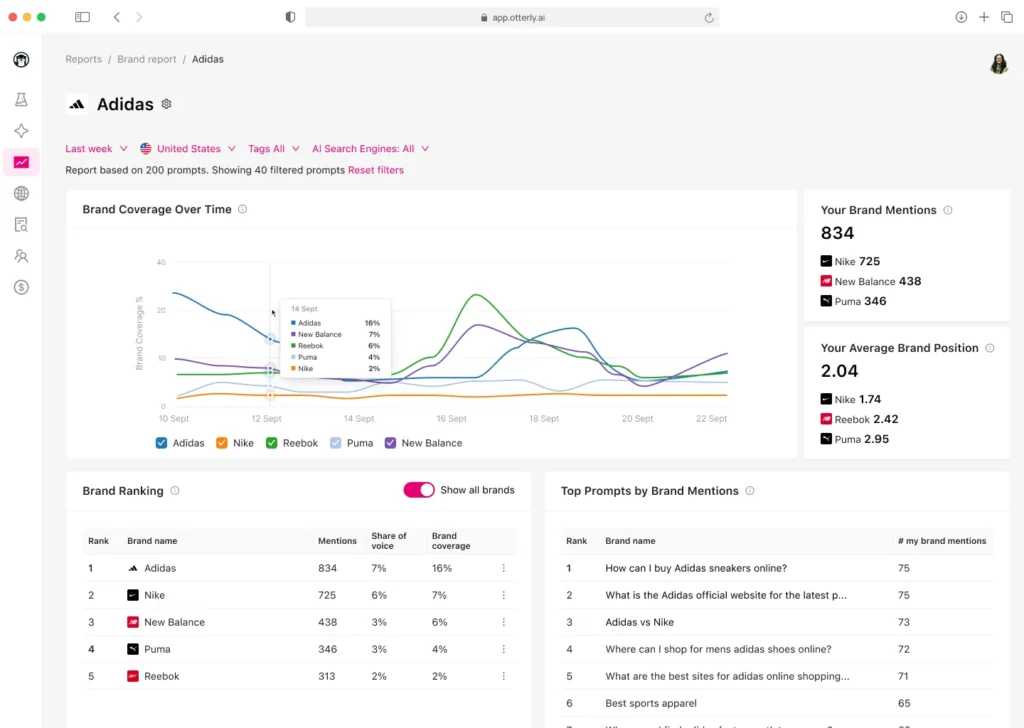
It doesn’t offer the deep forensics of GetMint or the compliance features of Profound, but it’s perfect for a “health check.” It provides straightforward dashboards for share of voice and competitor benchmarking.
This makes it accessible for teams who can’t afford enterprise software but need to know if they’re visible.
Brand Monitoring Features
- Multi-platform tracking: Monitors the four primary AI engines (ChatGPT, Google AI Overviews, Perplexity, and MS Copilot).
- Sentiment indicators: Uses simple visual cues to show if AI responses are favorable or critical.
- Keyword tracking: Monitors specific brand terms to confirm appearance in generative answers.
Pros
- ✅ Extremely low barrier to entry (price and usability).
- ✅ Tracks more engines than many expensive SEO tools.
- ✅ No training required to interpret the data.
Cons
- ❌ Lacks deep governance, SOC2 features, or custom integrations.
- ❌ No workflow features to address the issues it identifies.
- ❌ Limited historical data depth and fewer workflow features compared to Profound or GetMint.
Pricing
- Lite: $29/month (15 search prompts, 4 answer engines)
- Standard: $189/month (100 search prompts, 4 answer engines)
- Premium: $489/month (400 search prompts, 4 answer engines).
Adding 100 extra search prompts costs $99 (Standard and Premium plans only). Google AI Mode and Gemini are available as extra add-ons.
How to Choose the Right Tool for Your Stack
We’ve looked at seven powerful platforms, but they don’t all serve the same master. The biggest mistake brands make is buying a “social listening” tool expecting it to fix their “AI reputation,” or vice versa.
To make the right investment, map your primary goal to the specific tool category.
| If your primary goal is… | You need… | Recommended Tool |
|---|---|---|
| Crisis Detection | To know immediately when a viral social media post is spreading negative sentiment. | Brandwatch, Mention, or Sprout |
| Compliance and Auditing | To report to the board on how your brand appears globally across AI models, without necessarily fixing it. | Profound |
| Reputation Repair | To identify why the AI is negative and fix the underlying source to change the answer. | GetMint |
| Market Intelligence | To see who’s winning the “share of voice” battle in your industry. | GetMint or Semrush |
For mid-to-large brands, the answer is often “both.” You need a social listening tool to monitor the human conversation (the noise) and an AI monitoring tool to track the machine consensus (the signal).
How AI Perceives Brands Differently
This distinction matters because AI models don’t treat all brands equally. Recent research conducted by Mint analyzed over 4,500 LLM responses to understand how visibility works in the wild. The data revealed a huge divide between B2B and B2C landscapes.
- B2C brands have high visibility but high risk. Consumer brands appear frequently in AI answers, but they face a “sentiment tax.” Because AI models ingest Reddit threads and consumer reviews, B2C brands are far more likely to have negative feedback surface in an AI overview.
- B2B brands have lower visibility but higher trust. B2B companies are mentioned less often, but when they are mentioned, the sentiment is usually neutral or positive. The challenge for B2B isn’t fixing bad press. It’s actually getting the AI to notice you in the first place.
This means your tool choice depends on your sector. If you are B2C, you need a tool with strong sentiment alerts to catch the negativity (e.g., Brandwatch, Mention, etc.). If you’re B2B, you need a tool with strong optimization workflows to build the authority required to be cited (e.g., GetMint).
Understanding these sectoral nuances is the primary reason why you should track AI brand visibility. Crisis management aside, it helps you understand your specific market risk.
Why Monitoring Alone Is Not Enough
Most of the tools on this list stop at the dashboard. They’re excellent at telling you that you have a problem, like showing you a drop in sentiment or a lost share of voice, but they don’t give you the tools to fix it.
Monitoring without action is like having a smoke detector without a fire extinguisher. You know the house is burning, but you can’t put it out. The future of reputation management is listening. You need to be able to
- Diagnose the source to identify exactly which third-party URL (a blog, a review, or a news article) is teaching the AI to dislike your brand.
- Correct the record by publishing authoritative content that contradicts the hallucination.
- Verify the fix by tracking if the AI updates its answer after your intervention.
- Benchmark your performance by running an AI search competitor analysis to see if your rivals are winning the same answers you are losing. You can’t fix your visibility in a vacuum.
GetMint is the only platform designed to close this loop. It moves beyond passive monitoring to active Generative Engine Optimization (GEO) and gives you the tools to shape your reputation.
Start your free AI reputation audit and see exactly what the models are telling your customers right now.
Frequently Asked Questions (FAQs)
Is AI brand monitoring the same as social listening?
No, they’re fundamentally different. Social listening tracks what humans say on platforms like X, Reddit, and TikTok. AI brand monitoring tracks what machines (LLMs) generate when answering user questions.
Social listening captures the raw noise; AI monitoring captures the synthesized answer that decision-makers actually trust.
Can’t I just check ChatGPT manually?
You can, but it’s not reliable. AI models are “non-deterministic,” which means they often give different answers to different users on different days. A manual check only gives you a single snapshot.
Automated tools run hundreds of simulations to show you the probability of how you’re showing up, which is much more accurate than a one-off search.
Can I remove negative mentions from an AI answer?
You can’t hit a “delete” button like you would on a social media post. Since AI models are trained on public data, you have to fix the root cause.
You’ll need to identify the negative source (like an outdated review or incorrect article) and publish fresh, authoritative content to “overwrite” that data in the model’s understanding.
How often should I check my AI reputation?
For most brands, a weekly review is enough to spot trends. However, if you’re in a volatile industry or launching a new product, we recommend daily monitoring.
Hallucinations can spread quickly, and catching them early gives you the best chance to correct the narrative before it settles.
Does this help with my SEO rankings?
Indirectly, yes. The same signals that make you visible in AI (like brand authority, positive sentiment, and high-quality citations) are heavily weighted by Google’s algorithms. By optimizing for AI visibility (GEO), you’re usually building the kind of authority that boosts your traditional SEO performance too.

