



Perplexity doesn’t work like Google, and the traditional SEO tactics you might be familiar with matter less than you think.
The AI engine uses a sophisticated L3 XGBoost reranking system that filters content through quality gates, manual authority lists, and topic-specific multipliers that can make or break your visibility.
Most content never passes Perplexity’s initial quality threshold. Even well-optimized pages get dropped before users ever see them.
This guide reveals how to rank in Perplexity using the most impactful ranking factors discovered through analyses by Metehan Yesilyurt and other researchers.
Key Takeaways
Ranking in Perplexity requires understanding and optimizing for 8 main systems:
- L3 reranking: Lead with direct answers, entity-rich content, and concrete numbers.
- New post window: Treat publishing as a coordinated 60-minute launch event.
- Topic multipliers: Prioritize AI, tech, and science over entertainment and sports.
- Entity disambiguation: Define everything explicitly with full context.
- Authoritative domains: Reference and incorporate whitelist sources naturally.
- Time decay: Refresh content every 7 to 14 days to maintain visibility.
- Semantic relevance: Cover topics comprehensively with varied vocabulary.
- Engagement signals: Optimize for clicks, dwell time, and return visits.
To rank in Perplexity, you simply need to create genuinely valuable, well-structured content that satisfies both AI quality filters and human readers.
Why Should You Care About Perplexity Rankings?
Perplexity processed 780 million queries in May 2025, capturing roughly 2% of the AI search market. Although that number sounds small, these are high-intent users who trust AI answers more than traditional search results.
Here are three reasons why tracking AI brand visibility matters:
- 60% of Perplexity’s citations overlap with Google’s top 10, meaning strong SEO content has a foundation but needs optimizations specific to Generative Engine Optimization (GEO) to win.
- Zero-click answers mean users get your information without visiting your site, making brand visibility and trust-building important.
- Early mover advantage exists because most brands haven’t optimized for Perplexity yet.
Unlike Google, where ranking takes months of link building, Perplexity offers a 60-minute window where new content can immediately gain visibility if it meets quality standards.
What Are the Main Perplexity Ranking Factors?
Perplexity uses over 50 individual ranking signals to determine which content gets cited, but these 8 main systems represent the foundational factors with the highest impact on visibility.
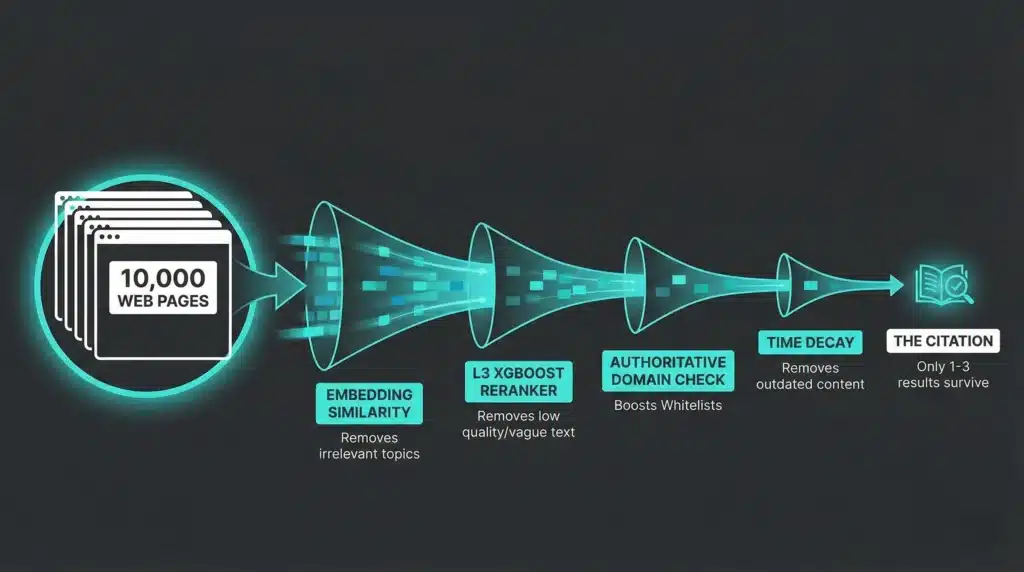
These systems work independently but simultaneously (you don’t need to “pass” one before moving to the next). Instead, your content is evaluated across all factors at once, and the combined signals determine your final ranking position.
| Ranking Factor | What It Does | How It Works | Difficulty |
|---|---|---|---|
| L3 Reranking System | Final quality filter | Removes content below machine learning-based quality thresholds | Medium |
| New Post Window | Tests fresh content | Requires click-through-rate (CTR) within first 60 minutes for amplification | High |
| Topic Multipliers | Category advantages | Boosts AI/tech/science topics vs. entertainment/sports | Low |
| Authoritative Domains | Manual trust signals | Whitelisted sources (GitHub, Reddit, etc.) get inherent boost | Medium |
| Entity Disambiguation | Clarity requirement | Content must explicitly define terms/names/concepts | Medium |
| Time Decay | Freshness penalty | Reduces visibility exponentially unless refreshed | Low |
| Semantic Relevance | Meaning threshold | Content must pass embedding similarity score to qualify | Medium |
| Engagement Signals | Performance tracking | Tracks clicks and dwell time over 7-day windows | High |
Note: Strong performance in one area (like topic selection) can compensate for weaker signals elsewhere, but failing to optimize for critical systems (like entity disambiguation) can eliminate you from the results entirely. Although Perplexity uses 50+ signals, these are the most impactful ones.
How Does Perplexity’s L3 Reranking System Work?
The L3 XGBoost reranker is Perplexity’s primary quality filter. After initial retrieval, this machine learning model re-evaluates results and discards content below specific thresholds.
Content that ranks well initially can still get dropped if it fails the L3 quality assessment. This explains why seemingly optimized pages never appear in Perplexity results, and it’s the same reason why optimizing for AI search requires different tactics than traditional SEO.
The two key parameters controlling this system are the following:
- l3_reranker_drop_threshold: The minimum quality score to remain in results
- l3_reranker_drop_all_docs_if_count_less_equal: Which discards entire result sets if too few passages meet quality standards.
How to Optimize for Perplexity’s L3 Reranking
To pass Perplexity’s quality gates, structure your content to satisfy the ML model’s scoring criteria.
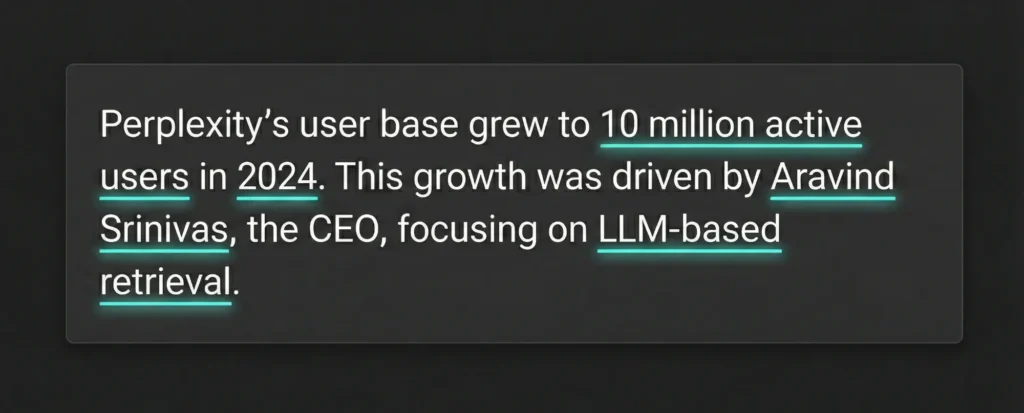
Here’s what Perplexity looks for:
1. Lead with Direct Answers
Start every piece with your answer in the first 80 tokens (roughly 60 words).
- Place your answer in the first paragraph, not buried in the introduction.
- Use the format: Direct Answer → Because Statement with concrete numbers → Supporting details.
Example: Perplexity ranks content using L3 XGBoost reranking. This system filters results through quality thresholds, with parameters like l3_reranker_drop_threshold determining which passages survive.
2. Include Entity-Rich Content
The reranker favors content with clear, specific entities rather than vague references.
- Define acronyms and technical terms immediately. For example, “RRF (Reciprocal Rank Fusion) merges ranking signals…”
- Name specific entities: companies, products, people, metrics. For example: “Sam Altman, CEO of OpenAI…”
- Avoid vague language like “many experts” or “recent studies.”
3. Add Concrete Numbers and Units
Quantify every claim you make with specific data points.
- Replace “significant increase” with “47% increase over 6 months” (statistics that apply to your claim and that can be backed up by a study/a reputable source).
- Include specific dates, percentages, dollar amounts, and timeframes.
- Quantify claims. Instead of “We analyzed many pages,” say “We analyzed 1,200 pages across 15 industries.”
4. Structure Content in Semantic Blocks
Organize information into self-contained, quotable sections.
- Use clear Definition → Steps → Comparison patterns.
- Each section should answer a specific sub-question completely.
- Create natural citation points throughout the content
How Does Perplexity’s New Post System Work?
The new post window is Perplexity’s most ruthless ranking factor. Fresh content enters a 60-minute evaluation period where performance determines long-term visibility. Its mechanics can make or break your content’s visibility and works this way:
- Content published within the last 60 minutes gets tested via new_post_impression_threshold.
- It must achieve a minimum click-through rate (CTR) during this window.
- If it passes the test, its visibility gets amplified. If it fails, it gets permanently obscured.
The system uses three critical parameters:
- new_post_published_time_threshold_minutes: Defines the evaluation window (typically 60 minutes).
- new_post_ctr: The required engagement threshold
- new_post_impression_threshold: Defines the minimum views needed during the window
How to Pass Perplexity’s New Post Window
To survive Perplexity’s new post window, you must treat every “publish” as a coordinated launch event, not just hitting “publish.”
Here’s how:
1. Plan Your Launch Burst
Strategic timing and distribution determine whether you survive the first hour. These tips might help:
- Schedule publication when your audience is most active (analyze your existing traffic patterns).
- Pre-announce content via email, Slack, and social media to drive immediate traffic.
- Target high-engagement channels first, including existing customers, email subscribers, and engaged social followers.
2. Optimize for Immediate CTR
Your headline and positioning must drive clicks within minutes, not hours. Here’s what we recommend:
- Write compelling, specific headlines that promise clear value.
- Use question-based titles that match user intent exactly.
- Include numbers and specifics: “8 Perplexity Ranking Factors” beats “Ranking in Perplexity.”
3. Monitor Early Performance
The first 60 minutes require active management, not passive waiting. Once you publish your article, do the following:
- Track the first hour of traffic religiously.
- If engagement is low, boost distribution immediately (paid social, communities, and partnerships).
- Consider the 60-minute window as a product launch, not just a publishing event.
Note: Most content fails this test because marketers treat publishing as the end of the workflow. For Perplexity, it’s the beginning.
What Topics Does Perplexity Favor?
Perplexity assigns visibility multipliers based on content categorization. Not all topics are created equal; some receive exponentially more visibility than others.
Here’s the multiplier hierarchy:
| High-Value Topics (Max Visibility) | Default Topics (Normal Visibility) | Restricted Topics (Penalized Visibility) |
|---|---|---|
| Artificial Intelligence and Machine Learning | Marketing and Advertising | Entertainment and Celebrity News |
| Technology and Software Development | Finance and Economics | Sports Coverage and Scores |
| Science and Research | Health and Wellness | Lifestyle and Personal Interest |
| Business and Analytics | Education and Learning | |
| Cybersecurity and Data Privacy |
The system controls this through four parameters:
- subscribed_topic_multiplier: Boost for topics users actively follow.
- top_topic_multiplier: Applied to high-value categories.
- default_topic_multiplier: Baseline for general content.
- restricted-topics: Categories facing visibility penalties.
The visibility gap is massive. Content in top-tier categories can receive significantly more visibility than restricted topics, even with identical quality metrics.
How to Optimize for Perplexity’s Topic Selection
Strategic topic framing can dramatically increase your baseline visibility before content quality even matters.
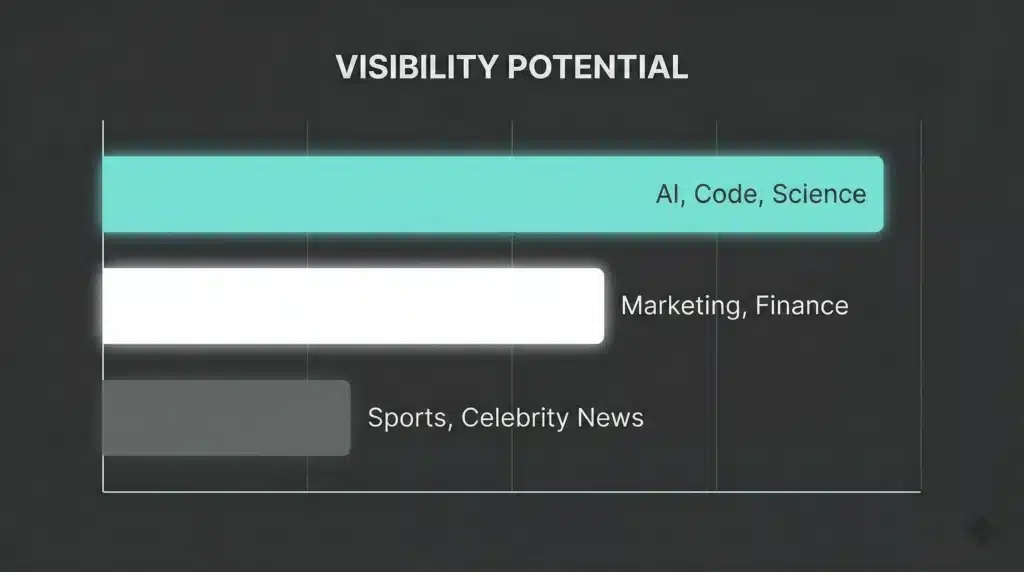
Keep these tactics in mind:
1. Align Content with Favored Verticals
Reframe your topics to fit high-value categories whenever possible. Here are a few tips:
- If your brand touches multiple topics, prioritize AI, tech, or science angles.
- Reframe business topics through technology or data analysis lenses
Example: Instead of “Marketing Automation Tools” (default), frame as “AI-Powered Marketing Automation” (high-value).
2. Avoid Restricted Topics
Don’t waste optimization effort on inherently penalized categories. Save entertainment and sports content for platforms where they perform better, and focus Perplexity efforts on AI, tech, science, and business topics.
3. Use Topic-Specific Terminology
Signal your category through language choices and reference points. Here’s how you can do that:
- Include category-relevant keywords, such as “machine learning,” “algorithm,” “data-driven,” and “research-backed.”
- Reference technical concepts and methodologies.
- Cite academic or technical sources when possible.
How to Optimize for Perplexity’s Entity System?
Perplexity uses BERT-based entity linking (BERT stands for Bidirectional Encoder Representations from Transformers) to resolve ambiguous terms and connect concepts. Content that fails disambiguation gets filtered out regardless of other quality signals.
Perplexity needs to understand who, what, where, and when you’re discussing with zero ambiguity.
How to Pass Perplexity’s Entity Disambiguation
Make every reference explicitly clear so the AI never has to guess what you mean. Here’s how:
1. Define Entities on First Mission
Provide full context immediately, not three paragraphs later. These matter most:
- Full names with context: “Sam Altman, CEO of OpenAI” (not just “Altman”).
- Company names with industry: “Anthropic, an AI safety research company.”
- Product names with category: “Claude, Anthropic’s conversational AI assistant”
2. Resolve Acronyms Immediately
Never assume the reader (or AI) knows industry shorthand. Remember these rules:
- Write out acronyms on first use: “Generative Engine Optimization (GEO)”
- Don’t assume familiarity with industry jargon.
- Create a clear mental model: “L3 XGBoost reranker, Perplexity’s machine learning quality filter”
3. Use Structured Data Markup
Help Perplexity’s entity extraction by providing machine-readable signals. Focus on these:
- Implement Schema.org markup for entities (Organization, Person, Product, and Article)
- Add JSON-LD to reinforce entity relationships.
- Remember that Schema represents roughly 10% of Perplexity’s ranking weight.
4. Create Entity-Rich Passages
Build semantic networks by connecting multiple entities explicitly. For example:
- Include multiple related entities per section
- Connect entities explicitly: “OpenAI’s ChatGPT competes with Anthropic’s Claude and Google’s Gemini.”
- Build semantic relationships between concepts.
A common mistake is writing for human readers who already understand context. Perplexity requires explicit entity resolution that would feel redundant in traditional writing.
What Are Perplexity’s Authoritative Domain Lists?
Perplexity maintains a manually curated whitelist of authoritative domains across categories. Content from or referencing these domains has inherent ranking boosts.
According to Metehan’s analysis, these whitelists are hardcoded into Perplexity’s configuration files rather than algorithmically determined, meaning the authority boost is immediate and consistent, not subject to the same fluctuations as traditional domain authority metrics.
We organized some of these websites in the table below:
| Developer/Technical | E-Commerce/Shopping | Professional Tools | Social/Community | Education |
|---|---|---|---|---|
| GitHub | Amazon | Notion | Coursera | |
| GitLab | eBay | Slack | Udemy | |
| Stack Overflow | Walmart | Figma | edX | |
| Developer.Mozilla.org | Best Buy | Jira | Discord | Khan Academy |
| BitBucket | Etsy | Asana | Skillshare | |
| LeetCode | Target | Confluence | ||
| FreeCodeCamp | Costco | Airtable |
How to Use Authoritative Domains to Rank in Perplexity
To rank higher in Perplexity, build connections with whitelisted sources to inherit their source signals. Here’s how:
1. Reference Authoritative Sources Naturally
Incorporate high-trust domains where they add genuine value. For example:
- Link to GitHub repositories when discussing code.
- Cite Stack Overflow threads for technical solutions.
- Reference Amazon product pages for e-commerce topics.
2. Create Content that Incorporates Whitelist Data
Use data from authoritative platforms as supporting evidence. The following tactics help:
- Use GitHub stars/forks as credibility signals.
- Reference Reddit discussions or community sentiment.
- Include data from authoritative educational platforms.
3. Build Relationships with These Platforms
Always position your content where Perplexity already looks for authority. You can either contribute guest posts and ask for mentions OR do the following:
- Contribute to Stack Overflow, GitHub, and Reddit communities.
- Create content that naturally lives on these domains.
- Get mentioned or featured by authoritative sources.
Important: Although this sounds manipulative, you’re simply creating content that naturally incorporates the high-trust sources that Perplexity already prioritizes. It’s a strategy!
How Does Time Decay Affect Perplexity Rankings?
Perplexity uses an exponential time decay curve (time_decay_rate) that reduces content visibility over time. Unlike Google’s slower decay, Perplexity prioritizes freshness aggressively.
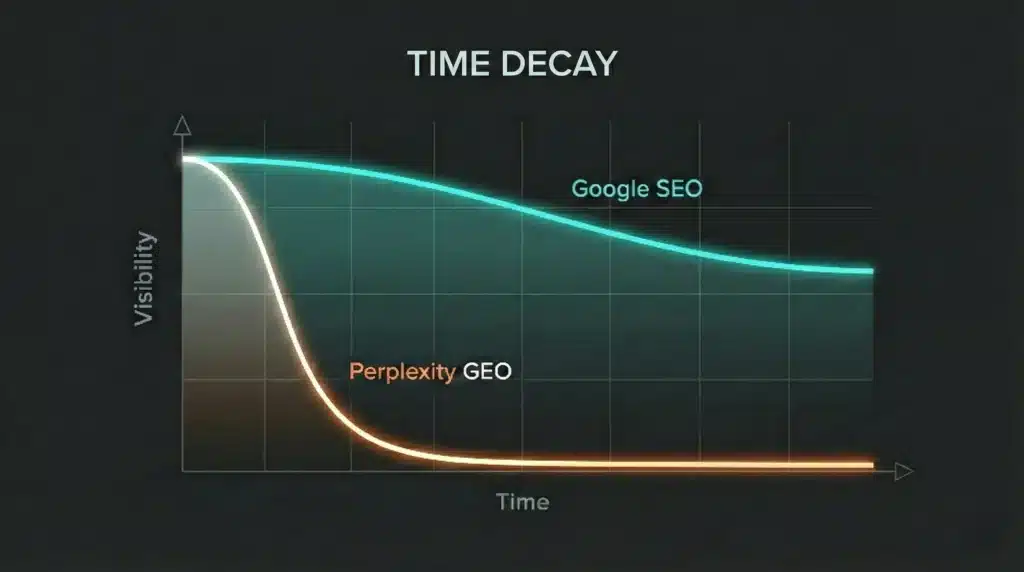
Here’s what that decay pattern looks like:
- Content visibility drops dramatically after initial publication.
- Without engagement signals, pages lose 50%+ visibility within 7 to 14 days. This is fundamentally different from how AEO and SEO optimization differ in terms of content freshness requirements.
- Only consistent engagement or content updates counter decay.
How to Combat Perplexity’s Time Decay
To maintain visibility, you’ll need to continuously put in effort, not optimize your content once and forget it. Keep these tips in mind:
1. Establish a Content Refresh Cadence
Regular updates signal freshness and reset the decay clock. Do the following:
- Update existing content every 7 to 14 days minimum for competitive topics.
- Add new data, examples, or insights rather than just changing dates.
- Refresh high-performing pages first to maintain momentum.
2. Build Evergreen Engagement Loops
Create content that naturally attracts repeat visits over time. These tips help:
- Design content that answers evolving questions.
- Use internal linking to keep older content connected to fresh material.
- Update timestamps when making substantive changes.
3. Publish Consistently
A regular publishing rhythm signals an active, authoritative source. Note the following:
- Maintain predictable publishing frequency (weekly or bi-weekly).
- Batch content creation and schedule consistent releases.
- Develop topic clusters that reinforce each other over time.
4. Monitor Visibility Trends
Data-driven refresh decisions beat arbitrary schedules, so remember to:
- Track which pages are experiencing decay.
- Prioritize refreshes based on historical performance and business value.
- Don’t let high-value content fall off the visibility cliff.
Note: Time decay means Perplexity optimization is an ongoing process, not a one-time effort. Budget for continuous content maintenance.
What Is Perplexity’s Embedding Similarity Threshold?
The embedding_similarity_threshold acts as a relevance quality gate. Content must achieve sufficient semantic similarity to target queries to be considered for ranking.
Perplexity converts content into vector embeddings and calculates similarity scores against user queries. Below-threshold content is filtered out before other ranking factors even apply.
How to Optimize for Perplexity’s Semantic Relevance
To pass the similarity threshold, you must create genuinely comprehensive coverage.
1. Cover Topics Comprehensively
Surface-level content fails semantic matching against detailed queries. When writing, remember to:
- Address the full scope of a query, not just one angle.
- Include related concepts, alternatives, and comparisons.
- Create content that answers follow-up questions before they’re asked.
2. Use Varied, Semantically Rich Vocabulary
Demonstrate topical mastery through natural language variation. For example:
- Include synonyms and related terms naturally throughout your content.
- Don’t repeat the same phrases; use semantic variations.
Example: “rank in Perplexity” → “appear in Perplexity citations” → “gain Perplexity visibility” → “optimize for Perplexity search”
3. Build Topical Authority Through Depth
Show understanding of the entire landscape, not just surface details, by:
- Covering subtopics thoroughly within each section.
- Connect concepts explicitly: “This relates to X because…”
- Demonstrate expertise through nuanced explanations.
4. Avoid Keyword Stuffing
Although this classic SEO tactic paid off years ago, current semantic models detect and penalize forced repetition. Keep these in mind:
- Semantic similarity measures meaning, not keyword frequency.
- Forced repetition can actually hurt relevance scores.
- Write naturally while ensuring comprehensive coverage.
How Do Engagement Signals Impact Long-Term Perplexity Rankings?
Perplexity tracks engagement through multiple timeframes to identify consistently valuable content. The system monitors three metrics:
- discover_engagement_7d: Weekly user engagement patterns.
- historic_engagement_v1: Long-term performance history.
- discover_click_7d_batch_embedding: Click pattern analysis.
Content that consistently earns clicks and engagement gets long-term ranking boosts that compound over time.
How to Optimize for Perplexity Engagement
To optimize for engagement, create content that users actively choose and spend time with. Follow these tips:
1. Craft Clickable Headlines
Your title determines whether users click your citation over competitors. Remember to:
- Be specific and descriptive: “8 Perplexity Ranking Factors for 2026” beats “Perplexity SEO Guide.”
- Use numbers, years, and concrete promises.
- Match search intent precisely.
2. Optimize for Dwell Time
Keep users engaged once they click through. To do that:
- Use skimmable formatting, including bullets, bold, tables, and clear headings.
- Break up text walls with visual hierarchy.
- Create content worth reading completely, not just skimming.
3. Deliver on Headline Promises
Meeting expectations drives repeat engagement and positive signals. When creating content, remember to:
- Ensure the content actually answers the question in the title.
- Front-load value; don’t bury answers deep in the article.
- Exceed expectations to encourage return visits.
4. Build Content Networks
Multi-page sessions signal topical authority and depth. Here’s how you can build content networks:
- Link related content to encourage exploration.
- Create topic clusters where each piece reinforces others.
- Use the boost_page_with_memory system by referencing previous content naturally.
What Mistakes Should You Avoid When Optimizing for Perplexity?
Even well-intentioned optimization efforts can backfire if you trigger Perplexity’s negative signals. Keep these points in mind:
- Failing the new post window: Publishing content without a launch plan is a mistake. Treat every publication as a coordinated launch event with pre-scheduled distribution.
- Writing for the wrong topics: Spending resources optimizing entertainment or sports for Perplexity is a waste. Save restricted topics for platforms where they perform better; focus Perplexity efforts on AI, tech, science, and business.
- Creating generic, entity-free content: Using vague language like “many companies” or “recent research” isn’t helpful to Perplexity. Always name specific entities, studies, companies, and individuals with full context.
- Ignoring content refreshes: Never publish content and forget about it. Schedule regular refreshes every 7 to 14 days to combat time decay.
- Ignoring semantic richness: Keyword stuffing or repeating the same phrases is an outdated tactic. Today, you must use varied vocabulary and cover topics comprehensively to rank.
- Burying answers: Long introductions before getting to the point hurt your visibility. Adopt an answer-first structure with direct responses in the first 60 words.
- Missing structured data: Forgetting Schema markup or entity disambiguation is a mistake. Always implement JSON-LD for key entities and use clear definitions throughout.
- Focusing on domains only: Assuming high domain authority alone will win AI citations is misguided. Remember that Perplexity’s L3 reranker evaluates content quality independently of domain metrics.
How Do You Know If You’re Ranking in Perplexity?
You can measure your AI search visibility manually, but it’s time-consuming. You have to:
- Run targeted queries related to your content topics.
- Look for your domain in the citation list (numbered sources at the bottom of the answers).
- Check if your content is quoted in the actual answer text.
- Test multiple query variations, since Perplexity may cite you for some phrasings but not others.
You won’t be able to track trends or analyze your brand performance across months or years, monitor at scale across hundreds of topics, or measure incremental improvements.
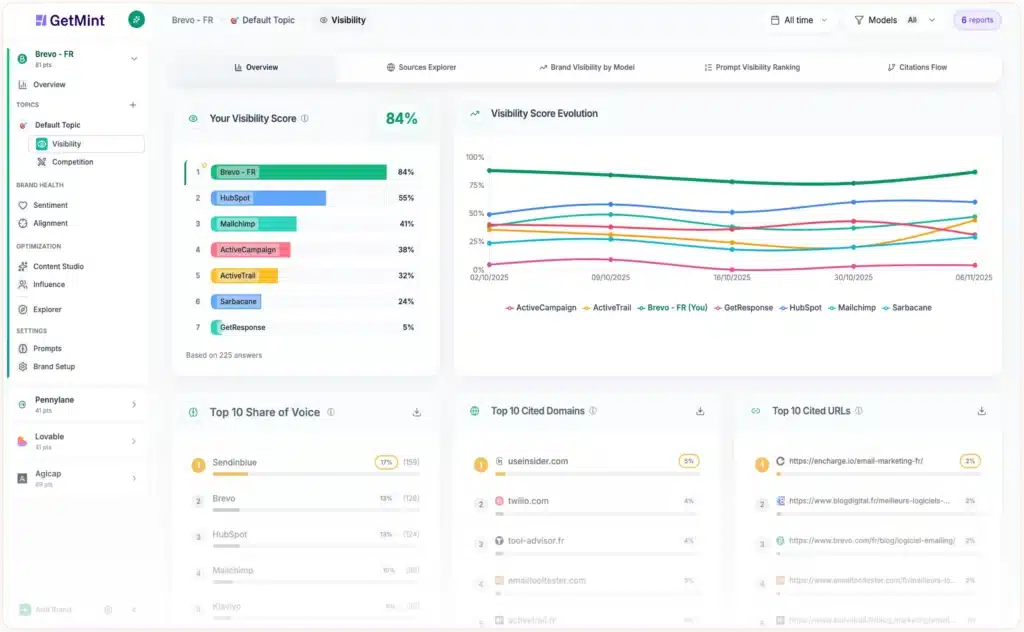
What we recommend instead is to automatically check if you’re ranking on Perplexity using an AI visibility platform. If you’re evaluating options, our guide to the best tools for GEO compares features, pricing, and tracking capabilities across leading platforms.
Start Tracking Your Perplexity Visibility Today
Understanding Perplexity’s ranking factors is the first step. The second is measuring whether your optimization efforts are actually working.
Manual checking across multiple queries and platforms is unsustainable at scale. GetMint provides automated AI visibility monitoring across Perplexity, ChatGPT, Claude, Google SGE, and other AI engines, giving you the data you need to optimize strategically rather than guessing.
Start your free AI visibility audit to see exactly how your content performs across generative search engines and where you have the biggest opportunities to improve.
Frequently Asked Questions (FAQs)
How long does it take to rank in Perplexity?
Perplexity operates on two timelines:
• Immediate (60 minutes): New content can gain visibility within the first hour if it passes the new_post_impression_threshold and new_post_ctr requirements during the critical window.
• Long-term (7–14 days): Building consistent visibility requires passing through multiple quality gates, earning engagement signals via discover_engagement_7d, and maintaining freshness to combat time_decay_rate.
Unlike Google (months of link building), Perplexity offers faster initial visibility but requires ongoing maintenance to sustain rankings.
Does Perplexity use backlinks for ranking?
Not in the traditional SEO sense. Perplexity’s L3 XGBoost reranker focuses on:
• Content quality and semantic relevance
• Entity disambiguation and specificity
• Answer-first structure and directness
• Engagement signals and click patterns
However, authoritative domain references matter. Content that naturally incorporates or cites domains from Perplexity’s manual whitelists (GitHub, Stack Overflow, Reddit, etc.) receives ranking advantages.
Can I optimize old content for Perplexity?
Yes, and you should. Use this approach:
• Add answer-first sections at the top of existing pages (80-token direct answers)
• Improve entity disambiguation by defining acronyms and specifying full names
• Include concrete numbers and replace vague claims with specific data.
• Implement Schema markup if missing
• Refresh content regularly (every 7–14 days) to combat time decay
Old content with strong engagement signals can outperform new content if properly optimized for Perplexity’s ranking factors.
What is the difference between ranking in Perplexity and ChatGPT?
Perplexity uses entity-focused reranking with strict quality gates, manual authority lists, and aggressive time decay. It favors answer-first, numerically rich, technically specific content.
ChatGPT uses Reciprocal Rank Fusion (RRF) that democratically merges multiple ranking signals. It tends to favor longer-form, comprehensive content with strong narrative structure.
Both benefit from entity-rich content, concrete data, and semantic depth. The main difference is Perplexity’s stricter quality thresholds and topic multipliers.
Do I need to do anything technical to rank on Perplexity?
At minimum, you need Schema.org markup, a clear HTML structure, fast page load times, and a mobile-friendly design.
Advanced technical optimization techniques include entity linking and disambiguation in structured data, semantic HTML that reinforces content meaning, and internal linking architecture for content networks.
The good news is that Perplexity prioritizes content quality over technical perfection. If you have basic SEO hygiene, focus on content optimization first.

