


Only 10% to 15% of ChatGPT citations overlap with Google’s top rankings. The AI search ranking factors that determine visibility in generative engines have almost nothing to do with traditional SEO metrics like backlinks or domain authority.
AI search traffic grew 527% in 2025. If you’re not optimizing for these platforms, you’re losing high-intent traffic to competitors who understand the new rules.
This guide breaks down the 6 AI search ranking factors that actually matter across ChatGPT, Perplexity, Claude, and Google AI Overviews, plus how to measure which factors are actually moving your rankings.
Do Google Rankings Predict AI Citations?
The answer is barely. Cross-engine correlation data reveals just how disconnected traditional search rankings are from AI visibility.

Consider the following:
- ChatGPT: 10% to 15% overlap with Google’s top results.
- Perplexity: 25% to 30% overlap with Google.
- Gemini: As low as 4% overlap.
This creates a paradox. 76% of URLs cited in Google AI Overviews also rank in Google’s top 10, but 40% of AI citations come from pages ranking below position 10.
This means that AI engines aren’t just reading Google’s results and picking the top-ranked pages. They’re evaluating content based on completely different signals.
The most telling statistic is that branded mentions correlate 3x more strongly with AI citations than backlinks. Traditional link-building strategies that worked for SEO barely register in Generative Engine Optimization (GEO).
Bottom Line: Ranking #1 on Google doesn’t mean you exist in AI answers. You need to understand what AI engines actually look for.
The 6 Main AI Search Ranking Factors
Unlike Google’s 200+ ranking signals, AI engines compress evaluation into six main categories.

These factors apply universally across ChatGPT, Perplexity, Claude, and Google AI Overviews, though each platform weights them slightly differently. Here’s what actually determines whether your content gets cited.
1. Entity Authority and Brand Strength
Entity authority is how clearly AI models understand who you are, what you do, and why you’re credible in your category.

This matters more than anything else, as research shows that only 3.3% of new brands appear in ChatGPT product discovery queries, while established brands achieve 99% recall when mentioned directly. That’s a 30x difference.
The reason is simple: 75%+ of ChatGPT-cited sources come from established institutions (like Mayo Clinic, NHS, PubMed, and Wikipedia). AI engines have been trained to trust these entities, and breaking into that circle as a new brand is extremely difficult.
How to Build Entity Authority
But not all is doom and gloom. Here’s what you can do to build your brand’s entity authority:
- Define your brand explicitly: Your Homepage and About page should contain clear, declarative statements like “GetMint is a GEO platform for enterprise brands” rather than vague taglines like “We help you win the answer.” AI models need subject-verb-object clarity.
- Maintain consistent structured data sources: Ensure your Wikipedia, Wikidata, and Crunchbase profiles are up-to-date and consistent. AI platforms don’t disclose exactly how they weight these sources, but we know that they provide structured entity information that helps establish clear brand definitions.
- Get cited by sources AI engines already trust: If Mayo Clinic links to your health content or Wikipedia references your company, you inherit some of that institutional authority. This is why AI brand monitoring matters; you need to know when and where you’re being mentioned.
Entity authority is the hardest factor to influence quickly, but it’s also the most durable. Once established, it compounds over time.
2. Content Structure and Extractability
AI engines don’t “read” content the way we humans do. They extract structured information from semantic HTML.

Research shows that pages scoring 0.70 or higher on structured metadata and semantic HTML frameworks demonstrate dramatically higher citation probability across all AI engines.
Here’s the data that proves structure matters: Comparison lists and “best of” articles make up roughly 33% of all AI citations, despite representing less than 10% of web content, because they’re formatted for extraction.
How to Structure Content for AI Extraction
To ensure your content is easily extractable by AIs, make sure you follow these tips:
- Use BLUF (Bottom Line Up Front) formatting: The top-cited sources answer the core question within the first 100 words. Don’t bury your answers three paragraphs deep; present it first and explain next.
- Prioritize extractable formats: AI engines favor tables for comparisons and data, bulleted lists for features or steps, clear H2/H3 hierarchies with question-based headings, and FAQ sections with up to 4-sentence answers.
- Implement structured data markup: Use Schema.org types like FAQPage, HowTo, Article, and Organization to make your content machine-readable. While the exact weight varies by platform, structured data helps AI systems parse entity relationships and content hierarchy.
- Avoid walls of text: Dense paragraphs without visual breaks make extraction harder. Break content into discrete, self-contained blocks that can stand alone as citations.
Pro Tip: If you’re writing content with Answer Engine Optimization (AEO) in mind, every section should be quotable without requiring additional context.
3. Source Credibility and Citation Patterns
AI engines exhibit strong institutional bias; they preferentially cite sources they’ve successfully cited before.

This essentially creates a self-reinforcing loop. If you’ve been cited by ChatGPT once, you’re more likely to be cited again. If you’ve never been cited, breaking in is significantly harder.
In addition, different AI engines trust different source types:
- ChatGPT: Wikipedia accounts for 47.9% of citations.
- Perplexity: Reddit makes up 46.5% of citations.
- Google AI Overviews: Balances different sources, including Reddit, YouTube, Quora, and LinkedIn, among others.
How to Build Source Credibility
To increase your chances of being cited, try the following strategies:
- Get cited on platforms AI engines already trust: Contributing to Reddit discussions (for Perplexity), writing on LinkedIn (for Google AI Overviews), or creating Wikipedia entries (for ChatGPT) can bootstrap your credibility.
- Use co-occurrence strategy: Get mentioned alongside category leaders in comparison content. When AI models see your brand repeatedly appearing next to established players, they begin treating you as a peer in the consideration set.
- Create citation-worthy formats: “X vs Y” comparison pages, “Best [Category] for [Use Case]” articles, and data-backed listicles get cited more frequently because they’re designed to answer direct queries.
- Reference authoritative sources yourself: Citing credible sources in your own content can increase your perceived authority. It signals that you’re part of the credible information ecosystem rather than operating in isolation.
Insight: AI search competitor analysis reveals which formats and platforms your competitors are using to win citations. Study what’s working in your category and form a strategy for it.
4. Content Freshness and Temporal Signals
Freshness matters more in AI search than traditional SEO because AI algorithms evolve faster than Google’s. In just 5 months of 2025, AI search traffic grew by 527%, showing extreme algorithmic volatility. What works today might not work next quarter.

AI engines heavily weigh recency signals, including:
- Publication dates in Schema markup
- “Updated [Current Year]” tags visible to parsers
- References to recent data, current versions, and latest events
How to Optimize for Freshness
To ensure AIs view your content as up-to-date and reliable, do the following:
- Make publication dates visible and machine-readable: Include datePublished and dateModified in your Schema markup. AI engines use this to filter out outdated information.
- Refresh content regularly: For competitive topics, plan monthly updates. Even small additions (new statistics, updated examples, and current year references) signal freshness.
- Reference current data and versions: “As of February 2026” or “In the latest version” tells the AI engines this information is current. Avoid evergreen phrasing that could apply to any year.
- Use temporal query patterns: Queries containing “latest,” “current,” “2026,” or “recent” trigger strong freshness weighting. If your content targets these queries, recency becomes even more important.
Note: Content decay is faster in AI search, especially for engines like Perplexity. Don’t create content and forget about it; plan for ongoing maintenance.
5. Answer Directness and Query Matching
AI engines reward content that directly answers the query in the opening paragraph. No fluff, no setup, no storytelling, just the answer.

This is different from traditional SEO, where you might ease readers into the topic with an anecdote or a personal experience. In AI search, directness is a ranking factor.
How to Write Direct Answers
Keep the following rules in mind when writing AI search-optimized content:
- Use question-based H2s with immediate answers: Your structure should look like this: Question in heading → Direct answer in the first sentence → Supporting details in the following sentences.
Example: What Is GEO? GEO (Generative Engine Optimization) is the practice of optimizing content to rank in AI-generated answers across platforms like ChatGPT, Perplexity, and Google AI Overviews. Unlike traditional SEO, which targets blue links, GEO focuses on winning citations.
- Eliminate fluff: Don’t start with “In order to understand X, we first need to…” Just answer the question.
- Front-load value: The first 50 to 100 words of every section should contain the core information someone came for. Supporting details, examples, and elaboration come after.
- Match conversational query patterns: AI users ask questions like “What’s the best CRM for small teams?” not “CRM software comparison.” Write answers that match natural language queries.
Pro Tip: If you can’t extract a satisfying answer from your first paragraph alone, restructure it. That first paragraph is what AI engines extract most often.
6. Multi-Format Signals and Context
Single-format content struggles in AI search because AI engines validate information across multiple sources and content types.

Multi-modal content (content including text, images and optionally videos) receives a 47% higher visibility boost compared to text-only pages because AI engines look for consensus.
If your brand appears in blog posts, YouTube videos, Reddit discussions, and LinkedIn articles (all saying consistent things), it signals authority and trustworthiness.
How to Benefit From Multi-Format Optimization
Keep the following strategies in mind when you’re creating content:
- Create companion formats: When you publish a blog post, create a YouTube video covering the same topic. When you release a guide, create an infographic summarizing key points.
- Publish across platforms AI engines scan: Different engines have different source preferences, but presence across YouTube, Reddit, LinkedIn, and your own site creates cross-validation.
- Maintain consistent messaging: AI engines detect inconsistencies. If your blog says one thing and your video says another, it reduces trust. Use the same data, terminology, and positioning across formats.
- Embed rich media: Include images, videos, and downloadables in long-form content. This signals comprehensive coverage and gives AI engines multiple entry points to understand your content.
In other words, think cross-platform, not just cross-format. Your brand’s total footprint across the web matters more in AI search than in traditional SEO.
How Do AI Engines Differ in Terms of Ranking Preferences?
While the 6 factors above apply universally, each AI engine has distinct preferences that influence which content gets cited.
Understanding these differences helps you prioritize optimization efforts based on which platforms matter most to your audience.
ChatGPT’s Ranking Preferences
Wikipedia accounts for 47.9% of citations, with 75%+ coming from established institutions like Mayo Clinic, NHS, and PubMed. ChatGPT favors:
- Established brand authority over freshness
- Institutional and academic sources
- Comprehensive, in-depth analysis
- Long-standing entity recognition
The problem is that new brands struggle significantly, as only 3.3% of them appear in product discovery queries compared to 99% recall for established names.
→ To optimize for ChatGPT, focus on entity building and institutional relationships. If you can’t get on Wikipedia, get cited by sources that are already on Wikipedia.
Perplexity’s Ranking Preferences
Reddit dominates Perplexity’s citations, as the platform favors community-driven content. Here’s what it looks for:
- Recent, up-to-date content
- List-style, structured formats
- Clear citation-ready blocks
- Active community discussions
→ To optimize for Perplexity, build presence on Reddit and forums. Create highly structured comparison content. For specific tactics, see our guide on how to rank in Perplexity.
Google AI Overviews’ Ranking Preferences
Google AI Overviews has a balanced distribution; it draws information from multiple sources, including Reddit, YouTube, Quora, and LinkedIn. This is what it favors:
- Pages already in Google’s top 10
- Conversational query matching over exact keywords
- Multi-format content (text + video)
- Strong E-E-A-T signals
→ Fortunately, strong traditional SEO remains foundational, but remember to layer in conversational language and multi-platform presence to increase your chances of being cited.
Claude’s Ranking Preferences
Claude favors primary sources and in-depth technical documentation over aggregator sites. The rules to keep in mind when creating content are as follows:
- Comprehensive, detailed analysis (2,500+ words)
- Technical depth and accuracy
- Primary research and original data
- Clear logical structure
→ Put simply, create authoritative, detailed guides that serve as definitive resources. Claude rewards depth over breadth.
Note: These preferences evolve. What works now may shift down the line as platforms refine their algorithms!
How to Prioritize AI Search Ranking Factors
Not all six factors matter equally for every piece of content or every business. Here’s how to prioritize based on your situation:
If you’re a new brand (less than 2 years old):
- Content Structure (easiest to control immediately)
- Answer Directness (quick wins through formatting)
- Multi-Format Signals (build cross-platform presence)
- Entity Authority (long-term investment)
If you’re an established brand:
- Entity Authority (leverage existing recognition)
- Source Credibility (get cited by platforms AI trusts)
- Freshness (maintain competitive edge)
- Content Structure (optimize existing assets)
Entity clarity, BLUF formatting, and structured data typically deliver 80% of AI search results. Master these three before worrying about platform-specific optimization.
Pro Tip: Strong Reddit presence helps Perplexity visibility, which builds authority that eventually helps ChatGPT citations. Think of GEO as an ecosystem, not as individual engines.
How to Measure Which AI Search Ranking Factors Impact Your Rankings
AI rankings are non-deterministic. Ask ChatGPT the same question twice and you might get different citations. This makes measurement difficult. You can’t just check your position like you would in Google Search Console.
Although you could do it manually (and it would take 10 to 15 hours per month), the best way to track which content formats, topics, and optimization tactics correlate with visibility changes is to use an AI visibility platform.
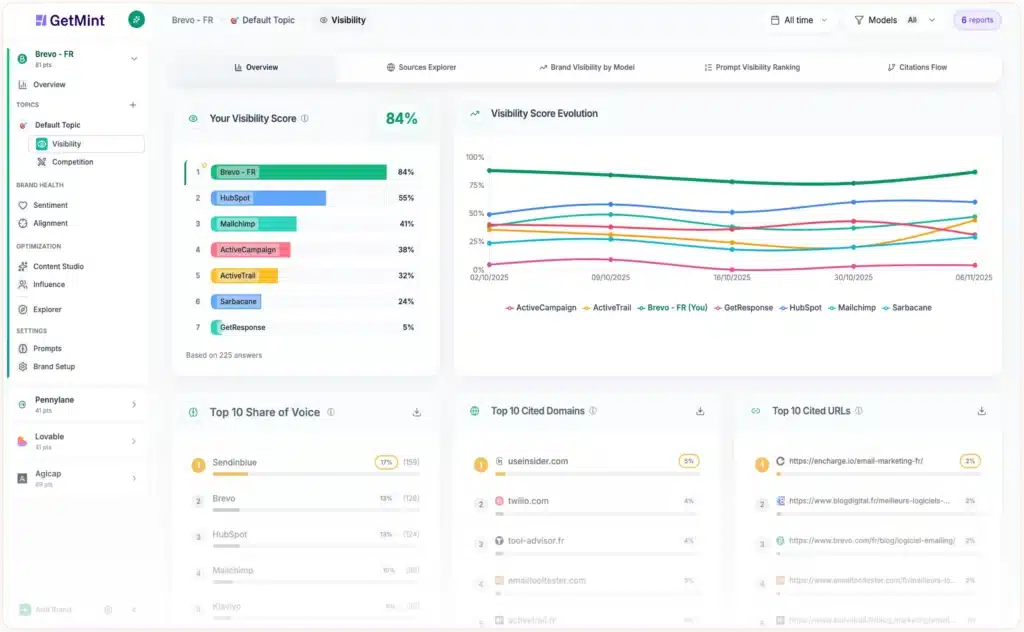
For example, GetMint’s dashboard tracks your citations across ChatGPT, Perplexity, Google AI Overviews, and other AI engines in real time, showing you:
- Which pages are getting cited most often
- How your visibility trends over time
- What topics and formats perform best
- Where competitors are outranking you
This turns AI search optimization from guesswork into a data-driven strategy.
Common Mistakes to Avoid When Optimizing for AI Search
Just as important as knowing what works is understanding what doesn’t.
- Keyword stuffing: Semantic relevance isn’t about keyword density. AI engines evaluate meaning, not word frequency. Forced repetition hurts more than it helps.
- Backlink-only strategies: Remember, brand mentions correlate 3x more strongly with citations than backlinks. Links still matter, but they’re not the primary lever.
- Single-engine optimization: With only 10-30% correlation between platforms, optimizing exclusively for one engine means missing 70–90% of potential visibility.
- Assuming Google rank = AI visibility: The correlation has collapsed to 10–15% for ChatGPT. You can rank #1 on Google and be completely invisible in AI search.
- Publishing without structure: Walls of text don’t get extracted. If AI engines can’t easily parse your content, they’ll cite someone else who made it easier.
- One-and-done content: AI search requires ongoing maintenance. Without regular updates, your citations will decay as newer, fresher content replaces you.
AI Search Ranking Factors Differ From Traditional SEO
AI search ranking factors differ fundamentally from traditional SEO. The brands dominating AI search in 2026 are optimizing for the six factors AI engines actually use to determine AI search visibility and measuring what’s working through continuous citation tracking.
The question isn’t whether to optimize for AI search. It’s whether you’ll do it before or after your competitors.
Stop guessing which factors matter. Start your free AI visibility audit to see exactly which content is winning citations and where you have the biggest opportunities to improve.
Frequently Asked Questions (FAQs)
What is the most important AI search ranking factor?
Entity authority is the most important long-term factor, but it’s also the hardest to build. For immediate results, focus on content structure and answer directness, as these are fully within your control and deliver quick wins through formatting changes.
Do backlinks matter for AI search rankings?
Yes, but far less than in traditional SEO. Brand mentions correlate 3x more strongly with AI citations than backlinks. Focus on getting mentioned in places AI engines already trust (Reddit, Wikipedia, industry publications) rather than just building links.
How long does it take to rank in AI search?
It varies by engine. Perplexity can surface new content within hours if it’s well-structured. ChatGPT typically takes weeks to months because it relies more on established authority than freshness. Google AI Overviews fall somewhere in between, with 76% of citations coming from pages already in the top 10.
Can you rank in AI search without ranking on Google?
Absolutely. Only 10-15% of ChatGPT citations overlap with Google’s top results, and even Google AI Overviews pulls 40% of citations from pages ranking below position 10. AI engines evaluate content based on different factors than traditional search algorithms.
How do you track AI search rankings?
Unlike Google, where you can check Search Console, AI rankings require specialized tracking because answers are non-deterministic.
You need an AI visibility platform that continuously samples queries across engines and tracks when and where your content gets cited. For a comparison of tracking tools, see our guide to the best tools for GEO.

