
Jan 8, 2026
Profound vs Hall AI for GEO: Technical and Commerce Comparison (2026)
Profound and Hall AI look similar on paper, but they serve fundamentally different goals.
Profound is a corporate reputation engine designed to track high-level sentiment and share of voice. Hall AI is a technical infrastructure tool built to debug crawlers and monitor e-commerce product placements.
One tracks if your brand is trusted; the other tracks if your product is buyable.
In this guide, we compare Profound vs Hall AI for GEO, dissecting their pricing gaps, technical capabilities, and specific cases to help you align the tool with your business model.
Profound vs Hall AI for GEO: At a Glance
Here’s a direct comparison of the entry-level paid plans for both Profound and Hall AI. We focused on their infrastructure and data limits.
Features | Profound (Starter) | Hall AI (Starter) |
|---|---|---|
Monthly Price | $99 | $239 |
Tracked Prompts | 50 | 500 |
Update Frequency | Daily | Daily |
Platform Coverage | ChatGPT | ChatGPT, Perplexity, Google AI Overviews |
Historical Data | All-time | 6 months |
Export Options |  | CSV |
Unique Capability | Thematic brand sentiment | AI crawler and bot tracking |
Best Use Case | Corporate reputation | Technical SEO and E-commerce |
Although Profound offers a lower starting price, Hall AI includes significantly higher query volume and across-platform tracking on its base tier.
Which Platform Offers Better Technical SEO Insights?
Both platforms offer agent analytics to track how AI crawlers interact with your site, but the depth of the audit differs.
Hall AI’s Real-Time Monitor
Hall AI focuses strictly on agent activity.
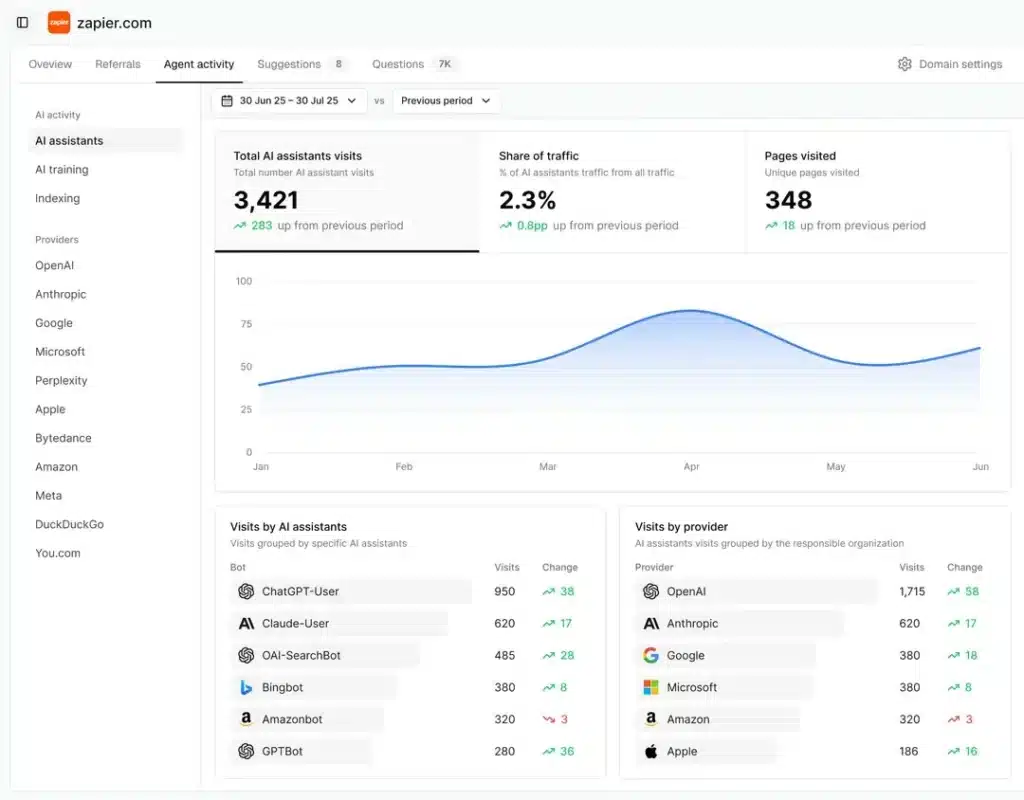
Bot tracking: It excels at identifying how AI companies are accessing your content (tracking IPs and user agents).
Real-time focus: Users choose Hall AI when they need to debug crawler issues in real-time, often treating it as a specialized “server log” for the AI era.
Profound’s Technical Health Check
Profound approaches technical SEO from a “health” perspective. While Hall focuses on bot activity, Profound focuses on bot readiness to help you ensure your site meets the technical standards AI crawlers expect.
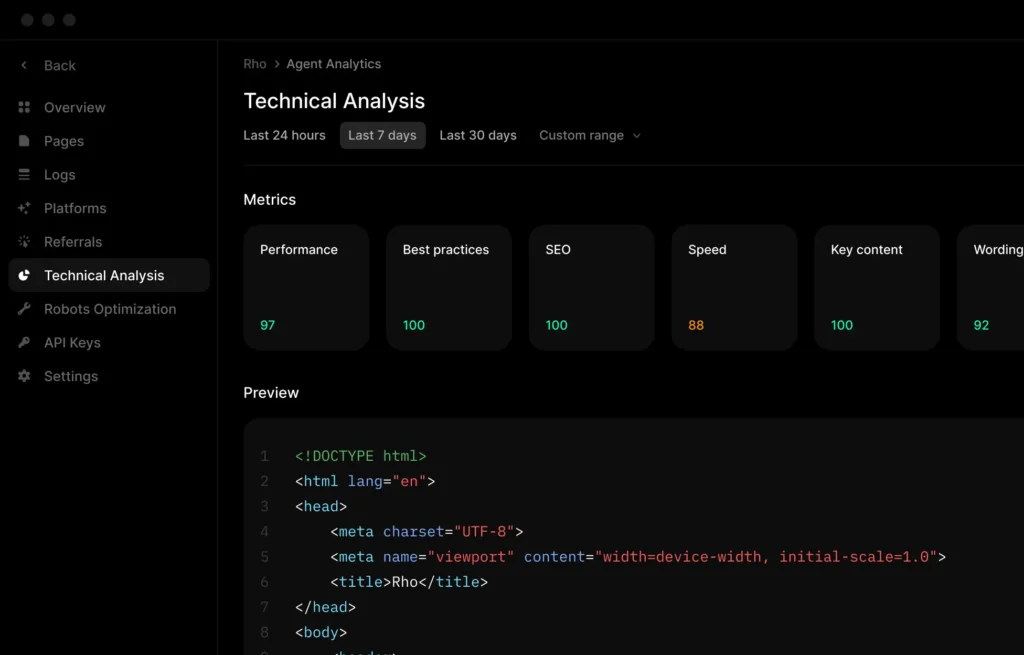
Code optimization: It runs a Lighthouse-style audit on your pages, giving you specific scores for performance, SEO, and best practices.
Bot readiness: While Hall tracks activity (who’s visiting), Profound tracks readiness (are you built to be read?). IT checks your HTML structure to ensure AI crawlers can actually parse and index your content effectively.
→ Hall AI watches the traffic; Profound helps you guarantee traffic reaches you in the first place. If you need to debug live bot behavior, choose Hall. If you need to audit your site’s technical health to ensure it’s AI-readable, Profound provides the superior checklist.
How Do They Measure AI Visibility?
Both platforms track the standard metrics that matter for AI search visibility (citations, mentions, and visibility scores). However, beyond the basics, they specialize in two completely different types of intelligence: category context vs. commercial availability.
Profound’s Conversation Engine
Profound excels at showing you the broader context of the market. Its standout feature, the Conversation Explorer, tracks the questions users are asking around your industry.
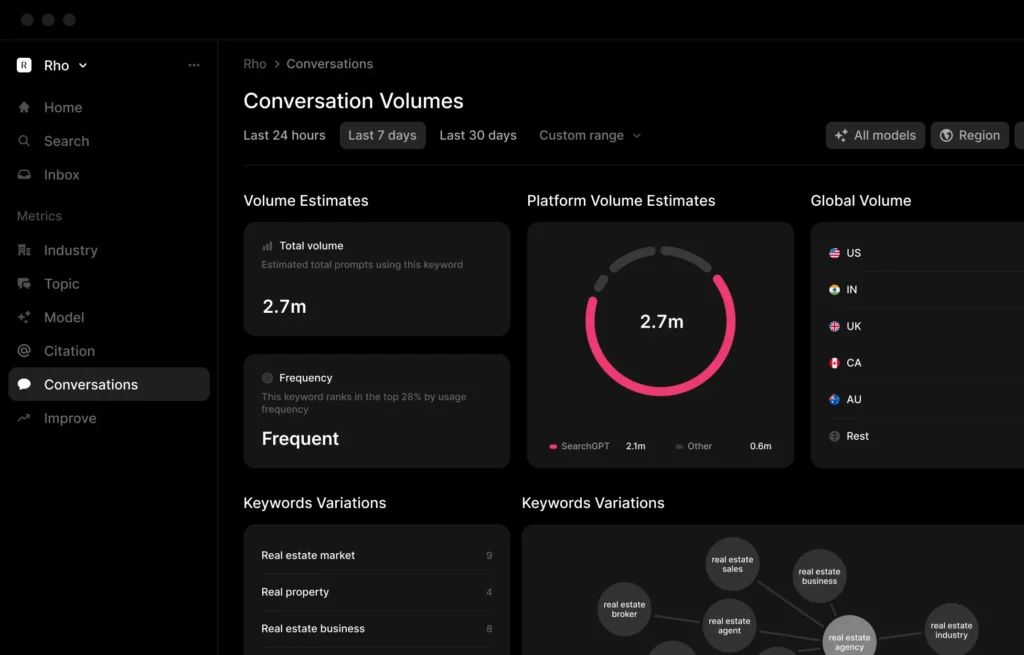
Topic authority: It identifies high-level themes (e.g., “Best enterprise CRM for security”) and measures your dominance in those specific conversations, not just direct brand queries.
Thematic sentiment: It categorizes sentiment by business topic (e.g., “Customer Support” vs. “Pricing”), helping you understand why you’re winning or losing share of voice in a specific vertical.
However, the shopping and attribute analysis are restricted to the custom Enterprise plan. If you’re on the self-serve tiers, you’re primarily tracking high-level brand visibility, not granular product attributes in the shopping field.
Hall AI’s Shopping Engine
Hall AI treats shopping visibility as a primary feature for everyone, rather than a gated upgrade.
Product performance: Hall AI specifically tracks how your products appear in ChatGPT shopping results. It monitors specific SKUs to see if they’re being recommended in the “buying” phase.
Retailer citations: It tracks which third-party retailers (e.g., Amazon, Walmart, or specialized distributors) are driving those product placements.
Hall AI basically allows e-commerce and DTC brands to track product visibility without needing a five-figure enterprise contract.
→ If you’re a corporate brand that needs to measure share of voice against major competitors, Profound is the superior dashboard. If you’re a DTC brand that needs to track product rankings in ChatGPT shopping today without a custom contract, Hall AI is the accessible choice.
Can You Optimize Content Inside Profound or Hall AI?
Monitoring visibility is the first step to your GEO strategy. Once you identify that your competitor is winning the answer, you need to update your content to reclaim the citation. This is where both platforms reveal their limitations as “monitoring-first” tools.
Profound’s Article Cap
Profound markets itself as a “Read/Write” platform, but in reality, its “Write” capabilities are severely restricted on self-serve plans.
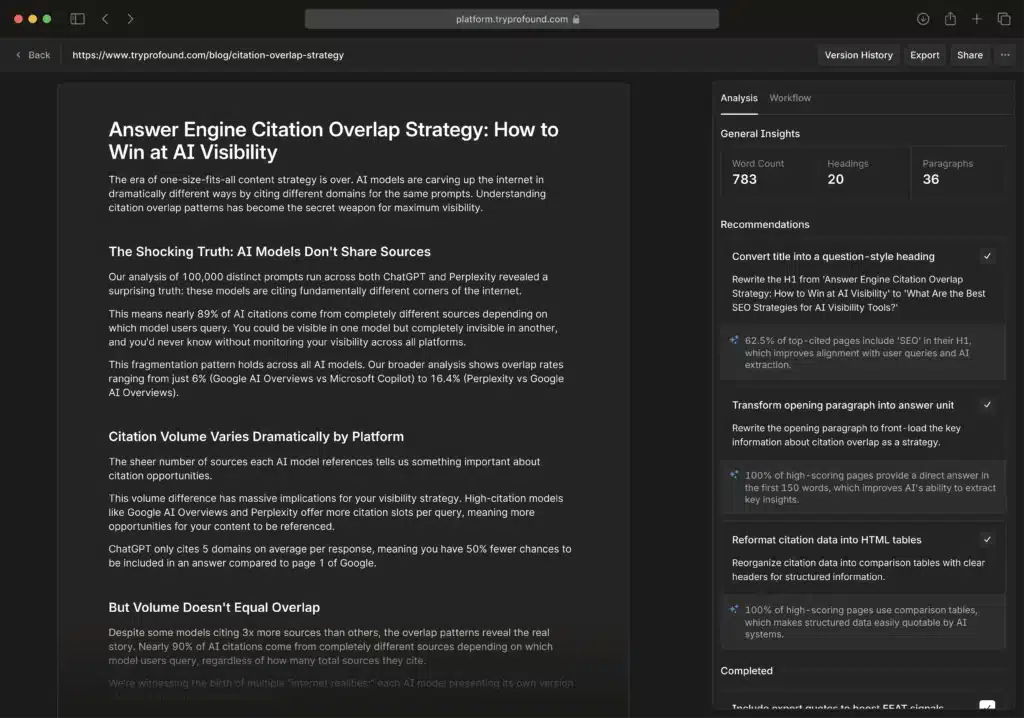
The Growth plan caps content generation at just 3 articles per month. The Starter plan has zero content generation capabilities.
If you have 50 keywords to optimize, Profound will help you fix 3 of them. For the other 47, you’re on your own. It’s a diagnostic tool, not an execution tool.
Hall AI’s Actionless Insights
Hall AI focuses on diagnostic insights. It excels at telling you why a page is performing poorly (e.g., “missing product schema” or “low crawl frequency”), but it stops short of helping you write the fix.
It identifies improvement opportunities based on citation patterns, but it doesn’t provide an editor, a brief builder, or a generative writing tool to help you execute those changes.
You have to take the data out of Hall AI and move it into a separate tool (like Google Docs or Jasper) to actually do the work.
→ Both platforms create a “now what?” problem. They’re excellent at showing you a visibility drop, but neither provides the robust content infrastructure needed to fix it at scale. You’ll likely need to purchase a separate content optimization tool to pair with either of them.
Which Platform Offers Better Data Retention?
If you’re trying to prove ROI to your board, you need historical context. You need to answer, “How has our visibility trended over the last year?”
Profound’s Unlimited History
Profound treats data like an enterprise asset. They offer all-time history across their plans.
You can look back to day 1 of your tracking to see year-over-year growth. This is important for Quarterly Business Reviews (QBRs).
Hall AI’s Time-Capped Data
Hall AI puts a strict limit on how long they keep your data. This forces you to upgrade if you want a longer memory.
Lite (Free): 3 months of history.
Starter ($239): 6 months of history.
Business ($599): 12 months of history.
Enterprise ($1,499): Unlimited history.
→ Profound is the clear winner for long-term strategic tracking. Hall AI is sufficient for “in-the-moment” debugging but lacks the archival depth unless you pay for the top tier.
How Do These Platforms Compare in Pricing?
The biggest barrier is financial. The pricing models of these two platforms reveal exactly who they’re trying to serve.
Hall AI’s Developer-Friendly Model
Hall AI wins on accessibility hands-down.
Lite Plan (Free): Hall AI offers a completely free plan. It allows you to track 1 project and 25 questions. This is perfect for developers or freelancers who need to run a quick audit or test the waters without a credit card.
Pricing Gap: However, there’s a massive gap in their pricing ladder. To move from the limited free plan to a serious tracking plan, you must jump straight to $239/month. There’s no “middle ground” for small teams.
Profound’s Enterprise-Only Model
Profound uses feature gating to force upgrades. It offers a limited “Try for Free” option on the Growth tier, but any meaningful use of the platform requires a subscription.
Starter Plan ($99/mo): This plan is severely limited (ChatGPT only). It serves as a paid demo rather than a functional tool for serious GEO.
Real cost: To get cross-platform tracking (Perplexity, Google, etc.) and reasonable volume, you’re forced into the $399/mo tier immediately.
→ If you have a zero budget, Hall AI is the only option. If you have $200, neither tool fits you well. Hall is too expensive, and Profound is too limited. If you have $500+ to spend, Profound offers the deeper enterprise feature set.
Which Platform Is Safer for Enterprise Teams?
When buying software for a large company, the decision is often made by IT and security, not by marketing.
Profound’s SOC2 Compliance
Profound passes the procurement test.
They heavily market their SOC 2 Type II compliance, which is a mandatory checkbox for most Fortune 500s.
Their Enterprise plan includes a dedicated AEO strategist and a private Slack channel. You effectively bring along a consultant when you invest in the Enterprise plan.
Hall AI’s Community Support
Hall AI’s support model is more typical of a SaaS startup.
The free plan relies on “community support.” You don’t get email support until the $239 tier, and you don’t get a customer success manager (CSM) until the custom Enterprise tier ($1,499+).
Features like SCIM and JIT provisioning (these are important for managing large teams via Okta/SSO) are locked behind the $599 Business tier.
→ If you need to get through a rigorous InfoSec review or need a human to help you execute the strategy, Profound is the safer bet. Hall AI is designed for self-serve teams who don’t need hand-holding.
How Easy Is It to Export Data?
Data is useless if it’s trapped in a dashboard. For agencies that need to create client reports or teams that want to integrate GEO data into their own business intelligence (BI) tools, data portability is a non-negotiable feature.
Hall AI’s Data Portability
Hall AI prioritizes data access, even on its lower tiers.
CSV exports: Hall AI lets you export your data in CSV format on both its Free and Starter ($239) plans. The platform respects the need for users to manipulate their own data.
Looker Studio integration: On the Business ($599) plan, Hall AI offers a native Looker Studio (now Google Data Studio) export. This is a massive advantage for technical agencies and data analysts who want to pipe GEO metrics into custom BI dashboards.
Profound’s Reporting Issues
While Profound’s dashboards are visually polished, verified users report significant limitations in getting the data out.
No exports on starter: The entry-level $99 plan has zero export options. You can view the data, but you can’t download it. You must upgrade to the $399 Growth plan to unlock CSV and JSON exports.
Reporting friction: Even on higher tiers, users complain about the reporting workflow. One G2 reviewer noted they “cannot export the beautifully designed reports,” which “forces me to resort to taking screenshots.” This is a major workflow bottleneck for teams that need to present data to stakeholders.
→ For agencies and data-driven teams who need to integrate GEO data into their own reporting stacks, Hall AI is the clear winner. Profound is great for users who are content to view the data exclusively within its own dashboard.
What Do Actual Users Say?
It’s the user reviews that reveal what using the software actually feels like, not sales demos. We analyzed verified feedback from G2 to identify the friction points you won’t see in a demo.
Hall AI’s Pros and Cons
Users praise Hall AI for its speed and real-time data, but the feedback confirms its positioning as a developer-first tool. Non-technical marketers struggle with the initial configuration.
Real-time visibility:Users value the immediacy of the insights, specifically for tracking “online presence” and “product impact” across AI platforms.
Automated collection:The automated data gathering is cited as a major time-saver for reporting and SEO strategy planning.
Responsive support:Users highlight that the support team is active and helpful with the product roadmap.
Complex setup:Multiple reviews cite “complex setup” and “learning difficulty,” specifically noting that it’s challenging for non-developers to onboard.
Weak sentiment view:Users find the current sentiment analysis view lacking in utility compared to other features.
Free tier limits:Users quickly hit data ceilings when trying to monitor multiple sites or APIs on the Lite plan.
Profound’s Pros and Cons
Profound users value the depth of the data for high-level strategy (”shaping initiatives’), but the reviews highlight significant usability and stability concerns for a tool at this price point.
Centralized intelligence:Users appreciate having all competitor mentions and visibility metrics in one place.
Strategic value:The data is frequently cited as valuable for high-level planning and understanding the broader market landscape.
Technical instability:Critical reviews mention broken tracking, billing errors, and features that simply don’t work properly.
Overwhelming UX:The dashboard is described as data-heavy and overwhelming, with a steep learning curve for new users.
Reporting friction:Users express frustration with the ability to easily export reports, often resorting to taking screenshots to share data with stakeholders.
The Third Option: Fix the Narrative Without the Enterprise Tax
If you’re a technical SEO debugging crawler behavior, Hall AI is your best choice. If you’re a Fortune 500 needing SOC2 compliance and historical reputation logs, Profound is the safe bet.
However, if you’re a content marketer or SaaS founder who simply needs to track visibility and fix the content gaps today, these tools might not be the solution. You’re either stuck with a free tool that only updates weekly (Hall AI Lite) or an expensive dashboard that refuses to help you write the content (Profound).
This leaves a gap for teams that need both the monitoring and the execution.
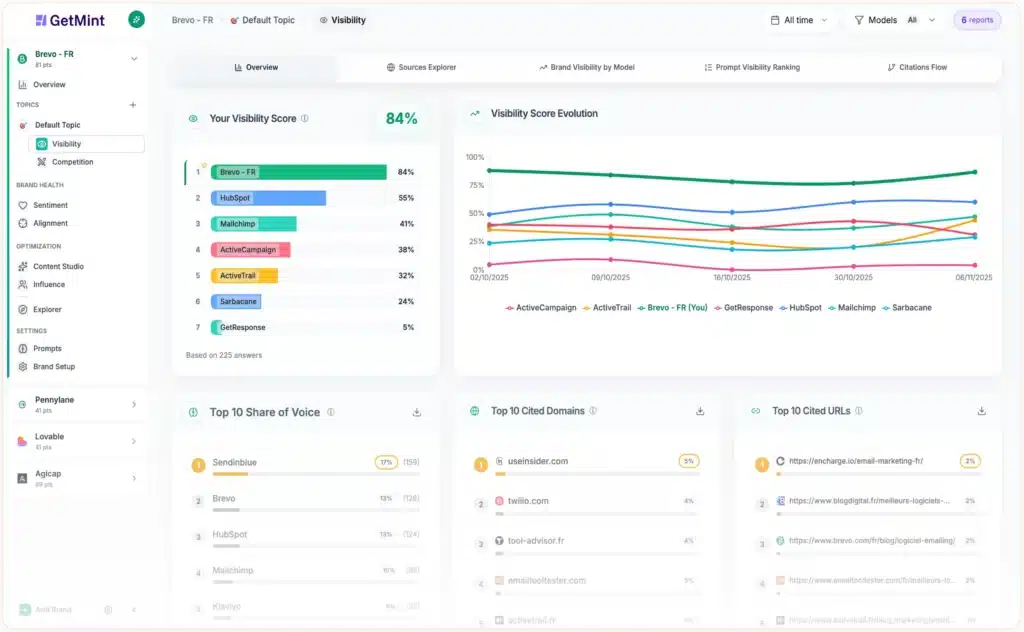
This is where GetMint fits in. It bridges that gap by removing the server log complexity of Hall and the gatekeeping of Profound. It’s built for teams that need actionable narrative intelligence, not just charts.
1. Professional Entry Price Point
Hall AI forces you to jump from free (weekly updates) to $239 (daily updates). Profound’s $99 plan limits you to ChatGPT only.
→ GetMint’s starter plan (€99) includes daily updates and access to the big three engines (ChatGPT, AI Overviews, and Perplexity) standard. It gives you 3x the visibility for the same entry price as Profound.
2. Built-In Content Studio
Profound caps content generation at 3 articles/month. Hall AI offers “insights” but no writing tools. Both force you to buy separate software to actually do the work.
→ Content optimization and creation are included on every GetMint plan. If you find a negative sentiment or a visibility drop, you can generate an optimized brief and content draft immediately within the platform.
3. Marketer-First Dashboard
Hall AI is technical (crawler/shopping focus). Profound is analytical (reputation/thematic focus).
→ GetMint is designed for action. The dashboard shows you raw data, runs an automated SWOT analysis to tell you exactly how the AI frames your brand vs. your competitor, suggests areas that need immediate attention, and provides you with a one-click “generate content” button to fix gaps.
Final Verdict: Which Platform Is Right for You?
Here’s how the three platforms stack up when you compare their entry-level professional tiers.
Feature | Profound (Starter) | Hall AI (Starter) | GetMint (Starter) |
|---|---|---|---|
Monthly Price | $99 | $239 | €99 |
Engines Included | 1 | 3 | 3 |
Tracked Prompts | 50 | 500 | 50 |
Tracked Languages | 1 | 1 | 2 |
Content Creation | | |  |
Technical Focus | Site Health (Lighthouse) | Bot Traffic (Logs) | Content Strategy |
E-Commerce Tools | | | |
Best For | Enterprise Reputation | Tech SEO & E-Com | Agile Content Teams |
So, which one should you choose? That depends on your needs. Here’s a quick buying guide:
Choose Hall AI if you’re a technical SEO needing to debug crawler activity or an e-commerce brand tracking ChatGPT hopping results.
Choose Profound if you’re a large enterprise that requires historical reputation data (12+ months) and a dedicated account strategist.
Choose GetMint if you want to track the most important AI engines today, optimize your content immediately, and avoid the enterprise tax.
While Profound and Hall offer specialized solutions for executives and developers, GetMint provides the integrated workflow that connects analysis to action. Don’t just watch the bots; control the narrative. Run your AI visibility audit with GetMint today.
START FREE. NO CREDIT CARD REQUIRED.
Your competitors are already visible in AI. Are you?
See what ChatGPT, Gemini and Perplexity say about your brand. Set up in 5 minutes.

