


Nearly 60% of all Google searches in the US/EU in 2024 ended without the user ever clicking on a website link. When people get their answers directly on the results page, the only way to reach them is to own the answer box itself.
Choosing the right software to do this is difficult. The market for Answer Engine Optimization (AEO) tools is full of platforms designed for different goals, which makes it hard to know which ones are built for the Google Search Engine Results Page (SERP) versus other AI platforms.
To help you choose the right platform for this specific job, we tested the top options available. Here are the 5 best answer engine optimization tools focused on winning featured snippets and other answer-driven results on Google.
What Is Answer Engine Optimization (AEO)?
Answer Engine Optimization (AEO) refers to the practice of optimizing content so that it can be directly surfaced by answer-oriented search and AI systems, rather than just being one link in a list of results.
It focuses on providing the answer to a user’s question, not merely trying to rank for a keyword.
The 5 Best AEO Tools for Google SERP Visibility
These five tools are the best on the market for the specific job of winning answer-focused results on Google.
Each has specific strengths, from all-in-one tracking to specialized technical implementation to help with your AEO strategy.
| Tool | Best Use-Case | Main Differentiator | Best For |
|---|---|---|---|
| Semrush One | Unified SEO + AI/answer engine visibility | One workspace for tracking classic SERPs + emerging AI/answer surfaces | Teams managing both traditional SEO and answer engine strategy |
| Ahrefs | Competitor analysis for featured snippets | Strong reverse-engineering of what competitors own in answer boxes | Teams focused on snippet capture via competitor insight |
| Moz Pro | SERP feature/GEO tracking + local keyword depth | Good blend of answer-feature tracking and local search reach | Businesses with local/multi-location presence |
| AlsoAsked | Research into user questions (PAA data) | Visual mapping of “People Also Ask” question clusters | Content teams building answer-first editorial strategies |
| SchemaApp | Structured data/entity-linking readiness for answer engines | Focus on schema markup and knowledge-graph entity linking | Organizations scaling technical AEO foundations |
If you’re exploring tools for AI-model visibility rather than classic SERP answer features (AEO), see platforms such as GetMint.
1. Semrush One – Best For Unified SEO and AI Visibility
Semrush One is the platform’s latest evolution that unifies traditional Search Engine Optimization (SEO) capabilities with AI-driven visibility. It currently sits at 4.5/5 stars across 2,850+ reviews on G2.
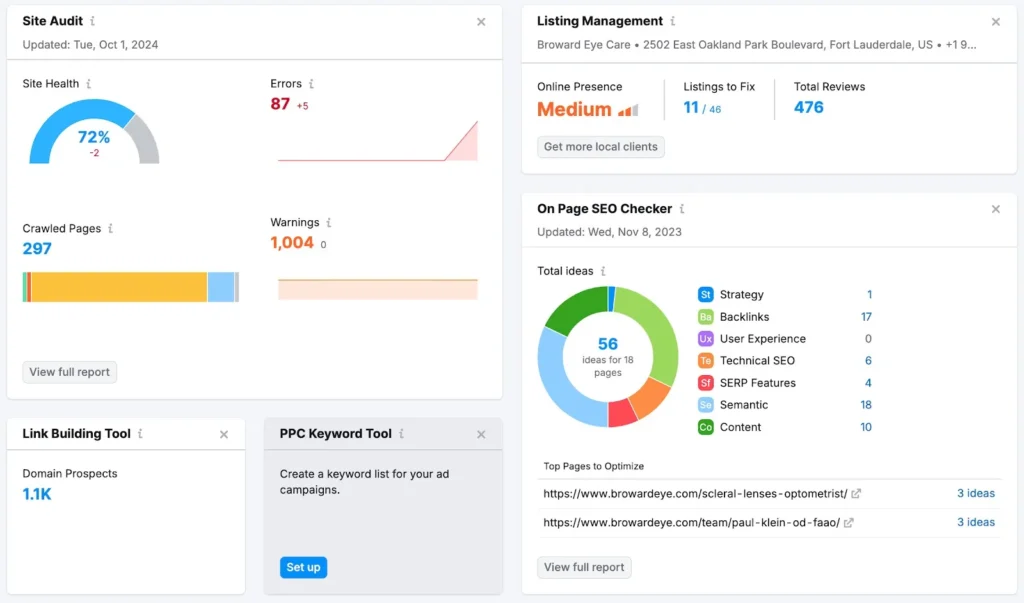
It aims to give teams focused on AEO one workspace for tracking how your content performs not only in classic SERPs but also in emerging discovery engines.
AEO Features
- Unified tracking: Connects your domain’s performance on traditional Google SERP features with insights into how your brand appears in AI-driven discovery surfaces (e.g., AI Overviews and LLM responses).
- Prompt and brand-mention monitoring: Lets you track specific user prompts/queries and see how often your brand or content appears in the resulting AI answers or LLM responses.
- Technical audit checks: Includes features aimed at evaluating whether your site is well-prepared for AI discovery (e.g., checking for AI bot accessibility and crawl readiness).
Pricing
- Starter: $199/mo
- Pro+: $299/mo
- Advanced: $549/mo
- Free trial available
Our Take
For teams that want to manage both traditional SEO and the emerging answer engine/AI visibility challenge, Semrush One is a strong option.
It might not guarantee that you’ll immediately “win” every answer box, but it helps you see where you stand and what the opportunities are.
Your results may vary by niche and geography, as this field continues to evolve.
2. Ahrefs – Best for Competitor Analysis for Featured Snippets
Ahrefs is best known for its backlink analysis, but it also offers tools that help with AEO, especially for teams focused on competitor strategy. It’s sitting at 4.5/5 stars across 600+ reviews on G2.
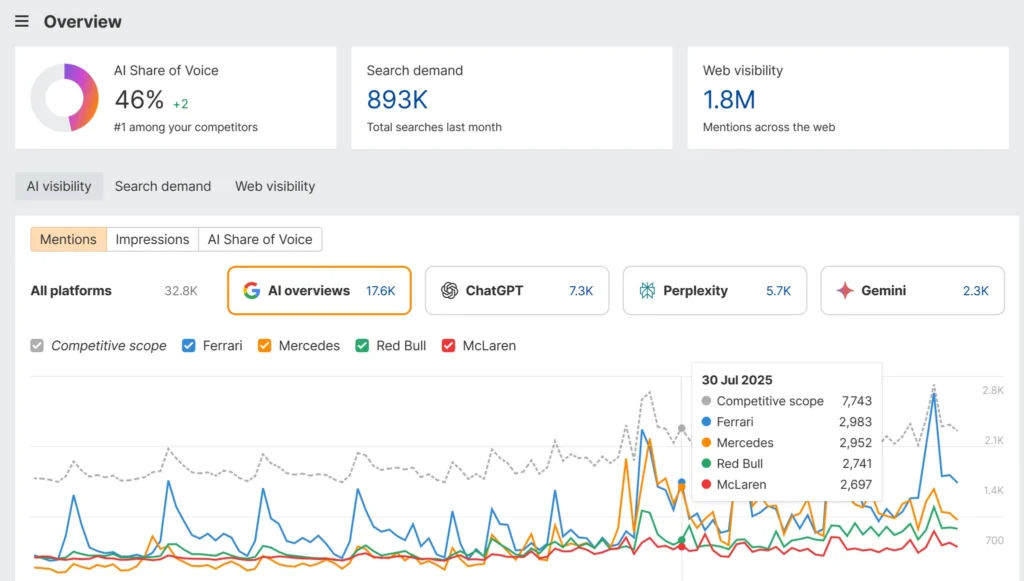
Its strength lies in surfacing exactly where your competitors are winning featured snippets, which makes it ideal for reverse-engineering their content tactics.
AEO Features
- Site explorer: Reveals the exact keywords for which competitors own featured snippets, allowing you to identify and target high-value opportunities.
- SERP overview: Shows which pages rank in answer boxes and how they’re structured, helping you model your own content accordingly.
- Keyword explorer: Highlights keywords with featured snippet potential, including question-based queries and long-tail formats.
Pricing
- Starter: $29/mo
- Lite: $129/mo
- Advanced: $449/mo
- Enterprise: $1,499/mo
Our Take
If your AEO strategy centers on outperforming competitors in featured snippets, Ahrefs is a very strong tool. It’s built for strategic insight and is ideal for teams that want to reverse-engineer success and act fast.
3. Moz Pro – Best for SERP-Feature Tracking and Local Keyword Reach
Moz Pro is a trusted platform for SEO teams that need to align AEO with local search strategy. Over 600 reviews on G2 have brought its rating to 4.3/5.
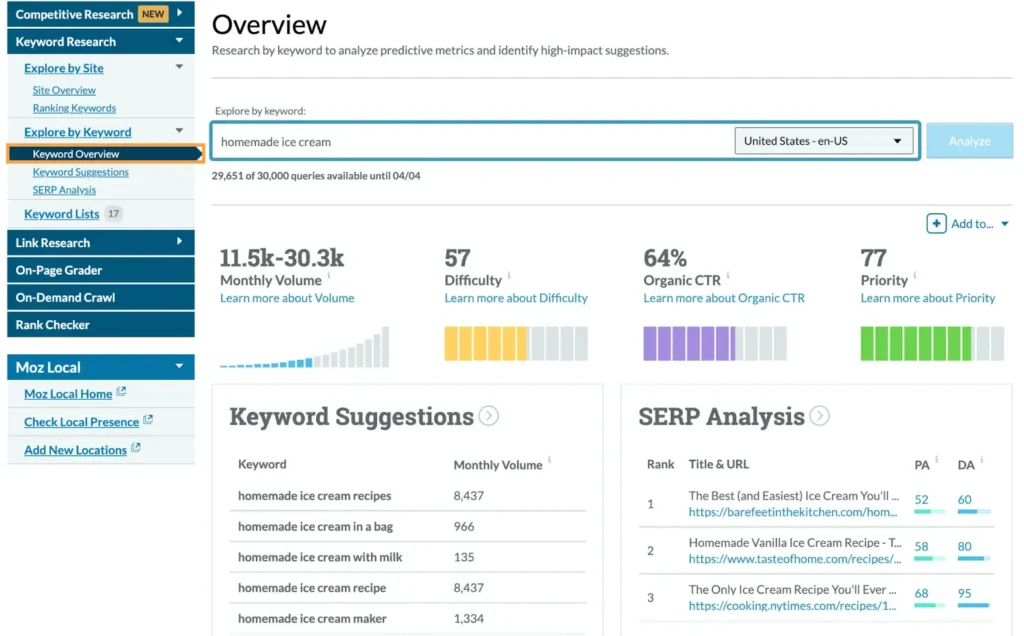
Its tools offer strong support for tracking SERP features and local keyword tracking capabilities, which makes it useful for teams balancing answer-box optimization with regional search visibility.
AEO Features
- SERP feature tracking: Moz Pro allows you to monitor visibility across multiple non-standard search result types (e.g., Featured Snippets, Knowledge Panels, and Related Questions) for your tracked keywords.
- Local keyword-level tracking: You can specify locations (city- or postal-code-level) for keywords in Moz Pro Campaigns, which helps if you’re competing in local search markets.
- Intent-based keyword research: Using Moz’s Keyword Explorer and rank tracker, you can identify and monitor question-based queries or long-tail keywords that may trigger answer boxes or PAA-like features, even at a local level.
Pricing
- Starter: $49/mo
- Standard: $99/mo
- Medium: $179/mo
- Large: $299/mo
- Free trial available
Our Take
If your business has a strong local or multi-location component (for example, a service provider covering cities or ZIPs), Moz Pro gives you a pragmatic set of features for both SERP-feature tracking and local keyword reach.
It’s not as deeply focused on large-scale AI-visibility data (as some newer tools), but it’s a solid bridge between standard SEO, local search, and answer feature awareness. You’ll notice that its capabilities on AI overviews and AI citations are weaker compared to others.
4. AlsoAsked – Best for Research Into “People Also Ask” Data
AlsoAsked is a niche but useful tool built specifically for exploring the question-based structure of Google’s “People Also Ask” (PAA) feature.
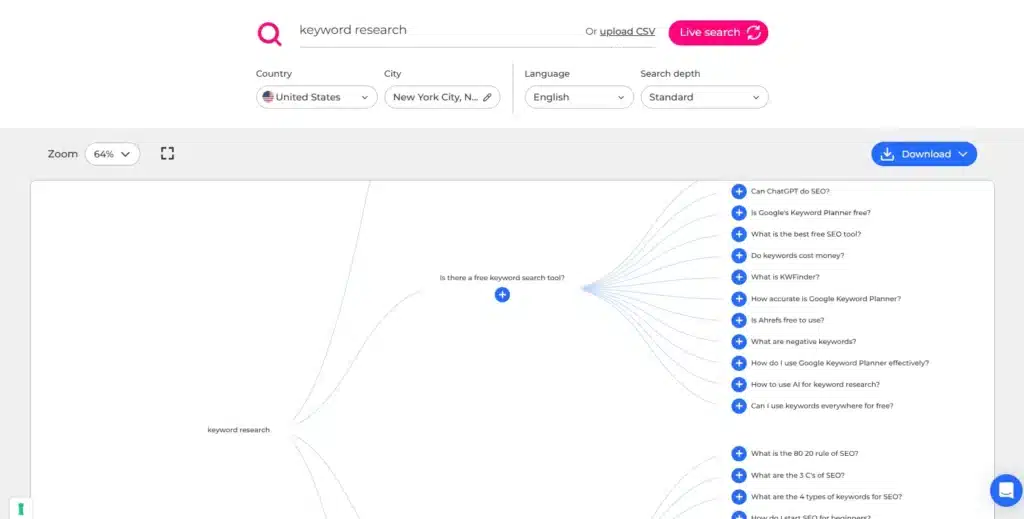
It’s made for deep research rather than tracking, which makes it ideal for content teams that want to understand how users frame their queries and how Google clusters related questions.
AEO Features
- Keyword mapping: Takes a single keyword and generates a branching diagram of related PAA questions.
- Visual structure: Helps you see how questions are grouped and sequenced, revealing content gaps and clustering logic.
- Expert options: Allows you to download question maps for editorial planning and stakeholder presentations.
Pricing
- Basic: $12/mo
- Starter: $23/mo
- Pro: $47/mo
- Limited testing available
Our Take
While it doesn’t track rankings or SERP performance, AlsoAsked is unmatched in its ability to surface the real questions users are asking. For AEO-focused content creation, it’s the clearest tool for building answer-first editorial strategies.
5. SchemaApp – Best for Structured Data and Entity Linking for AEO Readiness
SchemaApp is a specialized tool for deploying, managing, and scaling structured data markup and entity-linking workflows. It’s currently rated 4.7/5 across a little bit over 15 reviews on G2.
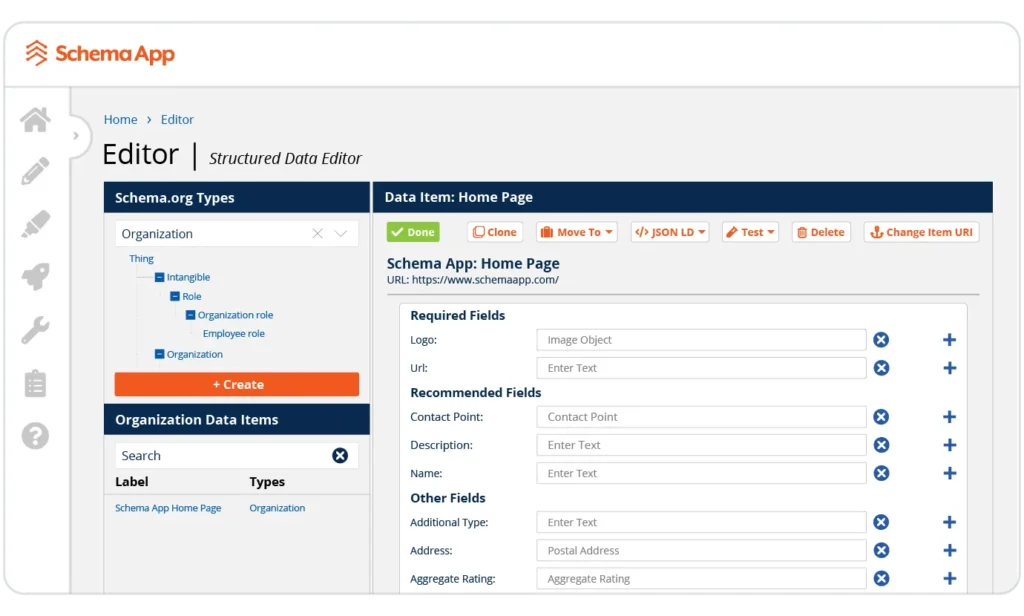
This is important for making your content clear, easy to understand, and ready to be found by search engines and answer platforms. It helps connect ideas in a way that makes sense to both people and machines, so your information shows up accurately wherever it’s needed.
AEO Features
- Automated schema deployment: SchemeApp enables non-developers (or developers with minimal effort) to apply JSON-LD markup types (FAQPage, HowTo, Product, etc.) and maintain them at scale.
- Maintenance and audit capabilities: SchemaApp offers monitoring and entity performance analytics so you can check how well your structured data is deployed and whether it’s helping with visibility.
- Entity linking/knowledge-graph signaling: The tool supports External Entity Linking (EEL), which automatically identifies named entities in your content and associates them with authoritative knowledge-base identifiers (e.g., Google Knowledge Graph) to clarify the meaning of your content for machines.
Pricing
SchemaApp’s pricing is quote-based and varies depending on your enterprise’s needs. Demo-scheduling is available.
Our Take
Structured data and entity clarity don’t by themselves guarantee you’ll land the featured snippet or PAA box, but they form an important part of the technical foundation for AEO.
If your content team is ready to scale markup, invoke entity context, and reduce ambiguity, SchemaApp is the most complete solution on the market.
It removes implementation friction and ensures your content sends the right signals to Google at scale.
How to Choose the Right AEO Tool
The most important step in choosing a tool is understanding what job you need it to do. A true AEO tool is focused on one primary goal: winning the answer-focused features on the Google SERP.
It’s important not to confuse this with another category of software: Generative Engine Optimization (GEO) tools. GEO tools are designed to track citations and mentions in conversational AI platforms like ChatGPT. That’s a different, though related, discipline.
For a tool to be effective at AEO on the Google SERP, it should preferably have capabilities in these four areas:
- Featured snippet tracking. The tool must be able to identify which of your keywords are ranking in the “Position Zero” featured snippet and, just as importantly, which of your competitors’ keywords are.
- “People Also Ask” (PAA) analysis. It should provide data and insights into the question-and-answer ecosystem around your topics, helping you discover new content opportunities to target the PAA box.
- AI overview monitoring. As Google rolls out AI overviews more broadly, the ability to track when your content is being used as a source in these summaries is becoming important.
- Structured data capabilities. The best tools either help you generate Schema markup or track the performance of pages that have it, as this structured data helps you win rich answers.
Some tools try to be the all-in-one solution you need, whereas others focus on one capability and try to be the best at it, so make your choice based on your specific needs.
When to Look Beyond AEO Tools
The AEO tools we’ve covered are the best on the market for winning answer-focused results on the Google SERP. They provide the data you need to own the featured snippets and “People Also Ask” boxes that you need to reach users in a zero-click environment.
But visibility on Google is only one part of a modern search strategy. The next frontier is tracking your performance inside conversational AI platforms like ChatGPT and Perplexity, and the tools listed above can be lacking in that specific department.
To see that other half of the picture, you need a dedicated GEO platform. While AEO tools focus on the SERP, GEO platforms are built to monitor the conversations happening inside AI models.
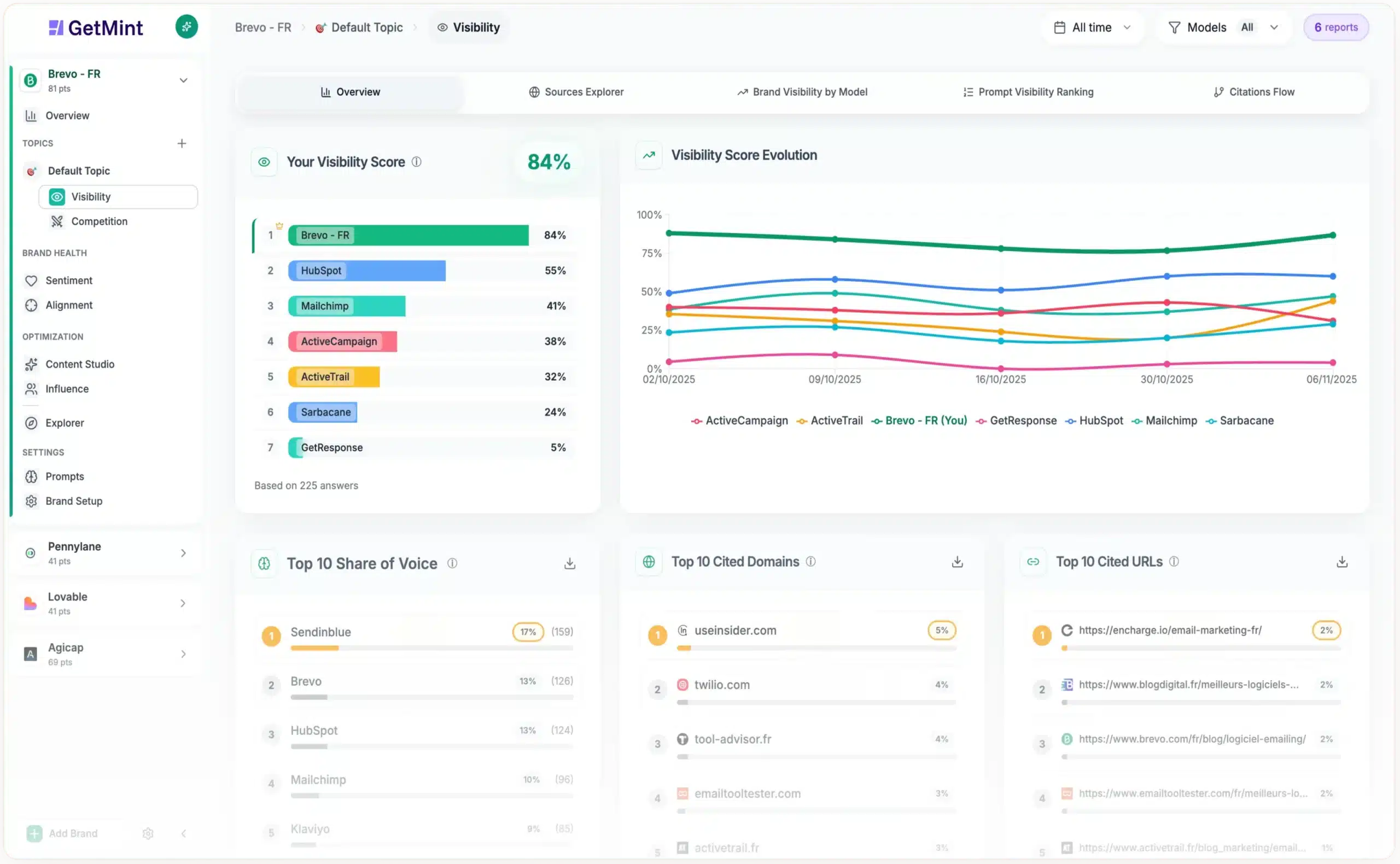
GetMint is a specialized GEO platform that gives you a complete picture of your AI footprint. It allows you to:
- Track the citations and mentions that AEO tools miss, showing you when your brand is being used as a source or recommended by name in conversational AI.
- Monitor your visibility across all major AI platforms, not just the Google SERP.
- Benchmark your performance against competitors to see who is owning the conversation in your niche.
When you’ve optimized for SERP and want to extend to conversational AI platforms, GetMint will provide the data you need to maximize your visibility. Run your AI visibility audit today and see the complete picture.
Frequently Asked Questions (FAQs)
Do I need a standalone AEO tool if I already use Semrush or Ahrefs?
For most teams, no. Your primary SEO suite like, Semrush or Ahrefs, is your AEO tool, as their position tracking and keyword research features are essential for winning featured snippets.
You may, however, add a specialized tool like AlsoAsked for deeper, question-based research or SchemaApp for advanced technical implementation.
What is the difference between an AEO tool and a GEO tool?
AEO tools focus on winning answer-focused results on the Google SERP, such as Featured Snippets and “People Also Ask” boxes. GEO tools focus on tracking your visibility inside conversational AI platforms like ChatGPT and Perplexity.
If your goal is to track AI citations and mentions, you need a dedicated GEO tool.
Can these tools track Google’s AI Overviews?
Yes, this is becoming a standard feature. The major platforms like Semrush and Ahrefs are actively integrating AI Overview tracking into their toolsets.
As AI Overviews become more common, the ability to monitor when your content is being used as a source is an important AEO capability.
How long does it take to see results from AEO?
You can see the impact of tactical changes, like optimizing an existing high-authority page for a specific featured snippet, in as little as a few weeks.
However, building the foundational topical authority needed to consistently win answer boxes for competitive keywords is a long-term strategic effort that typically takes six months or more.

