
Dec 4, 2025
The 5 Best Tools for Monitoring AI Overviews (2026 Review)
When an AI Overview appears, the #1 organic result for an informational keyword can lose as much as 34.5% of its clicks.
These AI-generated summaries answer questions directly, which changes how people search. The downside is that your rank tracker doesn’t measure this, leaving a blind spot in your data and making it hard to know if your content is really visible.
Based on our hands-on testing, we review the best tools for monitoring AI Overviews to help you see exactly where you stand, diagnose performance issues, and build a strategy to win in this new search landscape.
What Are Google AI Overviews?
Google AI Overviews are AI-generated summaries that appear at the top of the search engine results page (SERP). They provide a quick, direct answer to a user’s question by drawing information from multiple web pages.
Instead of having to click and read several links, a user can theoretically get everything they need from this one block of text.
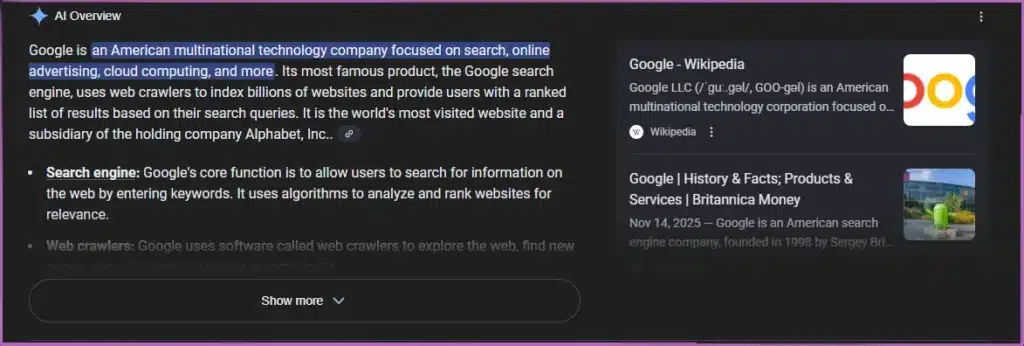
Although this is useful for users, it creates a problem for businesses and publishers. These summaries effectively become the new “position #1,” and they’re highly competitive.
An AI Overview (AIO) typically shows 8 sources per response. Sometimes, that figure ranges between 6 and 14, but visibility remains scarce. Plus, since over 88% of queries that trigger them are informational, they capture a huge portion of top-of-funnel (TOFU) search intent.
If your site isn’t being used as a source, you’re invisible to a growing segment of your audience at a critical stage of their journey.
You can learn more about optimizing for answer engines by reading our Answer Engine Optimization (AEO) guide.
The 5 Best Tools for Monitoring AI Overviews
We spent weeks testing the most popular AI Overview trackers to see which ones deliver real strategic value versus those that are just basic rank checkers with a new label.
Tool | Best For | Starting Price | Starting Engines | Unique Feature | Free Trial |
|---|---|---|---|---|---|
GetMint | Strategic marketing teams | 99€/mo (50 prompts) | 3 | Tracks the full AI ecosystem (Google, ChatGPT, etc.) |  |
Omnia | Enterprise analytics teams | €79/month | 7 (ChatGPT, AI Overviews, AI Mode, Perplexity,Claude, Gemini, and Copilot) | Advanced (AI + SEO mentions, competitor benchmarking) | |
Thruuu | Content teams and SEOs | $19/month (75 credits) | 1 | Deep content and source URL analysis | |
Ziptie | Simple keyword monitoring | $69/mo (500 AI searches) | 3 | AI assistant for keyword discovery | |
SE Ranking | Existing SE Ranking users | ~$136/mo (Base + Add-on, 200 prompts) | 5 | Integrated into a complete SEO platform | |
Note: This guide focuses on Google AI Overviews because they directly impact search traffic. However, advanced platforms also track standalone LLMs (like ChatGPT or Perplexity).
1. GetMint – Best for Strategic Marketing Teams
GetMint is the right platform for businesses that need to measure the complete impact of AI on their brand. It offers the most strategic view by putting AIO performance in the context of your overall AI visibility.
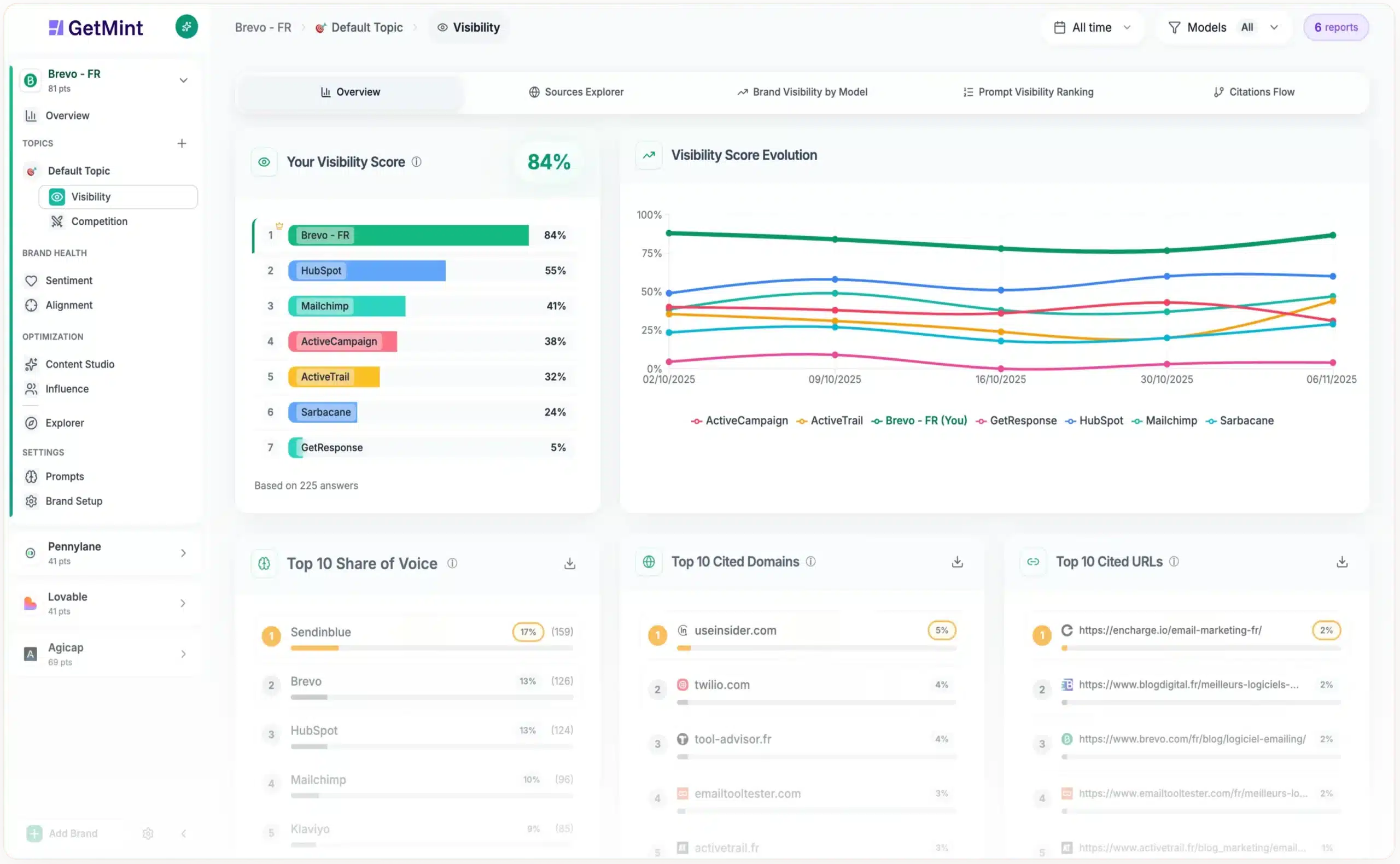
It’s built for teams who understand that Google AI Overviews are just one part of a much larger AI landscape. Its main purpose is to track brand visibility across all major generative engines (including ChatGPT, Perplexity, and Claude) and display that data in a single dashboard.
This solves the problem of siloed data, where your AIO report might look positive while you’re losing ground on other AI platforms where customers are asking high-intent buying questions. It connects your Google Performance to the places where purchase decisions are actually being influenced.
AIO Features
Cross-engine visibility: Tracks your brand’s mention rate, sentiment, and share of voice across Google AIOs, ChatGPT, Perplexity, and more.
Source explorer: Lets you enter a query and immediately see the exact URLs being cited in the AIO, which helps you with content optimization.
Competitive share of voice: Benchmarks your AIO mention frequency against your top competitors for the keywords you care about most.
Sentiment analysis: Tells you if your brand is being described positively, neutrally, or negatively in AI-generated answers, which is an important metric for brand health.
Pros
Tracks the full AI ecosystem, not just Google AIOs.
Provides strategic metrics like brand sentiment and share of voice.
Directly connects AIO performance to your visibility on other AI engines.
Cons
May have more features than needed for teams only interested in basic AIO tracking.
Pricing is positioned higher than entry-level, AIO-only tools like Thruuu, due to its broader feature set.
Pricing
Starter: 99€/month (50 prompts)
Growth: 299€/month (200 prompts)
Enterprise: 549€/month (custom)
2. Omnia – Best for Teams That Want AI Visibility + Actionable Recommendations
Omnia is an AI visibility platform that tracks brand presence across Google AI Mode, Google AI Overviews, ChatGPT, and Perplexity. The platform is designed for marketing and SEO teams that want visibility tracking combined with practical optimization recommendations.
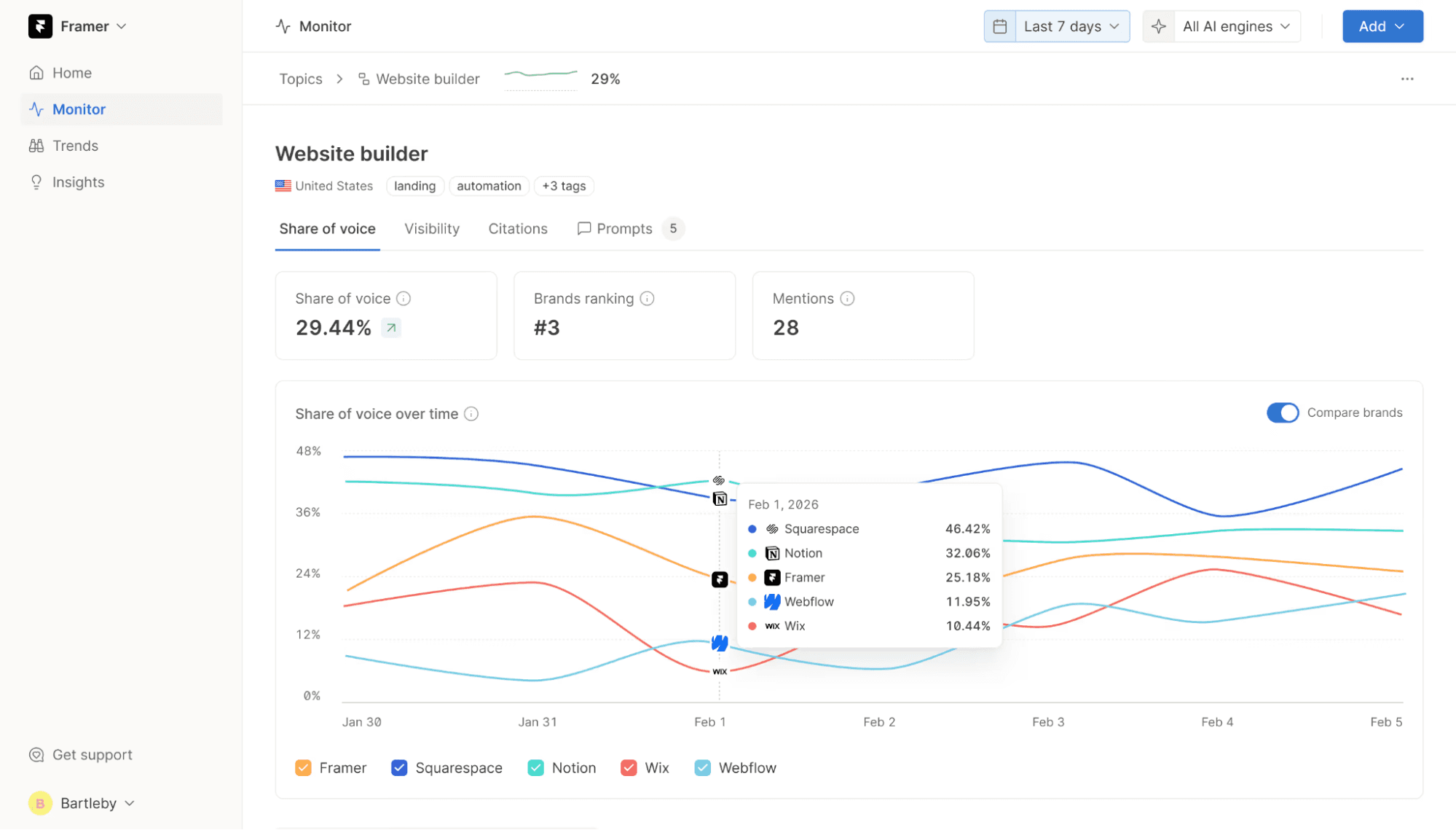
Omnia dashboard tracking AI visibility, citations, and competitor share of voice across AI engines
What makes Omnia stand out is its focus on turning visibility data into actionable next steps. The platform analyzes citation gaps, tracks competitor mentions, and recommends what content should be updated, expanded, or created to improve AI visibility.
Omnia also uses real browser simulations rather than relying only on APIs, helping teams see AI responses closer to how actual users experience them.
AIO Features
AI visibility tracking: Monitors brand visibility across Google AI Mode, Google AI Overviews, ChatGPT, and Perplexity.
Citation analysis: Tracks which sources AI engines rely on and where competitors are being cited.
AI Prompt Discovery: Finds real AI search prompts and customer questions.
Competitor benchmarking: Compares share of voice and citation frequency across competitors.
Action recommendations: Suggests content improvements and new content opportunities.
Pros
✅ Covers multiple AI engines in one platform.
✅ Includes practical optimization recommendations, not just monitoring.
✅ AI Prompt Discovery helps uncover real AI search behavior.
✅ Unlimited countries and brands across plans.
Cons
❌ Better suited for dedicated marketing teams than solo creators.
❌ Some advanced features are still rolling out.
Pricing
Growth: €79/month
Pro: €279/month
Enterprise: Custom pricing
3. Thruuu – Best for Content Teams and SEOs
Thruuu is the best tool for content-focused SEOs who want to understand why certain pages are being chosen as AIO sources and how to optimize their content to compete.
It’s also one of the only SEO tools that specifically focus on AIO and let you generate content briefs based on them. However, to actually use these features, you need to invest in the Pro ($49/mo plan).
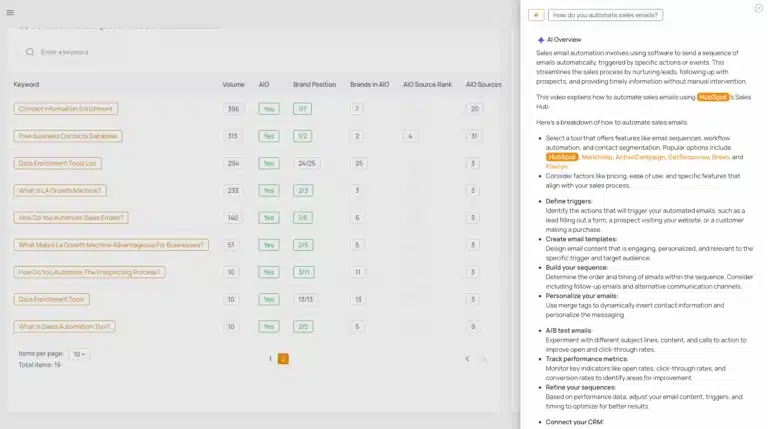
The platform is designed for deep content analysis. While other tools report if an AIO is present, Thruuu breaks down the content within the AIO and its cited sources.
To use it, you input a list of keywords, and the tool analyzes the on-page data from the URLs Google is citing. It extracts common terms, questions, and topics to give you a blueprint for what a successful piece of content looks like for that query.
This makes it highly effective for content teams who need to reverse-engineer a winning strategy.
Pro Tip: A smart way to use a tool like Thruuu is to find keywords where your domain is cited as a source but your brand isn’t mentioned in the summary. This is a quick-win opportunity to update your content and make your brand and value proposition more explicit.
AIO Features
Source content analysis: Scrapes and analyzes the content of URLs cited within AI Overviews to show you what topics to cover.
Brand mention tracking: Identifies both your brand and competitor mentions inside a summary.
Integrated content briefs: Uses the AIO source data to help you generate data-driven content outlines.
SERP preview: Provides a live preview of the search results and AIO for any country without needing a VPN.
Pros
Excellent for deep content and source URL analysis.
Integrated content briefs help streamline content creation.
Very affordable entry-level pricing.
Simple, user-friendly interface focused on one job.
Cons
Only tracks Google AI Overviews
AIO tracking features aren’t available on the $19 Starter plan; they require the Pro ($49/month) plan or higher.
Pricing
Starter: $19/month (75 credits)
Pro: $49/month (250 credits)
Agency: $99/month (700 credits)
4. Ziptie – Best for Simple Keyword Monitoring
Ziptie is a solid, no-fluff AI Overview tracker for marketers who need a simple way to monitor a specific list of keywords and competitors, particularly if they operate in one of the countries Ziptie supports.
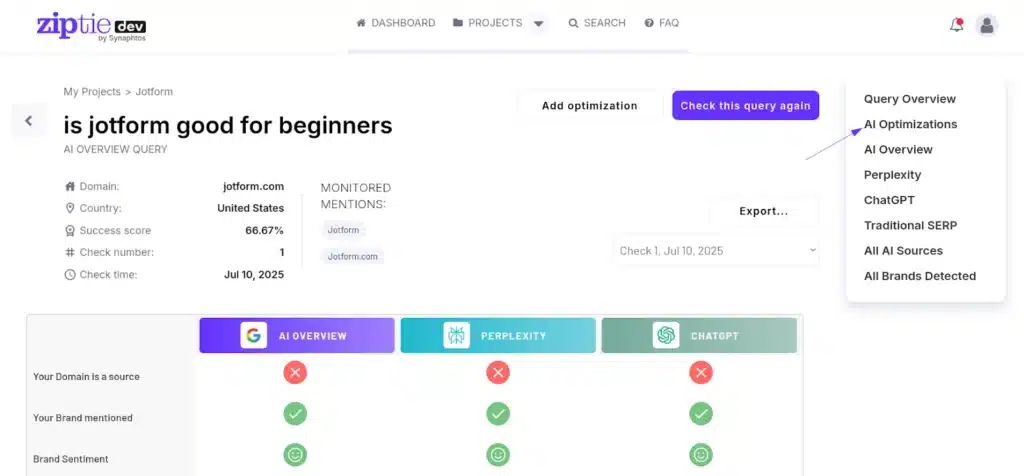
Ziptie was one of the first dedicated AI Overview trackers on the market, and it focuses on providing a straightforward monitoring experience.
Its primary differentiators are its AI assistant for keyword discovery and its tracking support for a handful of international markets. The dashboard gives you a clean summary of your AIO presence and a share of voice graph to see how you stack up against the competitors you’ve chosen to track.
AIO Features
AI keyword assistant: You can give it your domain and it will generate a list of keyword ideas to monitor.
Scheduled monitoring: Allows you to set up recurring AIO checks at intervals like daily or weekly to automatically track changes.
Share of voice graph: Visualizes your AIO presence in a simple bar chart compared to your competitors.
Multi-country tracking: Offers tracking support for roughly 10 different countries.
Pros
Simple, easy-to-use interface for straightforward monitoring.
AI assistant is helpful for initial keyword brainstorming.
Allows for scheduled, recurring checks for ongoing insights.
Imports keywords from Google Search Console
Cons
Users have reported performance delays during checks.
Limited to tracking in only 6 countries, including the US, UK, and Canada.
Pricing
Basic: $69/month (500 AI searches)
Standard: $99/month (1,000 AI searches)
Pro: $159/month (2,000 AI searches)
5. SE Ranking – Best for Existing SE Ranking Users
SE Ranking is a convenient choice for enterprise or agency clients who are already heavily invested in the ecosystem and prefer the simplicity of a single invoice over cost savings. However, for smaller teams, the add-on price is high relative to the number of prompts provided.
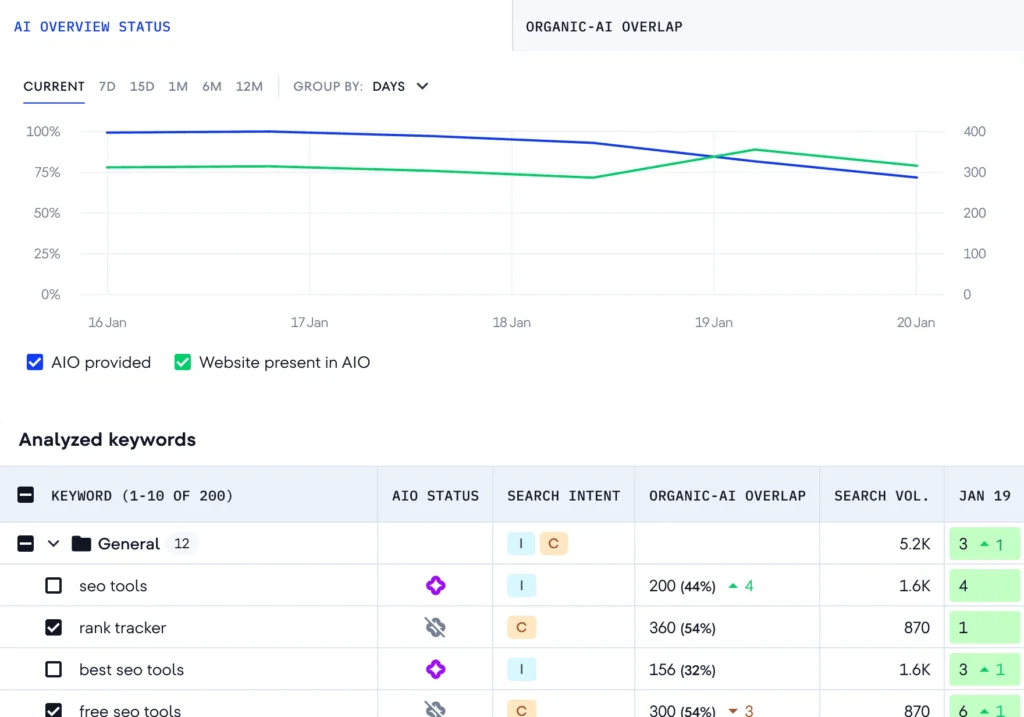
For teams already using SE Ranking for SEO, their AI Overview Tracker is a well-integrated feature that keeps your workflow streamlined. It allows you to monitor your domain’s presence in AI mentions and source links directly alongside your traditional keyword rankings.
Note that the AI search is a paid add-on. It’s not part of the base subscription.
The main advantage here is consolidation. Even though it requires an extra investment, having AI data located in the same dashboard as your site audits and backlink reports is ideal if you want to keep your tech stack minimal and avoid managing another login.
Pro Tip: Use SE Ranking to create a custom dashboard that places your AIO visibility widget next to your traditional organic traffic and rankings reports. This allows you to instantly correlate a drop in traffic to a competitor appearing in the AIO for a target keyword, giving you a complete performance picture in one view.
AIO Features
Integrated SEO suite: AIO tracking data is presented within the same dashboard as your other rank tracking projects.
Historical data: Tracks your AIO presence and source link performance over time so you can spot trends.
Competitor monitoring: Shows you which of your competitors are being featured in AI Overviews for your tracked keywords.
Pros
Seamless integration for existing SE Ranking customers.
Combines AIO data with all other traditional SEO metrics in one place.
Tracks visibility across all countries where the feature is available.
Cons
The AI feature alone starts at around $71/month just for 200 prompts, which effectively doubles the monthly bill for users on the “Essential” plan.
Scaling up to 1,000 prompts pushes the add-on price to $276/month, which is steeper than many dedicated GEO platforms.
Pricing
Essential: $65/mo
Pro: $119/mo
Business: $259/mo
AI Search: $71.20/mo (200 prompts), $143.20/mo (450 prompts), $276/mo (1,000 prompts)
5. Omnia – Best for Teams That Want AI Visibility + Actionable Recommendations
Omnia is an AI visibility platform that tracks brand presence across Google AI Mode, Google AI Overviews, ChatGPT, and Perplexity. The platform is designed for marketing and SEO teams that want visibility tracking combined with practical optimization recommendations.
Omnia dashboard tracking AI visibility, citations, and competitor share of voice across AI engines
What makes Omnia stand out is its focus on turning visibility data into actionable next steps. The platform analyzes citation gaps, tracks competitor mentions, and recommends what content should be updated, expanded, or created to improve AI visibility.
Omnia also uses real browser simulations rather than relying only on APIs, helping teams see AI responses closer to how actual users experience them.
AIO Features
AI visibility tracking: Monitors brand visibility across Google AI Mode, Google AI Overviews, ChatGPT, and Perplexity.
Citation analysis: Tracks which sources AI engines rely on and where competitors are being cited.
AI Prompt Discovery: Finds real AI search prompts and customer questions.
Competitor benchmarking: Compares share of voice and citation frequency across competitors.
Action recommendations: Suggests content improvements and new content opportunities.
Pros
✅ Covers multiple AI engines in one platform.
✅ Includes practical optimization recommendations, not just monitoring.
✅ AI Prompt Discovery helps uncover real AI search behavior.
✅ Unlimited countries and brands across plans.
Cons
❌ Better suited for dedicated marketing teams than solo creators.
❌ Some advanced features are still rolling out.
Pricing
Growth: €79/month
Pro: €279/month
Enterprise: Custom pricing
How to Pick the Right AI Overviews Monitoring Tool for Your Team
Choosing the “best” tool depends entirely on your business goals, your team’s workflow, and your budget. A platform that’s perfect for a large analytics team, like seoClarity, might be overkill (and too expensive) for a small content group. Use these points as a framework to make the right choice.
1. Start with Your Goal
First, consider your primary objective. Are you defending traffic or building a brand?
→ If you’re defending traffic, your main concern is protecting the clicks coming to your existing high-ranking pages.
For this, you need a tool with strong source URL tracking to see exactly which content you’re competing against.
Tools like Thruuu and GetMint are effective here because they let you drill down into the specific sources Google is citing.
→ If you’re building a brand, your goal is broader.
You need to understand how your brand is perceived across the entire AI ecosystem.
This requires features like sentiment analysis and cross-platform visibility to know how you’re being described on Google, ChatGPT, and elsewhere. GetMint is the only tool on this list built for this purpose.
2. Consider Your Workflow
Next, match the tool’s features to your team’s daily tasks. Are you dealing with content creators or data analysts?
→ Content teams will get the most value from a tool that provides actionable insights for creating better content. The on-page analysis and content brief generation in Thruuu are designed specifically for this workflow.
→ Analysts and strategists need high-level data to see the bigger picture. They require features like competitive share of voice and multi-engine data to inform market strategy. GetMint and seoClarity are best suited for this type of analysis.
Pro Tip: GetMint’s built-in Content Studio helps you identify gaps in your AI search visibility and generate targeted articles to close them, effectively turning missed opportunities into measurable wins.
3. Evaluate the True Cost
Finally, think about the cost beyond the monthly subscription. The most expensive mistake is paying for a tool that gives you incomplete data.
A cheap tool that only tracks Google AI Overviews becomes a wasted expense if your customers are asking high-intent questions on ChatGPT and your competitors are dominating that channel.
Calculate the cost of the “unknown” (the insights you’re missing by not having the complete picture). The right tool gives you visibility where it matters most for your business.
Is Tracking AI Overviews Enough?
Monitoring your visibility in Google AI Overviews helps you protect your traffic and understand how your content performs on the world’s largest search engine, but it’s fundamentally reactive. It tells you what happened yesterday on one platform.
The reality is that your customers are getting answers from more than just Google. 60% of U.S. adults now use AI to search for information, meaning that brand preferences are being influenced on ChatGPT, Perplexity, and other AI engines before users even decide what to Google.
This requires you to shift from traditional SEO to Generative Engine Optimization (GEO). GEO is the practice of ensuring your brand is the definitive, most visible answer wherever users ask questions.
A simple AI Overview tracker isn’t enough for GEO. A GEO platform lets you measure the metrics that actually signal influence in AI search: your mention rate, the sentiment of how you’re described, and your share of voice across the AI ecosystem to be the answer.
Ready to see the full picture? Get your free, comprehensive AI brand analysis from GetMint to see how your brand really performs across all the AI engines your customers are using.
START FREE. NO CREDIT CARD REQUIRED.
Your competitors are already visible in AI. Are you?
See what ChatGPT, Gemini and Perplexity say about your brand. Set up in 5 minutes.

