


62% of consumers now trust AI tools to guide their brand choices, making consistent AI brand monitoring more important than ever.
This shifts authority from the search results page to the AI model. When a customer asks for a recommendation, the AI creates a shortlist. If your brand isn’t included, you’re effectively invisible.
If you’re still wondering why track AI brand visibility, the answer is simple: to protect your market share. Here are the 5 business risks of ignoring it.
What Is AI Brand Visibility?
AI brand visibility measures how frequently and accurately your brand appears in answers generated by Large Language Models (LLMs) like ChatGPT, Claude, and Gemini.
Unlike traditional SEO, which ranks website links, AI visibility ranks entities based on their presence in AI-generated recommendations. It’s calculated using three primary signals:
- AI mentions: This tracks when an AI recommends your brand by name without linking to you (brand awareness).
- AI citations: This tracks when an AI uses your content as a verified source of truth (trust and traffic) and links to your content.
- Sentiment: This tracks whether the AI describes your brand positively, neutrally, or negatively.
Note: These signals combine to calculate your Generative Share of Voice. It shows your market share compared to your competitors.
5 Reasons Why Not Tracking AI Visibility Is a Business Risk
Ignoring answer engines creates immediate blind spots that impact your revenue and market position.
1. Missed Revenue from Zero-Click Searches
Organic traffic is flattening across most industries. Demand isn’t disappearing. It’s staying on the results page. This is a zero-click search, where the user gets their answer directly from the AI without ever visiting a website (e.g., Google AI Overviews).
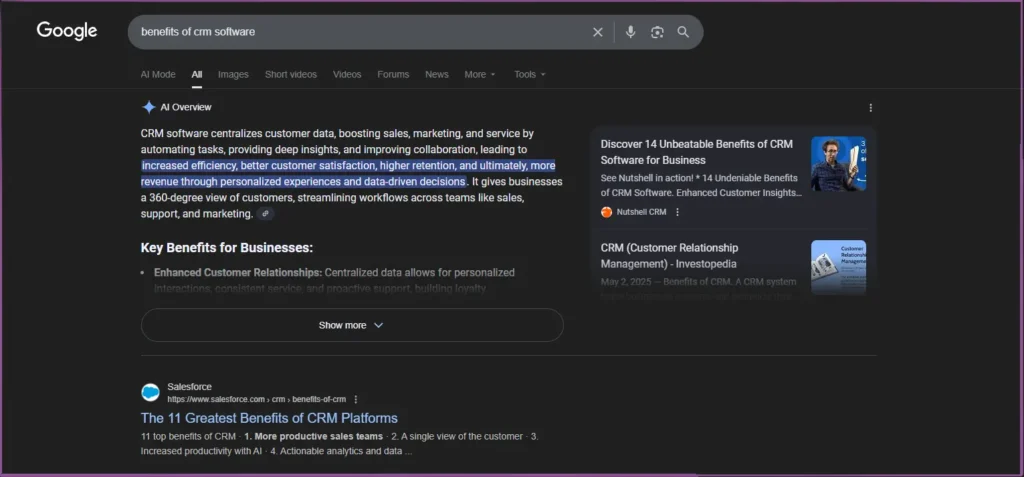
Even without a click, an AI recommendation drives revenue. In fact, AI-attributed leads already account for 10.8% of annual revenue for early adopters.
If you’re not tracking visibility, you’re likely misattributing this revenue to “Direct Traffic” in your analytics. This causes you to underinvest in the channel that actually drives the sale because you can’t see the attribution.
→ To fix this, you need to track specific sales metrics for AI visibility.
2. Brand Reputation and Hallucination Risks
AI models are confident, but they’re not always correct. Without monitoring, you leave your brand narrative unguarded. A model might tell thousands of prospects that your product is discontinued, incompatible, or overpriced based on outdated training data.
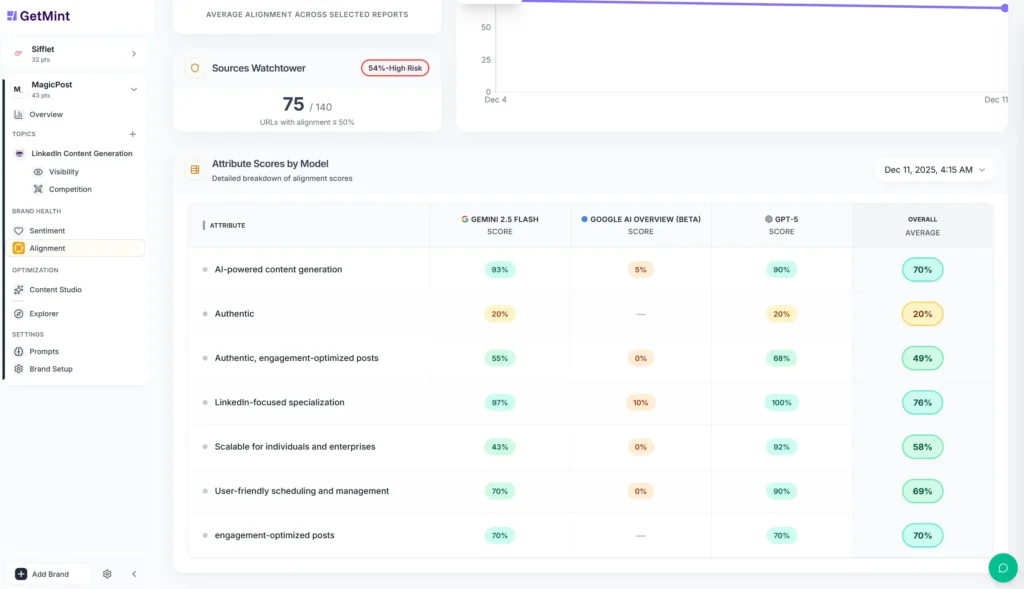
This creates a huge reputation risk. 73% of brands are invisible to ChatGPT due to poor entity optimization. Invisibility is dangerous, but inaccuracy is worse.
→ Tracking visibility allows you to spot these reputation issues early so you can correct the record.
3. Loss of Generative Market Share
Market share in 2026 is defined by share of voice. This measures how often you appear in the answer compared to your competitors.
1 in 5 global firms are completely invisible in AI answers, making them competitively vulnerable.
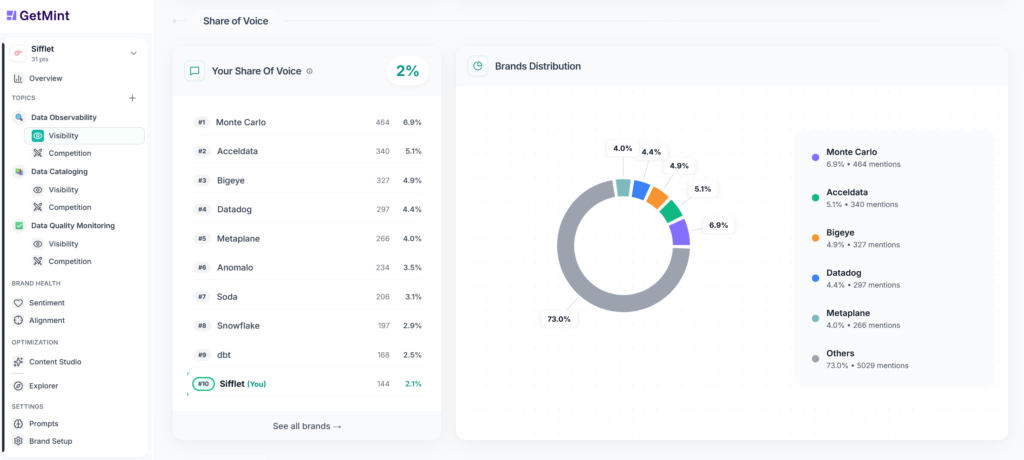
If your competitor has a better Generative Engine Optimization (GEO) strategy, the AI will default to recommending them. It chooses them simply because it understands their business better than yours.
→ If you don’t track this, you lose customers to competitors who are optimizing for the machine.
4. Trust Gap in Buyer Psychology
Buyers now view ads as interruptions. They view AI answers as objective advice. The data shows that nearly two-thirds of consumers say they trust AI tools to guide their brands’ choices.
If your brand appears in a paid ad slot but is missing from the organic AI recommendation, it creates a huge trust gap. The user basically sees that you paid to be there, but the “expert” (the AI) didn’t vouch for you. To them, this means you’re likely not worth considering.
→ Being cited by an AI acts as a third-party endorsement. It validates your brand before the sales conversation even begins.
5. Inability to Control the Output
Many marketers believe AI is a “black box” that can’t be influenced. This is false.
86% of AI citations come from brand-controlled sources like your website, documentation, and business listings.
This proves you can control the narrative. However, without tracking, you don’t know which of your assets are working.
→ If you ignore this data, you surrender your brand story to third-party sources (like Reddit threads or outdated reviews) instead of owning the information yourself.
How to Measure AI Brand Visibility
You can’t manage this channel with traditional SEO tools. You need to leverage the best tools for AI brand monitoring to establish a reliable baseline.
1. Audit Your Baseline with “Discovery” Prompts
The AI likely knows who you are if asked directly, so searching for your brand name isn’t the best approach. The real test is whether it recommends you when you’re not mentioned.
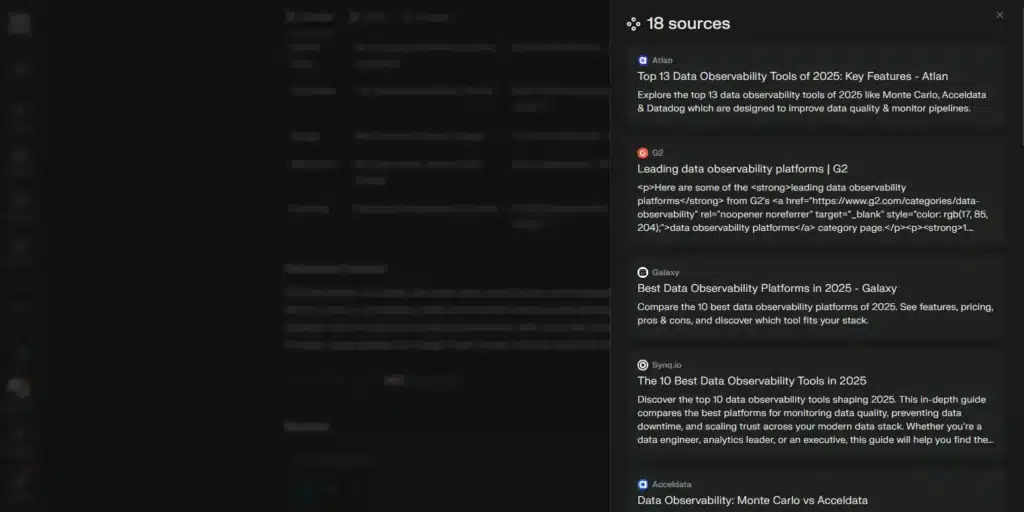
Run unbranded discovery prompts on ChatGPT, Perplexity, and Gemini. Ask questions like
- “What are the top 3 tools for [Your Category]?”
- “Compare [Competitor A] vs. [Competitor B]. Are there better alternatives?”
If you don’t appear in these answers, you have a visibility gap.
2. Analyze Your “Entity” Health
Once you find mentions of your brand, audit them for accuracy. AI models often rely on outdated training data. Check for these specific issues.
- Pricing errors: Is the AI quoting a price you haven’t used in two years?
- Feature gaps: Is it saying you lack a feature that you actually launched last quarter?
- Sentiment: Is the tone recommending you, or is it neutral/warning?
3. Implement Automated Tracking
Manual checks are useful for a snapshot, but they don’t scale. AI models are non-deterministic, meaning they give different answers on different days.
To get a true picture, you need a tool that runs these checks daily to spot trends and sentiment shifts over time.
For a step-by-step guide on fixing the issues you find in your audit, read our article on How to Optimize for AI Search.
Which Platforms Matter for AI Brand Visibility?
Not all AI models impact your business the same way. A complete visibility strategy needs you to focus on three environments.
- Traffic Drivers (Google AI Overviews): Google’s AI sits directly on the search results page and is partly behind the zero-click phenomenon. If you’re invisible here, you lose traffic. Prioritize this to defend your click-through rates.
- Reputation Engines (ChatGPT/Claude): These two models act as conversational advisors. If you’re invisible here, you lose brand preference, because they shape the user’s opinion before they ever search.
- Research Engines (Perplexity/SearchGPT): These tools are built for citation-heavy research. For B2B companies, targeting these engines helps to build credibility. Buyers use these tools to build vendor shortlists.
How GetMint Helps You Manage Your Presence
You can’t type hundreds of prompts into ChatGPT and Perplexity every morning just to see if the answers about your brand changed.
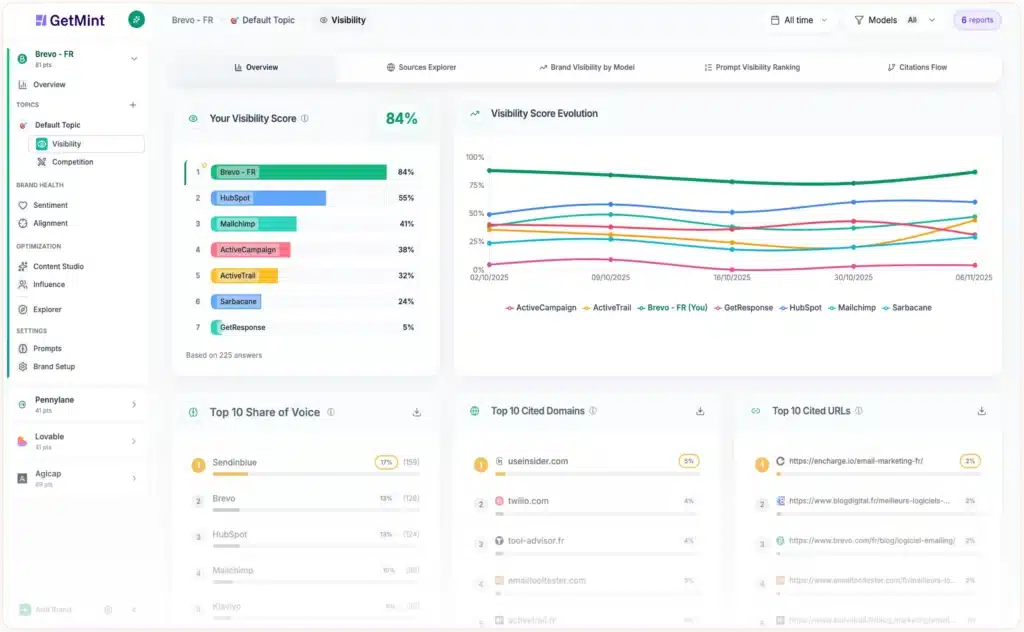
GetMint automates this for you. It acts as your eyes and ears inside the AI platforms and turns invisible conversations into a clear, simple dashboard. Instead of guessing, you can
- See your volume: Track exactly how often you’re recommended across ChatGPT, Perplexity, Google AI Overviews, and many other less mainstream answer engines.
- Catch bad info: Know immediately if an AI starts describing your brand negatively or sharing outdated pricing so you can fix it.
- Watch your competitors: Automate your AI search competitor analysis to see which rivals are winning the answers you want, and understand exactly why the AI prefers them.
Don’t leave your reputation to chance. Start your free AI visibility audit today and see exactly what the models are saying about you.
Frequently Asked Questions (FAQs)
Is AI visibility just a vanity metric?
No. It correlates directly with market share and pipeline. In an AI answer, visibility is binary. If you aren’t in the top citation or recommendation, you usually aren’t mentioned at all. This makes AI visibility a direct proxy for market share. If your visibility drops, your future pipeline will likely drop too.
Can I just use Google Search Console to track AI brand visibility?
No. Google Search Console only tracks clicks and impressions on Google. It tracks nothing that happens inside ChatGPT, Claude, or Perplexity. Because those platforms are private environments, Google has no access to that data. You need a dedicated tool to see those conversations.
Does tracking AI brand visibility replace traditional SEO?
It doesn’t replace SEO, but it complements it. SEO helps you rank in traditional search engines to drive clicks. AI visibility helps you earn citations and mentions in generative answers to drive brand awareness and influence. A modern strategy requires both because buyers use both channels.
How accurate is the data?
It’s accurate for trends but probabilistic for individual results. Unlike Google, which gives you exact server data, AI visibility tools use modeling to estimate share of voice. Think of it as a reliable compass that points you in the right direction rather than a GPS giving you exact coordinates.
Can I remove negative mentions from AI?
You can’t delete an AI’s answer like you can a social media post, but you can fix the underlying cause. AI models are trained on public data. To fix a negative mention, you must fix the source (like an outdated review or incorrect article) and then publish fresh content to overwrite the old data in the model’s understanding.

