


42% of product discovery happens inside AI models, yet this activity appears nowhere in your standard marketing reports.
Traffic hasn’t disappeared; it simply moved to a private channel. When a customer asks an AI for a software recommendation, the interaction is invisible to Google Analytics.
To capture this data, marketing teams are adopting a new piece of infrastructure: the AI visibility platform.
This guide explains exactly what an AI visibility platform is, the technical architecture behind how it works, and why it’s the necessary third pillar of your modern tech stack.
What Is an AI Visibility Platform?
An AI visibility platform is software designed to monitor, analyze, and optimize a brand’s presence inside Large Language Models (LLMs) like ChatGPT, Gemini, and Perplexity.

Unlike traditional SEO tools, which track rankings (your position on a static list), these platforms track narratives. They measure how an AI synthesizes information about your brand when prompted by a user.
Their primary function is to answer three questions that traditional analytics cannot:
- Presence: Are we being mentioned in the answer?
- Sentiment: Is the AI recommending us or warning users away?
- Attribution: Which specific sources is the AI reading to form its opinion?
Note: This software category is often referred to as Generative Engine Optimization (GEO) tools. While GEO is the strategy, the AI visibility platform is the instrument used to execute it.
Why You Need an AI Visibility Platform in 2026
Most marketing teams assume their existing tech stack can handle this shift. They try to track AI Overviews with their rank tracker or monitor ChatGPT with their social listening tool.
This approach fails because AI models operate on a fundamentally different architecture than search engines or social networks. You can’t measure a probabilistic, generative engine with tools built for static lists.
Here’s why your current stack is insufficient for AI search visibility.
1. SEO Tools Are Built for Rankings
Traditional SEO tools are deterministic. They query Google, see that you’re in position #1, and report it. Some personalization and localization is going on, but not nearly as much with LLMs.
AI models are non-deterministic. If you ask ChatGPT about your brand today, it might give a different answer than it gives your customer tomorrow. It doesn’t have a “ranking”; it has a probability of mentioning you.
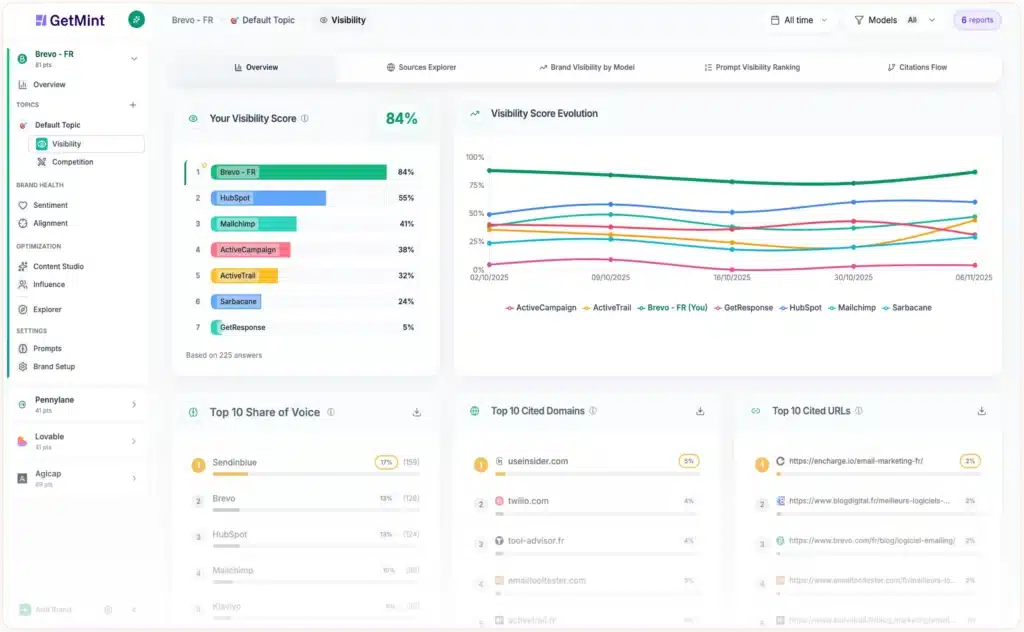
Standard SEO tools can’t calculate this probability. An AI visibility platform runs repeat simulations (querying the model hundreds of times with slight variations) to determine your share of voice. It turns a changing conversation into a hard percentage you can track.
2. Social Listening Tools Track Humans
Social listening platforms like Brandwatch or Sprout Social scrape the public web. They find what people are posting on Reddit, X, and news sites.
They can’t see inside the private interface of an LLM. When a user asks Claude for a software recommendation, that conversation is not indexed on the public web. It happens in a “black box.”
A dedicated platform listens to the web and interrogates the shopper. It acts as a “mystery shopper” that sends prompts to the AI to reveal what it’s saying about your brand behind closed doors.
3. The Ecosystem Changed
In 2020, you only had to worry about Google. Today, your customers are splitting their time between:
- The chatbots: ChatGPT, Claude, Gemini, Grok, and DeepSeek.
- The research engines: Perplexity and SearchGPT.
- The hybrid engines: Google AI Overviews and Microsoft Copilot.
Each of these models has a unique “personality” and training dataset. You might be the top recommendation on ChatGPT but completely invisible on Perplexity.
Manually checking 50 keywords across 5+ different platforms every day is impossible. A GEO platform automates this generative AI analytics workflow to give you a unified view of your performance across the entire landscape.
How Does an AI Visibility Platform Work?
Building software to track AI is significantly harder than building a rank tracker. You can’t just “scrape” a results page because there’s no static page to scrape.
Instead, a true AI visibility platform acts like a massive, automated mystery shopping fleet. Here’s how it works.
Frontend Simulation
The most important technical distinction in this category is how the tool accesses the data. Cheap tools simply query the OpenAI API (or any other AI’s API). This is fast but inaccurate because the raw API behaves differently than the chat interface your customers use.
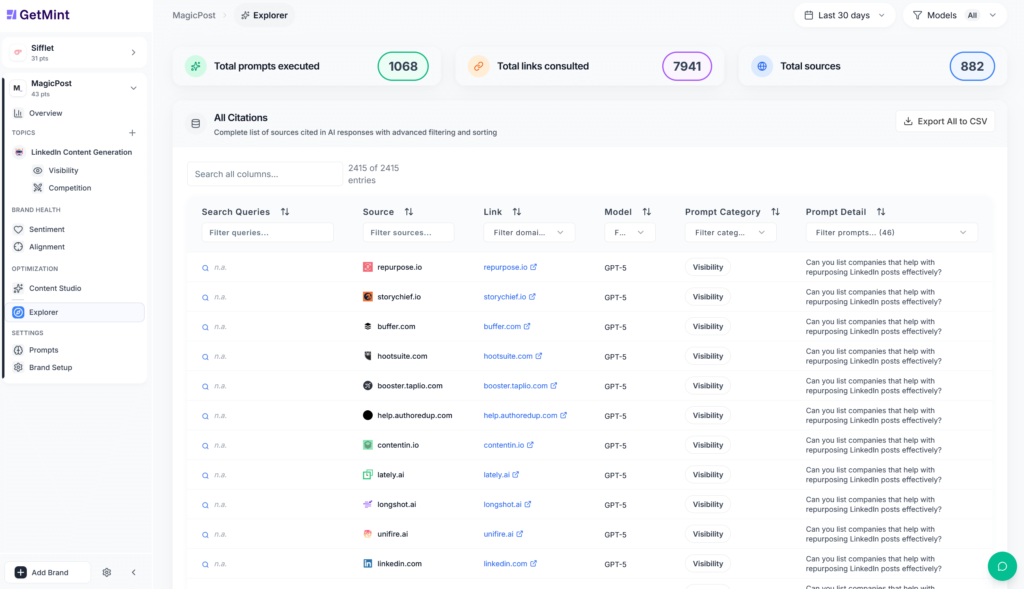
Real enterprise platforms (like GetMint or Profound) query the frontend. They simulate real user behavior on the actual interfaces of ChatGPT, Perplexity, and the rest. This captures the true user experience, including the ads, the specific source citations, and the browsing behaviors that API wrappers miss.
Data Processing
Once the platform receives the raw text response from the AI, it must turn that unstructured conversation into data. It uses Natural Language Processing (NLP) to parse the answer for specific signals.
- Presence: Did the AI mention your brand name?
- Attribution: Did the AI provide a citation (a clickable link) to your site?
- Context: How did the AI describe your brand? Did it say you’re a “legacy tool” or an “innovative solution”?
- Competition: Who else was mentioned in the same list?
Output
Because AI models are non-deterministic (they change their minds), a single check is useless. A proper AI visibility platform runs these checks repeatedly (sometimes sending the same prompt 50 times) to calculate a probability score.
For example, if ChatGPT mentions your brand in 40 out of 50 simulations, your generative share of voice is 80%.
This converts the changing conversation into hard metrics, such as “AI visibility score” and “share of voice,” that you can track on your dashboard alongside your revenue.
4 Features to Look For in an AI Visibility Platform
Not all tools are created equal. The market is currently flooded with simple wrappers that claim to track AI but only offer a basic connection to one API.
To get enterprise-grade data, a true platform must offer these four capabilities.
1. Multi-Model Coverage
If a tool only tracks Google AI Overviews, it’s an SEO tool, not an AI visibility platform. If it only tracks ChatGPT, it misses the research-heavy users on Perplexity. A complete platform must monitor the entire ecosystem where your customers are active: ChatGPT, Perplexity, Claude, Gemini, and Google AI Overviews.
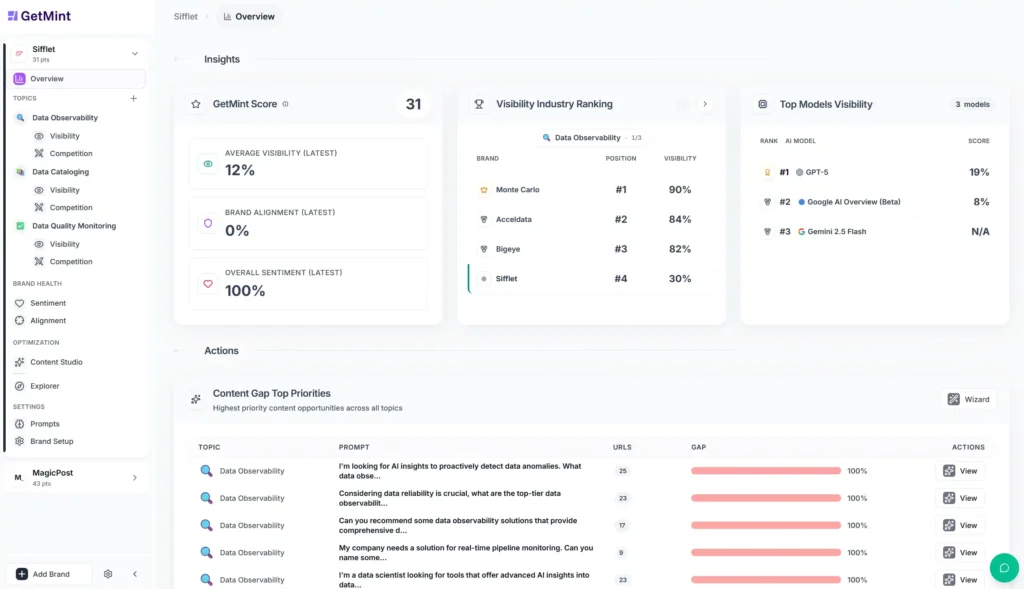
An enterprise-level platform should also offer insights into the less mainstream AIs, such as Grok and DeepSeek.
2. Source Forensics
Knowing what the AI said is useful, but knowing why it said it is actionable.
The platform must provide source forensics (the ability to trace an AI answer back to the specific URL it got the info from).
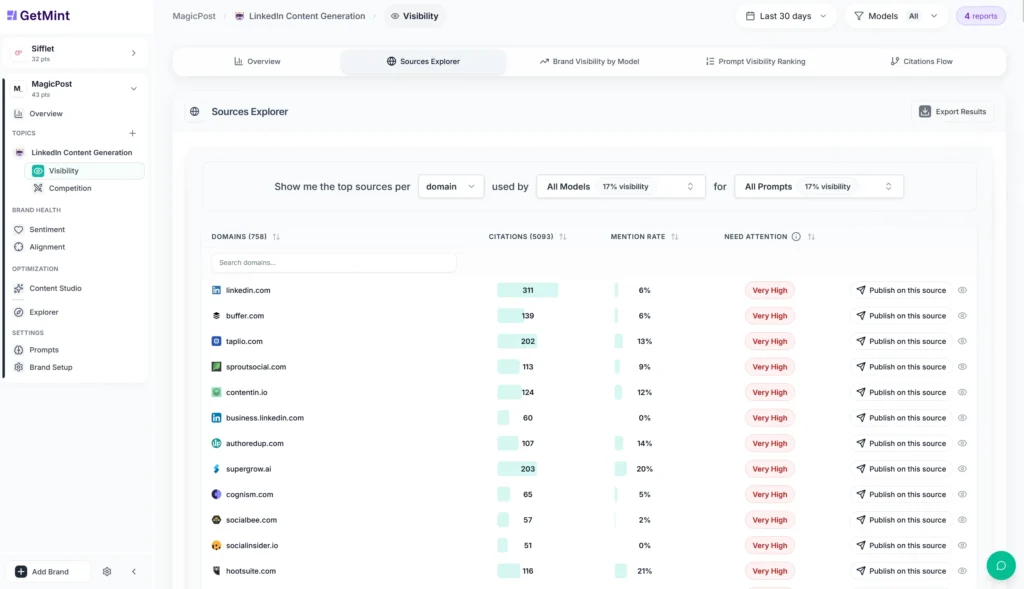
If Claude quotes your competitor’s pricing instead of yours, you need to know exactly which blog post or review site served as the source of that data so you can fix it.
3. Hallucination Detection
Standard sentiment analysis (positive vs. negative) is insufficient for LLMs. A review might be “positive” but factually wrong, such as praising a feature you deprecated three years ago.
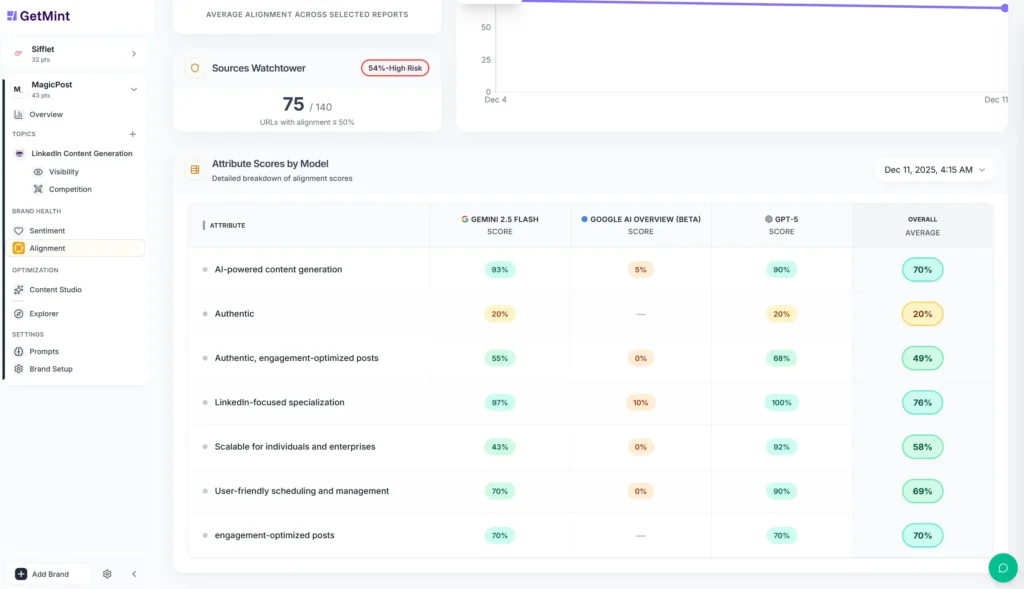
Advanced platforms distinguish between sentiment (opinion) and alignment (accuracy). They alert you to hallucinations (instances where the AI invents facts) so you can correct the record before it becomes a widespread narrative.
4. Generative Share of Voice
You can’t measure success in a vacuum. That’s why you need to know your AI share of voice relative to your competitors.
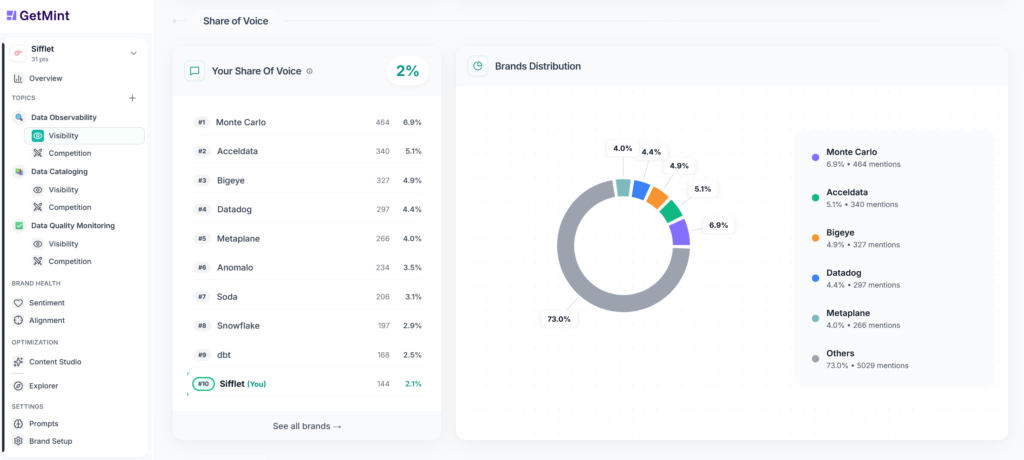
The platform should tell you: “In 1,000 simulations of buyer discovery questions, Brand A appeared 40% of the time, and you appeared 10%.”
This is the only metric that correlates directly with market share in the AI era.
How GetMint Helps You Track AI Visibility
Most tools on the market today stop at observation. They tell you that you’re invisible but leave you guessing how to fix it.
GetMint is the first AI visibility platform designed to close the loop between detection and action. It meets all the architectural standards of a true enterprise platform and adds optimization features.
AI Visibility Dashboard
Instead of logging into five different tools, GetMint gives you a single dashboard to track your generative share of voice across all major AI models, including ChatGPT, Perplexity, Claude, Gemini, Grok, and DeepSeek.
You can see exactly which models favor your brand and which ones are recommending your competitors.
Content Studio
GetMint closes the gap between reporting and improving.
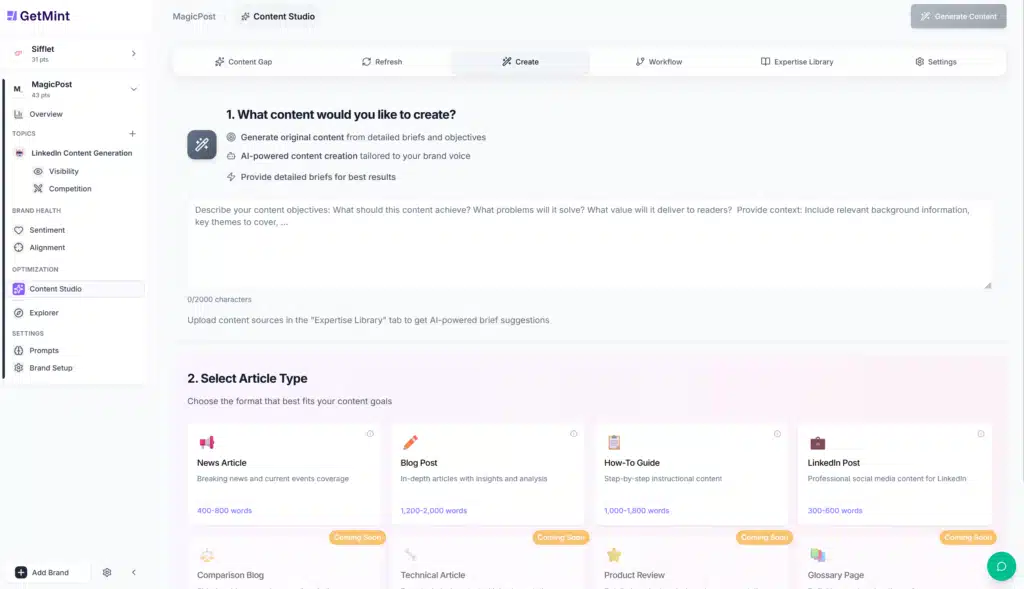
When it identifies a content gap (e.g., “ChatGPT doesn’t know you offer enterprise security”), the content studio helps you fix it.
- It analyzes the specific sources the AI is citing for that topic, as well as your expertise library (uploaded files, text, and PDFs).
- It helps you draft optimized content using Retrieval Augmented Generation (RAG) to fill that gap.
- It ensures your new content is structured in the specific format that the AI prefers to ingest.
Source Explorer
You don’t need to guess where to get press. GetMint identifies the exact third-party domains (like specific G2 reviews or TechCrunch articles) that are feeding the AI is opinions about you.
This gives your PR team a sniper-focused hit list to improve your external signals.
Want to see exactly how it works? Read our full GetMint review for a thorough explanation of the dashboard, pricing, and features.
Completing Your Marketing Stack
Ten years ago, marketing teams realized they couldn’t manage social media without a dedicated platform. Today, we’re at the same inflection point with artificial intelligence.
Your marketing stack likely already has a CRM for sales and an SEO suite for Google. But without an AI visibility platform, you have a blind spot covering the fastest-growing channel in digital history.
You can’t afford to let 42% of product discovery happen in the dark. You need to know when you’re recommended, when you’re ignored, and exactly what to do about it.
GetMint provides that clarity. It’s the best platform for connecting the dots between detection and action and influencing the answers that matter most.
Start your free AI visibility audit with GetMint and see exactly what the models are saying about you.
Frequently Asked Questions (FAQs)
What is an AI visibility platform?
It’s software designed to track your brand’s presence inside Large Language Models (LLMs). Unlike SEO tools that track website rankings, these platforms monitor AI citations and mentions to measure how often ChatGPT, Perplexity, and Gemini recommend your brand.
Is this the same as SEO software?
No. SEO software tracks static rankings on search engines like Google. AI visibility platforms track dynamic, probabilistic answers on generative models. Because the architectures are different (lists vs. conversations), you can’t use a standard rank tracker to measure AI performance accurately.
Can’t I just use social listening tools?
No. Social listening tracks what humans say on public channels like X and Reddit. AI visibility platforms track what machines generate in private conversations.
Social tools can’t access the internal outputs of models like Claude or ChatGPT, so they leave you blind to the actual answers users receive.
What’s the difference between GEO and an AI visibility platform?
GEO (Generative Engine Optimization) is the strategy. It’s the actions you take to improve your visibility. The AI visibility platform is the tool you use to measure those results. You practice GEO, but you track it with a platform.
Can I build this in-house?
It’s possible, but rarely cost-effective. Building a true visibility tracker requires managing complex frontend simulations, handling non-deterministic sampling (querying the same prompt dozens of times), and paying significant API costs.
Buying a dedicated platform is usually cheaper and more reliable than maintaining a custom scraper.

