


To understand the future of search, you first have to unlearn how Google works.
For the last 20 years, we treated search engines like librarians. You gave them a keyword (the book title), and they pointed you to the exact shelf where that book lived (the link). They didn’t read it for you; they just showed you where it was.
AI search engines aren’t librarians. They’re professors. When you ask a question, they read the books, synthesize the information, and write a custom answer just for you. This shift from pointing to thinking is the basis of Generative Engine Optimization (GEO).
To win in this new environment, you need to understand the mechanics behind the answer. If you’re wondering, “How does GEO work?” Here’s the simple, non-technical explanation.
What Is GEO?
Generative Engine Optimization (GEO) is the practice of organizing content so AI models can easily read, understand, and use it to generate answers. While SEO aims to rank a link in a list of results, GEO aims to make your content the trusted source the AI quotes directly.
This distinction changes the requirements for your website. Unlike traditional search, where the engine’s job ends at the results page, generative engines work differently:
- They must actually read and understand your text to use it.
- They combine information from multiple sources instead of picking one winner.
- Success is measured by AI search visibility and citations rather than just clicks.
Why Is GEO Different from SEO?
Traditional Search Engine Optimization (SEO) was built for static pages and keyword matching. Its goal is to get your page to rank #1 in Google. The user clicks your link, and your job is done.
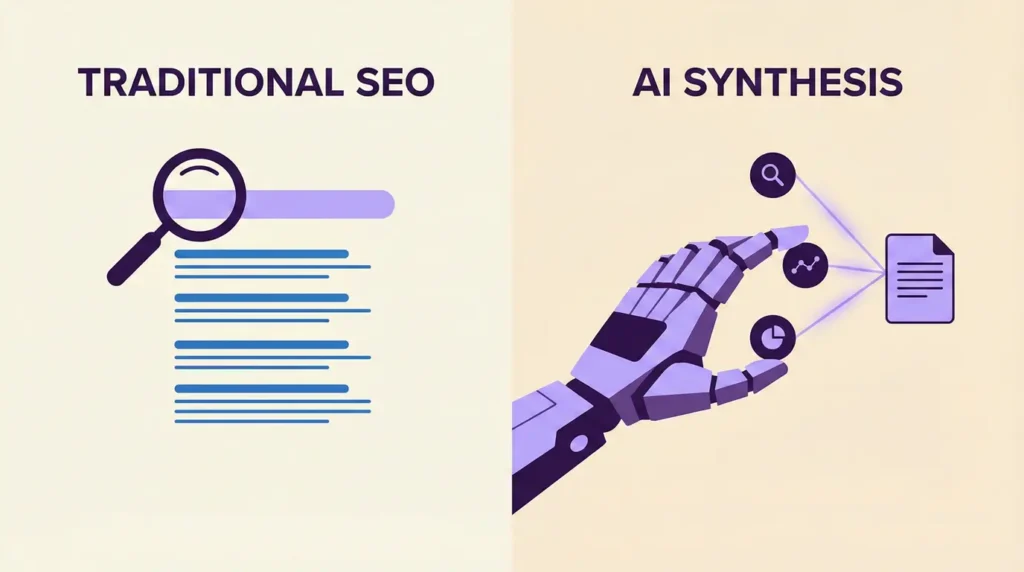
GEO operates differently because AI models don’t just rank; they synthesize. They read, understand context, and combine information from multiple sources to generate a unique answer. Your goal shifts from “ranking a link” to “becoming the trusted source” that the AI pulls from.
Simply put:
- SEO is a librarian pointing a user to a specific link.
- GEO is a subject matter expert whose knowledge is incorporated into the answer itself.
This fundamental difference in how search engines operate changes the process of optimizing for AI search. Instead of just optimizing for a keyword match, you need to optimize for comprehensiveness, clarity, and authority. These are the signals AI models use to trust a source.
To learn more about the strategic differences between SEO and this new field, read our guide on AEO vs SEO.
Note: Many principles that apply to Answer Engine Optimization (AEO) apply to GEO as well.
How Does AI Understand Your Content?
In the past, if you searched for “soda,” Google looked for pages that contained the specific letters s-o-d-a. It was a matching game.
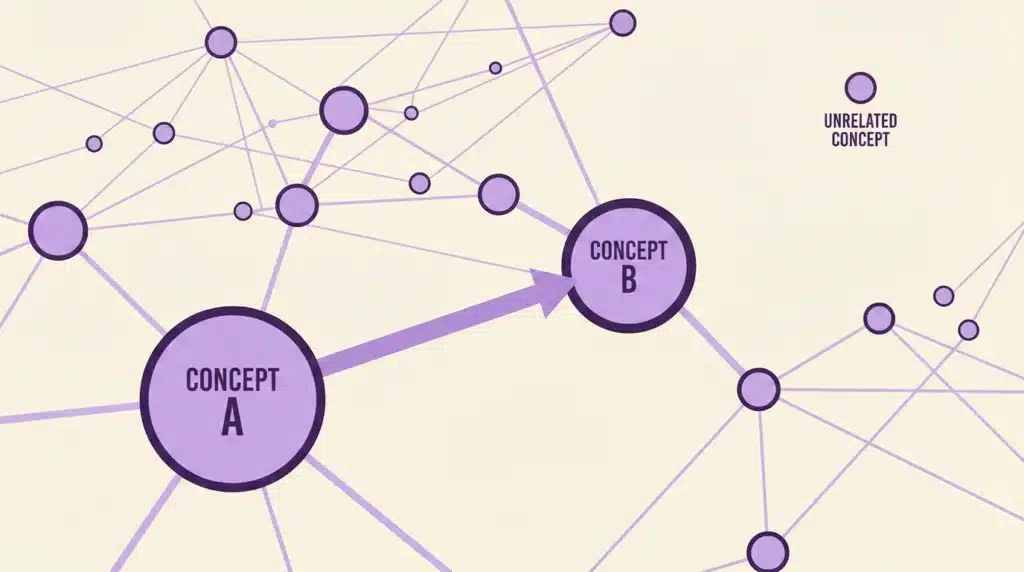
AI models today look for matching concepts, not just words. To do this, they use a technology called a vector search. To illustrate, think of the internet as a giant grocery store.
- Keyword search: You walk down the aisles looking for a sign that says “Apples.” If the sign is missing or misspelled, you’re lost.
- Vector search: You know that apples are usually near bananas because they’re both fruit. Even if there’s no sign, you know where to look based on the relationship between the items.
AI models map the internet like this grocery store. They turn your content into numbers (vectors) and place similar concepts close together on a 3D map.
This means you no longer need to stuff the exact keyword “Best CRM” into your page 50 times. If your content discusses “sales pipelines,” “lead tracking,” and “revenue,” the AI understands mathematically that you’re a CRM. It finds you based on meaning, not just specific words.
This is why AI search visibility is harder to manipulate than traditional rankings. You can’t trick the model with keywords; you have to prove that you belong in the right “aisle” through clear, conceptual writing.
How Does AI Find New Information?
AI models use a framework called Retrieval Augmented Generation (RAG) to access real-time data. This allows them to go beyond their training cutoff dates and answer questions about current events, live pricing, or recent news by fetching information from the live web.
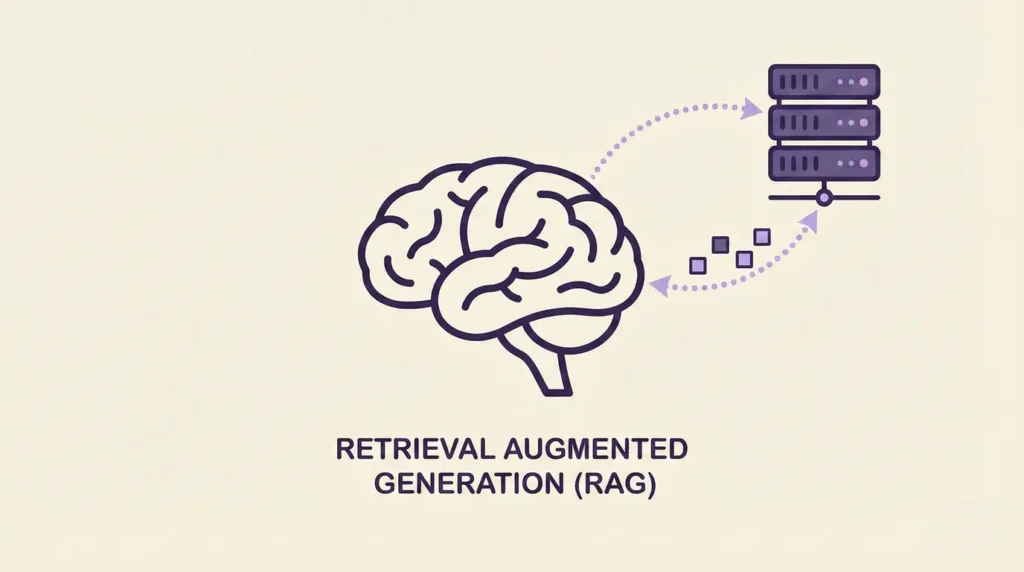
Without RAG, an AI is essentially stuck in the past, limited to the static dataset it “learned” years ago. RAG solves this by turning the model into a researcher that follows a three-step workflow:
- Retrieval: The model identifies a knowledge gap and searches trusted external sources (like your website) for the specific facts it needs.
- Augmentation: It combines its pre-trained language skills with this newly retrieved data.
- Generation: It writes a coherent answer that cites the source material.
This dynamic process makes the technical readability critical for Answer Engine Optimization (AEO). If your website is slow, cluttered with heavy code, or blocks crawlers, the retrieval system can’t parse your content. The AI will simply skip your site and use a cleaner, more accessible source to construct its answer.
How Does AI Create the Answer?
Once the AI retrieves its sources, it loads the text into its short-term memory (the context window) and synthesizes a summary. Because this memory has limited space, the model ruthlessly filters out content with low value and prioritizes information density.
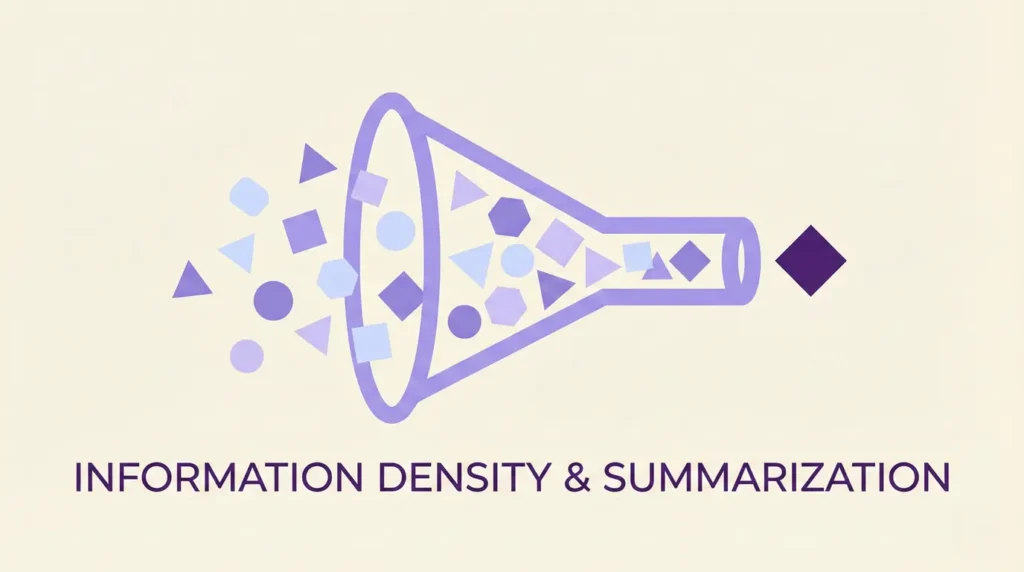
It’s essentially a summarization engine. It scans the retrieved text and asks, “Which parts of this text contain new, concrete facts?”
- It cuts fluff. Sentences like “In today’s fast-paced digital world, it’s important to know…” contain zero unique data. The AI discards them to save space.
- It keeps the signal. Sentences like “The vector database market is projected to reach $17.91 billion by 2034” contain high value. The AI keeps them to anchor the answer, giving retrieval models a factual spine to build relevance around.
This preference for density is why data-heavy content performs best in AI search visibility. Product specifications, direct comparisons, and statistical tables make up nearly 70% of citations because they’re dense with facts that the AI can easily extract and reassemble without losing meaning.
How Does AI Decide What to Cite?
AI models cite sources primarily to reduce the risk of hallucination. When a model links to your content, it’s using your authority to anchor its answer in reality and prove it isn’t making things up. It’s also rewarding you for good SEO and GEO optimization.
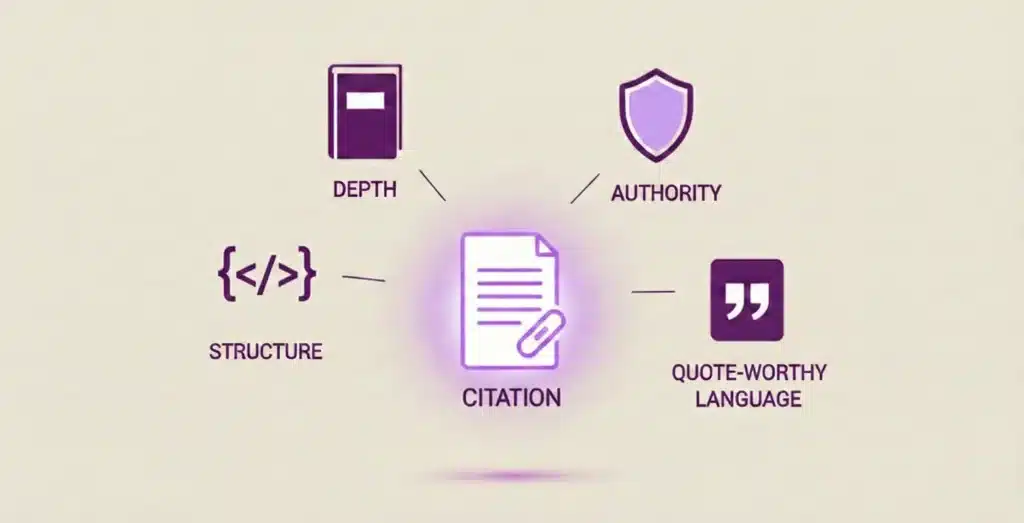
Getting an AI citation is effectively a confidence vote. The model assigns a probability score to the information it retrieves, and if that score exceeds a certain threshold, it credits the source to establish “Ground Truth.”
There are two main factors that trigger this citation behavior:
- Risk reduction: AI models are penalty-prone for accuracy errors. Citing a high-authority source shifts the burden of proof from the model’s “memory” to an external, verifiable document.
- User trust Data shows that 65.9% of users trust an AI answer more if they see a citation, even if they never click it. The AI includes links to signal reliability to the human user.
This is why original data, expert quotes, and unique definitions are the most cited forms of content. If you’re the primary source of a statistic, the AI is mathematically more likely to cite you than a blog that simply repeats that statistic.
What Are the New Ranking Factors in GEO?
Now that you understand the mechanics of GEO, you know that the ranking signals have also changed. You’re no longer optimizing for a crawler; you’re optimizing for a synthesis engine.
Here’s how the priorities have shifted:
| Traditional SEO Signal | New GEO (AI) Signal | Why It Changed |
|---|---|---|
| Keywords | Semantic Distance | The AI matches concepts (vectors), not just strings of text |
| Backlinks | Citation Confidence | The AI prioritizes sources that reduce its risk of hallucination |
| Word Count | Information Density | The AI has a limited context window and cuts fluff to save space |
| Rankings | Share of Voice | The AI doesn’t list 10 options; it synthesizes the top probability |
This isn’t to say that SEO is no longer important today. GEO doesn’t replace traditional SEO; it complements it. It’s a two-step dependency.
- Technical SEO ensures the AI crawler can find, index, and render your page. If your SEO is broken, the RAG system can’t retrieve your content, and GEO becomes impossible.
- Once retrieved, GEO optimization ensures the model understands your content well enough to cite it as the winner.
You can’t win in GEO if you’re losing in SEO. A strong SEO foundation is necessary to even be eligible for visibility in AI platforms.
How GetMint Helps You Track the Mechanics
You can’t see vector embeddings or probability scores with the naked eye. To manage this process, you need an AI visibility platform that translates these engineering concepts into marketing metrics.
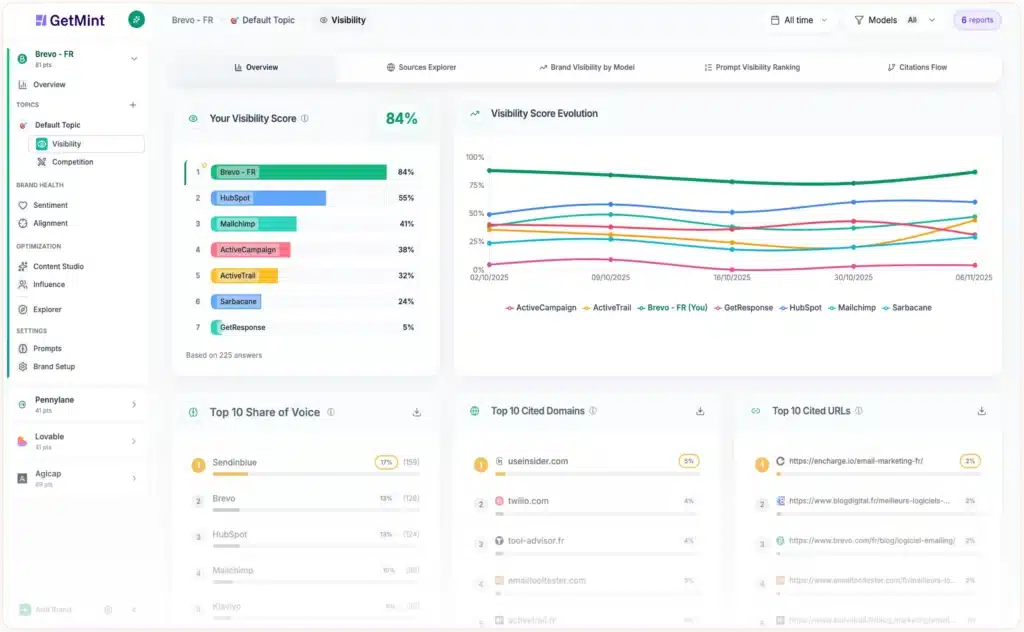
GetMint monitors the output of these black-box algorithms to show you exactly how AIs view your brand.
- Track RAG performance: See exactly which AI citations and mentions you’re winning and identify the specific sources the model trusts over yours.
- Measure vector health: Use our “Generative Share of Voice” metric to understand how closely your brand is mathematically associated with your primary category and how often AIs recommend it over competitors.
- Monitor narrative drift: AI synthesis can sometimes drift into negative territory. Our platform’s AI brand monitoring capabilities help you detect if the model is hallucinating weaknesses about your product so you can correct the record.
You don’t need to be a data scientist to win at GEO, but you do need the right instrumentation. We cover this platform’s best capabilities in our GetMint review.
Start Feeding the Algorithm Today
So, how does GEO work? The simple answer is that it retrieves meaning through vectors and density, not keywords and links. Optimization now means structuring content so AI can parse it easily, packing it with unique facts, and aligning it semantically with queries.
You can’t trick a predictive model with keyword stuffing or hollow content. If you’re invisible in these results, it’s likely not because your SEO is bad. It’s because your content isn’t optimized for the mechanics of retrieval.
Ready to see what the AI sees? Start your AI visibility audit with GetMint and learn exactly how the models are reading, ranking, and citing your brand today.
Frequently Asked Questions (FAQs)
Does GEO replace Technical SEO?
No, it builds on it. Technical SEO ensures your site can be crawled (found). GEO ensures your content can be synthesized (understood). Without a solid technical SEO foundation (speed, schema, clean HTML), the RAG process cannot retrieve your content effectively.
Can I check my “Vector Score”?
Not directly. Vector embeddings are complex mathematical representations inside the model’s “black box.” However, you can measure the result of that scoring using GEO tools. If your generative share of voice is high, it means your vector proximity to the user’s query is strong.
Why do AI answers change for the same question?
AI models are probabilistic, meaning they predict the next word based on statistical likelihood rather than a fixed database. A parameter called “Temperature” introduces a slight randomness to these predictions to make the answers feel natural, which causes variations in how often your brand is cited.
Does word count matter for AI rankings?
No. In fact, long, fluffy content often hurts you. AI models have a limited “Context Window” (short-term memory). They prioritize information density: the amount of unique facts per paragraph. Concise, data-rich answers are more likely to be synthesized than long-winded blog posts.
How often do AI models update their index?
It depends on the model. Search-enabled models like ChatGPT, Perplexity, and Google Gemini update in near real-time using RAG. Offline models rely on training data that can be months old, though they are increasingly adding browsing capabilities to bridge this gap.

