



You can publish the most authoritative content in your industry and still remain invisible to AI search engines.
The issue often isn’t your writing; it’s your code. Modern websites built for humans with heavy JavaScript and dynamic loading are often unreadable to AI crawlers. If the bot can’t render the page, it ignores the brand.
Scrunch solves this by combining AI search visibility monitoring with infrastructure tools that repair the technical handshake between your server and the AI.
This Scrunch AI review analyzes the platform’s monitoring dashboards, its unique Agent Experience Platform (AXP), and its pricing to determine if it’s the right fit for your strategy.
What Is Scrunch AI?
Scrunch AI is an enterprise platform for Generative Engine Optimization (GEO). It combines visibility tracking with technical infrastructure tools to help brands control how they appear in AI search results.
Unlike traditional SEO tools that focus on ranking links for humans, Scrunch AI focuses on optimizing your digital footprint for agents. It helps you measure your share of voice across Large Language Models (LLMs) and provides the technical tools to ensure those models can read your website correctly.
The three standout features Scrunch offers are:
- Agent Experience Platform (AXP): It sits at the edge of your network (working with CDNs like Cloudflare and Vercel) to detect AI bots and serve them an optimized, code-light version of your site. This fixes technical crawling issues without requiring you to rewrite your website’s code.
- Persona and funnel tracking: Instead of just tracking keywords, it segments your performance by “Ideal Customer Profile” (e.g., CTO vs. developer) and funnel stage, helping you align visibility with revenue goals.
- Optimization insights: It analyzes why you aren’t ranking and provides specific recommendations, such as identifying missed content opportunities or technical bugs preventing indexing.
Who Is Scrunch AI For?
Scrunch is designed for enterprise growth teams and technical SEOs.
If you’re a smaller brand looking for a simple rank tracker, the features here are likely overkill. It also isn’t the right fit for content leads managing hundreds of pages, as it lacks the automation needed to streamline bulk updates.
Scrunch is best for large organizations struggling with technical rendering issues (e.g., single-page applications that bots can’t read) or demand generation teams that need to prove ROI across specific buyer personas, as it offers the tools and the granular data they need.
Scrunch’s AI Visibility Features
Scrunch divides its platform into two primary disciplines: knowing where you stand (Monitoring) and understanding why you’re winning or losing (Insights).
While the technical AXP feature gets the headlines, these visibility dashboards are the daily drivers for marketing teams (and they’re what GEO tools are all about).
1. Monitoring
The monitoring module acts as your command center. It gives you a multi-dimensional view of your brand’s performance across the entire LLM ecosystem.
Competitive Benchmarking
This module visualizes your market share relative to your specific rivals. It’s essentially an AI search competitor analysis dashboard that shows not just whether you rank, but who you’re winning against.
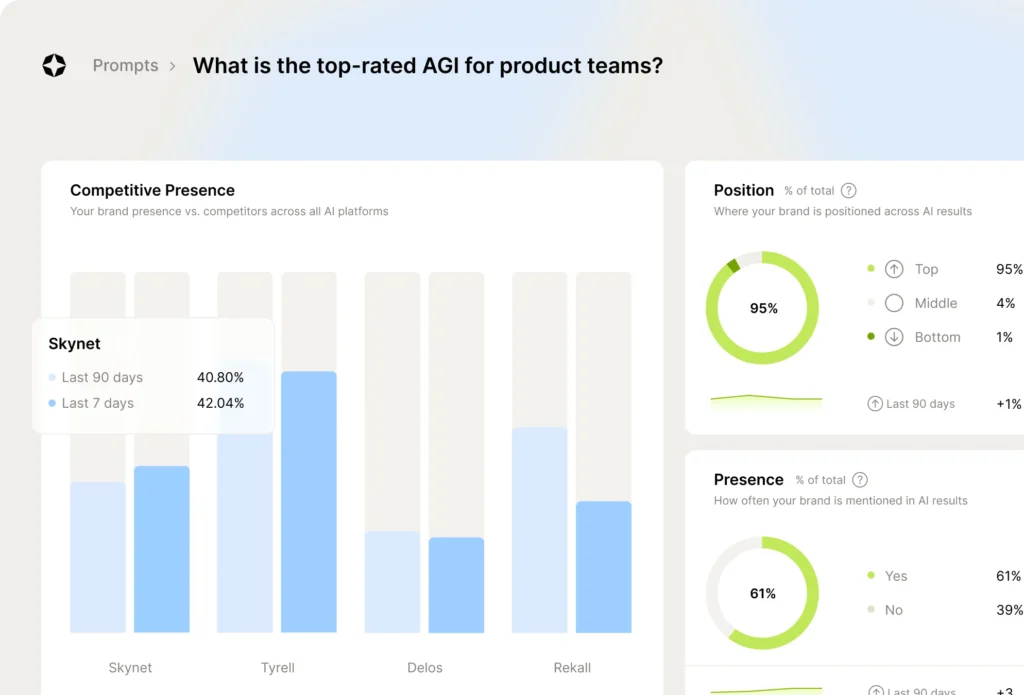
Instead of a static list of URLs, Scrunch visualizes your competitive presence, which is an important metric for AI brand monitoring. It tracks your brand’s visibility relative to the specific competitors you define (e.g., Skynet vs. Tyrell). The dashboard breaks this down into two important metrics:
- Presence: A binary metric (Yes/No). Did the AI mention you in the answer?
- Position: A qualitative metric (top/middle/bottom). Where did you appear in the answer?
The position metric is the most valuable signal here. In AI search, simply being mentioned isn’t enough. If you’re the last bullet point in a list of ten recommendations, you’re effectively invisible to the user. This view helps you distinguish between being indexed and being recommended.
You should also pay attention to the time comparison (last 90 days vs. last 7 days). AI rankings are probabilistic and fluctuate based on model updates. A sudden dip in the 7-day view is an early warning sign that a competitor’s campaign is displacing you. Investigate the cause before the shift becomes permanent.
Granular Segmentation
Scrunch allows you to move beyond aggregate data and slice your visibility metrics by specific buyer profiles, regions, and funnel stages.
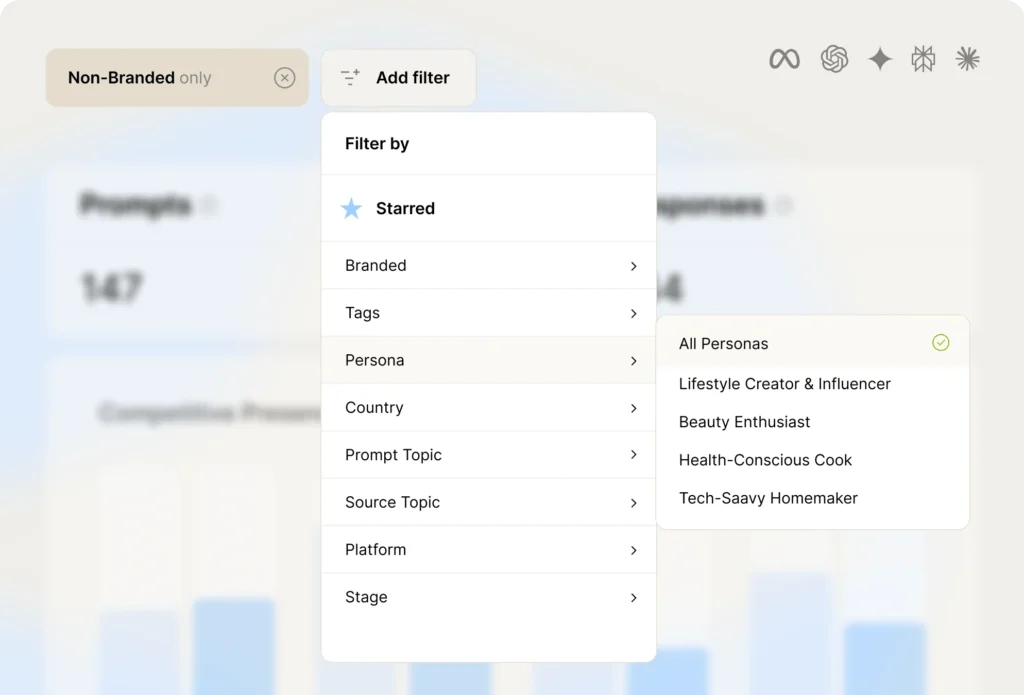
While most tools only filter by keyword tag or date, Scrunch introduces demand-generation filters. You can isolate performance based on persona (e.g., “Tech-Savvy Homemaker” vs. “Beauty Enthusiast”), funnel stage, and brand intent (branded vs. non-branded).
This prevents “vanity metrics” from obstructing your actual performance. For example:
- A brand might have a high overall visibility score but be completely invisible to their most valuable persona (e.g., “Enterprise Buyer”) or absent during the critical decision stage of the funnel.
- Filtering for non-branded queries lets you strip away navigational traffic to see if you’re truly capturing new audiences who aren’t already looking for you.
Prompt-Level Forensics
Aggregate scores are useful for reporting, but they can hide specific failures. This view allows you to drill down into the exact performance of a single, high-value query over time.

The dashboard provides a daily heartbeat for specific prompts (e.g., “What is the top-rated AGI for product teams?”). Instead of a simple ranking number, it tracks five variables simultaneously: presence, position, sentiment, citation, and competitor density.
This timeline view helps you diagnose volatility.
- Notice how, in the example above, the sentiment shifts from negative (red) on July 30 to positive (green) by August 4. Without this granular history, you wouldn’t know if a content update fixed the issue or if the model simply hallucinated a different answer that day.
Most importantly, this data is contextualized by persona and location. It doesn’t just show how the AI answers the prompt in general; it shows how the AI answers it specifically for a “Tech-CMO” in “Park City, UT.” This helps you verify if your personalization strategy is actually reaching its intended target.
Cross-Platform Intelligence
You can’t treat “AI” as a single channel; optimizing for AI search requires different strategies depending on the engine you’re targeting, as they all prioritize different signals.
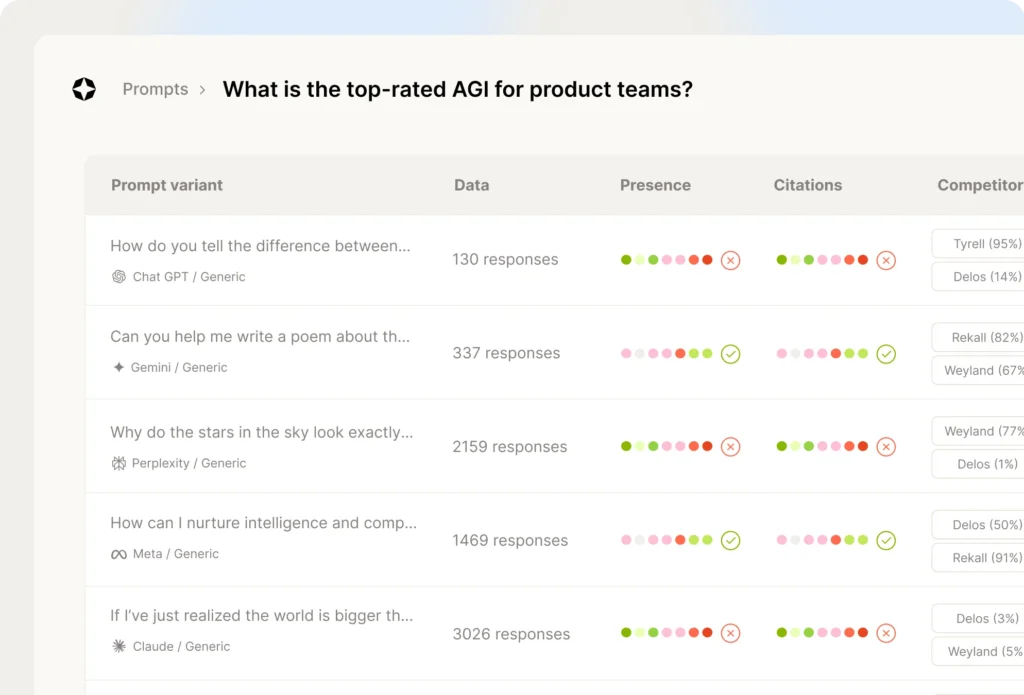
This dashboard breaks down your performance across every specific LLM, including ChatGPT, Gemini, Perplexity, Meta Llama, and Claude. This visualization highlights model variance.
- Notice how the brand has a positive presence (green checks) on Gemini and Meta but is failing (red X) on ChatGPT and Claude for similar prompts.
This is actionable diagnostic data. If you’re winning on Perplexity (which relies heavily on live web citations) but losing on Claude (which relies more on training data and context windows), it suggests your technical SEO is strong, but your historical brand authority might be lacking.
This allows you to tailor your strategy. Perhaps you could push for more press coverage to influence Claude while maintaining schema markup to hold your ground on Perplexity.
2. Insights
Monitoring tells you that you’re ranking; insights tell you why. This section reverse-engineers the black box of AI retrieval to show you the specific logic, sources, and technical factors feeding the model.
Citation Intelligence
This feature maps the supply chain of information. It identifies exactly which websites the AI uses to construct its answers about your industry.
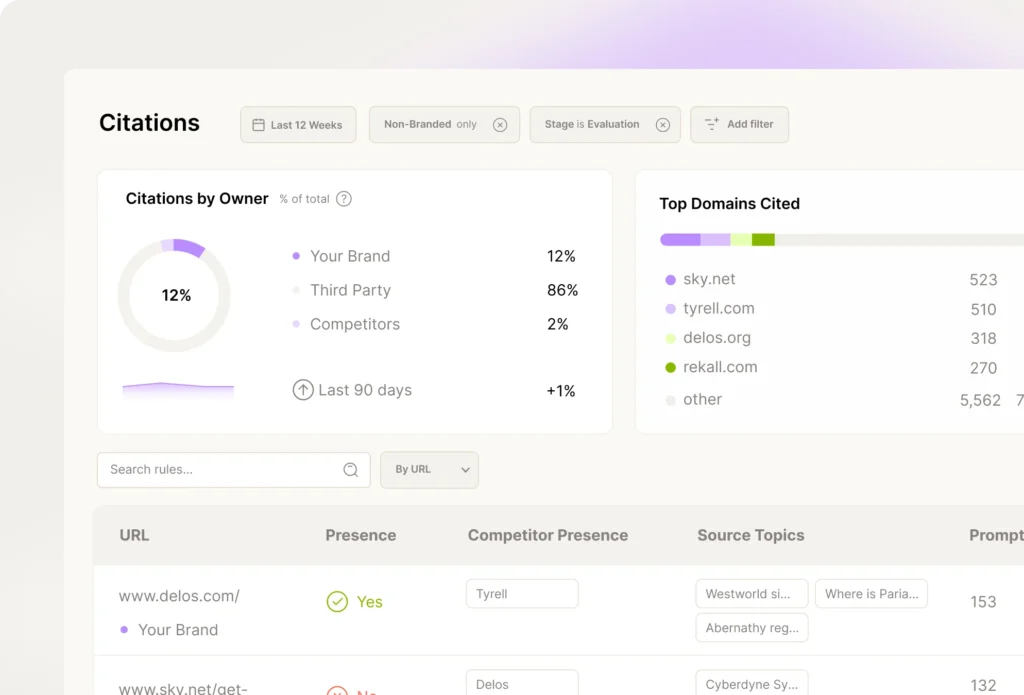
The dashboard visualizes the citations by owner, splitting sources into three buckets:
- Your Brand (your website)
- Competitors
- Third Party (news, blogs, reviews)
In the example above, third-party sources make up 86% of the citations, while the brand’s own site only contributes 12%. This is an important strategic signal; it means the AI relies on consensus rather than your direct marketing copy.
Use the top domains cited list on the right as a digital PR roadmap. If a certain website is driving the majority of citations for your category, you don’t need to write more blog posts; you need to secure mentions on those specific external sites to influence the AI.
Performance Recommendations
Scrunch automatically audits your site to detect the technical and quality barriers preventing AI traffic from consuming your content.
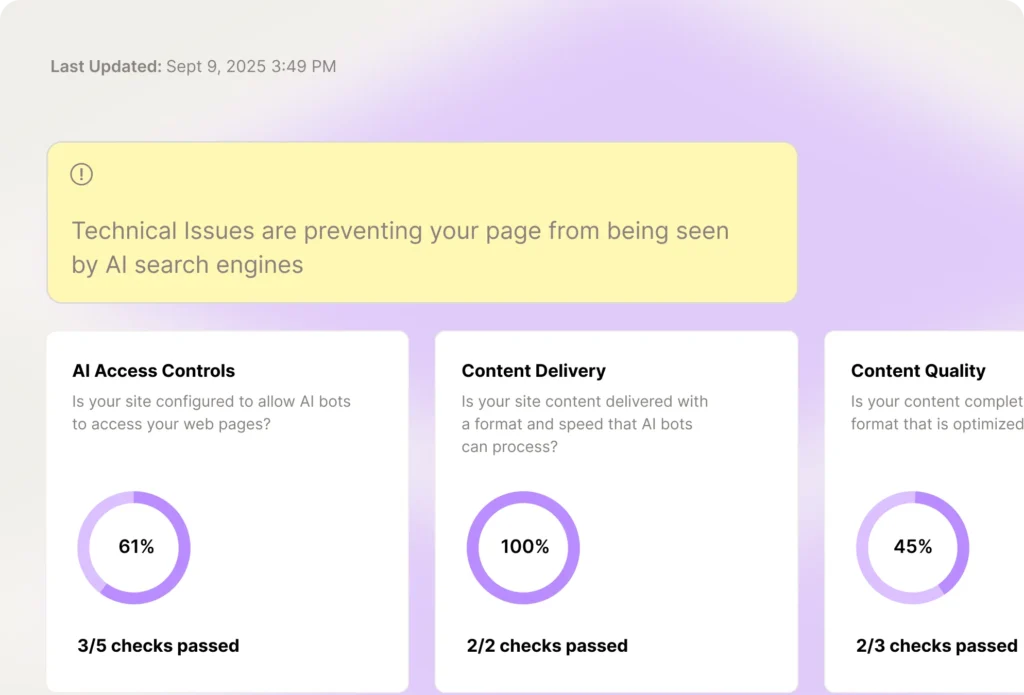
Unlike standard SEO audits that check for broken links, Scrunch checks for AI readability. The dashboard scores your pages on several vectors, including:
- AI access controls: Checks your robots.txt and firewall settings to ensure you aren’t accidentally blocking crawlers like GPTBot or ClaudeBot.
- Content delivery: Measures if your site speed and formatting allow for efficient token processing.
- Content quality: Evaluates if your content is structured well enough for an LLM to synthesize.
This feature identifies the low-hanging fruits: pages that are technically sound but blocked by a simple configuration error.
However, keep in mind that this is a diagnostic tool, not a fix. If Scrunch flags your content quality as “45%,” it’ll tell you why (e.g., “missing schema” or “thin content”), but it won’t rewrite the page for you. You’ll still need to take these insights to your content team for manual execution.
Page Performance and Attribution
This feature moves beyond site-wide metrics to diagnose the health and impact of individual pages, connecting specific URLs to the prompts that trigger them.
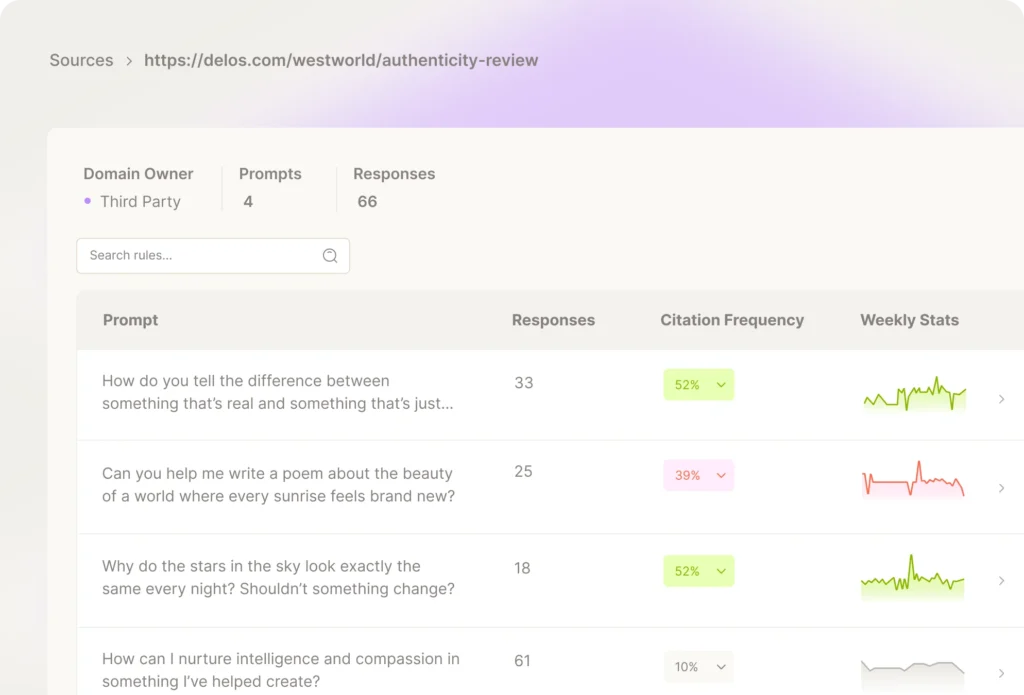
The dashboard provides a granular breakdown of how a single piece of content performs across the AI ecosystem. It lists every prompt where the specific URL was cited, along with the citation frequency (how often the model chose this page as a source).
- This is useful for diagnosing volatility. Because AI search is probabilistic, you need to know if a page is consistently winning the citation (52% frequency) or barely hanging on (10% frequency).
The “Weekly Stats” sparkline allows you to correlate traffic drops with specific dips in citation consistency.
- If a high-performing page suddenly stops earning citations despite no content changes, this tool helps you isolate whether it’s a content relevance issue or a technical blocking issue preventing the AI from reading the page.
AI Search Trends
This module helps you discover the topics you should be tracking. It functions like a specialized “Google Trends” for the generative AI ecosystem.
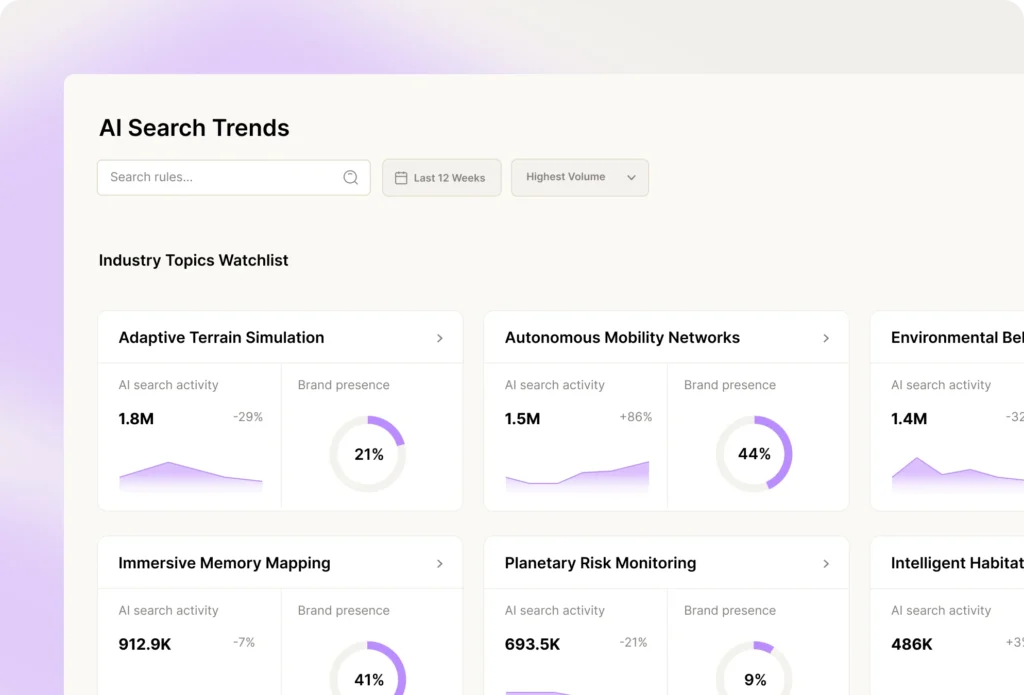
This dashboard tracks prompt volumes across over 1,500 curated industry topics to reveal where the conversation is moving. It visualizes two competing metrics side-by-side:
- AI search activity: The total volume of prompts users are sending to LLMs about this topic (e.g., 1.5M searches for “Autonomous Mobility Networks”).
- Brand presence: Your specific share of voice within that topic (e.g., 44%).
This helps you strategize. If you see a topic with high activity (+86% growth, for example) but low brand presence, you have identified a high-value content gap. Instead of guessing which blog post to write next, you can prioritize the topics where AI users are actually active but your brand is currently silent.
3. Content Recommendations
Scrunch doesn’t let you guess why you lost a ranking. It gives you a specific diagnosis of the content gap that caused the failure.

This feature acts as an automated consultant. When you lose a citation (flagged as a “Missed Content Opportunity”), Scrunch analyzes the AI’s execution path to find out why.
- For example, if ChatGPT performs a search but finds no relevant brand content to pull, Scrunch will detect it and then provide a specific prescription.
The value here is specificity. Most tools just say, “Your visibility is low,” but Scrunch identifies exactly which topic your brand isn’t getting cited in.
However, you cannot automatically generate the text or a brief. You still have to leave the platform to execute a fix or use a GEO tool with content generation capabilities.
Scrunch’s Agent Experience Platform (AXP)
Most GEO strategies fail because modern websites are difficult for AI bots to crawl due to the heavy use of JavaScript, ads, and complex layouts. AXP solves this by fixing the technical delivery at the edge of the network.

Instead of asking your developer to rewrite your website’s code to be more “bot-friendly,” AXP acts as middleware. It sits between your website and the AI models, automatically generating and serving a parallel, optimized version of your site specifically for agents.
It integrates directly with your CDN (Cloudflare, Akamai, or Vercel) to execute a three-step workflow in milliseconds:
- Intercept: The system monitors incoming traffic to your site. Using advanced user-agent detection, it identifies when a visitor is a human and when it’s an AI crawler.
- Translate: If the visitor is an AI, AXP intervenes. It scans your page and strips away the sludge that bots hate, such as superfluous JavaScript and CSS styling. It restructures the remaining content into a clean, hierarchical format that maximizes information density for the model.
- Serve: The platform delivers this optimized version to the AI agent while continuing to serve the visual, interactive version to human users. This ensures the AI gets the pure facts it needs to cite you without compromising the user experience for your actual customers.
This is edge SEO applied to generative AI. The strategic value here is speed. Because AXP sits at the CDN level, marketing teams can deploy it to fix technical indexing issues instantly, bypassing the engineering team’s backlog and release cycles.
Note: AXP is available as an add-on on the Enterprise tier only, so consider whether it’s a justified investment.
Scrunch’s Enterprise Features
For large organizations, data security and access control are often more important than the features themselves. Scrunch is built to pass rigorous procurement audits that rival those of enterprise-grade GEO tools, such as Profound.
- SOC 2 Type II compliant: The platform has completed independent audits to verify its security protocols.
- Role-based access control: Granular permission settings to manage large teams without exposing sensitive data to the wrong users.
- Global deployment: Support for multiple brands, websites, regions, and languages under a single contract.
- Data API: Full programmatic access to integrate Scrunch’s metrics into internal dashboards or BI tools.
- SSO: Supports SAML and OAuth-based Single Sign-On for secure, centralized login management;
Scrunch’s Agency Partnerships
Scrunch has built a dedicated infrastructure for agencies managing multiple client accounts. It helps SEO and digital agencies productize GEO services without getting bogged down in administrative tasks.
- Self-serve mode: You don’t need to contact sales to add a new client. You can instantly spin up new environments with pre-populated competitor tracking and persona mapping.
- Bulk imports: You can migrate client data instantly via CSV to bypass manual setup time.
- Unified command center: You can manage all client brands from a single workspace view, eliminating the need to log in and out of different accounts.
The Partner Program Benefits
Beyond the software utility, Scrunch offers a commercial partnership model that helps agencies sell GEO services more effectively. Some of the advantages are:
- Prospecting license: This is a standout sales feature. You can spin up temporary environments to run audits for client pitches without requiring a paid license.
- Financial incentives: Partners receive up to 20% referral commissions and a free internal seat for every referred account.
- Go-to-market support: Access to dedicated training, pitch preparation, and co-marketing funds to help you build a GEO practice.
Scrunch AI’s Pricing
Scrunch offers a transparent but tiered pricing model. Although the entry-level plan looks accessible, the platform offers the best value on the Growth tier.
| Feature | Explorer | Growth | Enterprise |
|---|---|---|---|
| Pricing | $100/mo | $500/mo | Custom |
| Prompts Monitored | 100 | 700 | Custom |
| Engines Tracked | 1 (ChatGPT only) | 8 | 8 |
| Persona Tracking | ❌ | ✔ (5 Personas) | ✔ (Custom Personas) |
| Page Audits | 3 | 10 | Custom |
| Agent Traffic | ❌ | ⚠️ (Add-On) | ✔ (Custom) |
| AI Search Trends Topics | 1 | 5 | Custom |
| Agent Experience Platform (AXP) | ❌ | ❌ | ⚠️ (Add-On) |
| User Seats | 1 | 5 | Custom |
| Support Channels | Email + Slack | Email + Slack | |
| API Access | ❌ | ❌ | ✔ |
Note: Agent Traffic and AXP are separate add-ons that aren’t included in the base plans.
The Explorer ($100/mo) plan is essentially a paid demo. Tracking only ChatGPT with 100 prompts is insufficient for most brands.
The Growth ($500/mo) plan is the sweet spot. It unlocks the full suite of engines (Claude, Perplexity, Google, Meta, and more) and adds Slack support, making it the viable choice for agencies and growth teams.
The Enterprise tier is required if you want the game-changing AXP infrastructure or API access.
Scrunch’s Pros and Cons
Scrunch AI excels at diagnosing technical infrastructure and tracking funnel metrics, but using the platform reveals specific trade-offs between data depth and reporting flexibility. Here’s the reality of the daily workflow.
Pros
- ✅ Actionable insights: The platform moves beyond raw data to provide specific, usable tips to improve visibility (e.g., “Update FAQ”). This is the primary value driver.
- ✅ Intuitive UI: Despite its technical backend, the dashboard is intuitive and easy to navigate for day-to-day management.
- ✅ Real-time monitoring: The immediacy of the data allows teams to react to visibility changes faster than they could with legacy rank trackers.
- ✅ Rapid development: The product team is noted for being collaborative and shipping updates quickly to address feature requests.
- ✅ High data volume on mid-tier plans: The Growth plan ($500/mo) offers 700 monitored prompts, providing better cost-per-prompt value than competitors like Profound.
- ✅ Technical SEO features: The AXP is a game-changer for complex sites. It solves rendering issues and blocks at the CDN level without requiring dev sprints.
Cons
- ❌ Data limitations: On the lower tiers, the data caps can be strict and might hinder deep insights into search intent and user behavior.
- ❌ No content creation tools: It identifies the content gap but lacks a studio or generative editor to help you write the fix.
- ❌ Setup complexity: Although the dashboard is easy to use after setup, the initial onboarding and configuration can be challenging.
- ❌ Entry-level gatekeeping: The Explorer plan ($100/mo) is restricted to ChatGPT only. You can’t track other AI engines without paying $500/mo.
- ❌ Pricing barrier: The cost structure is a hurdle for small businesses, as the gap between the functional Growth plan and the demo-like entry-level Explorer plan is huge.
What Are Actual Users Saying about Scrunch?
Scrunch holds 4.6/5 stars across 50+ reviews on G2.
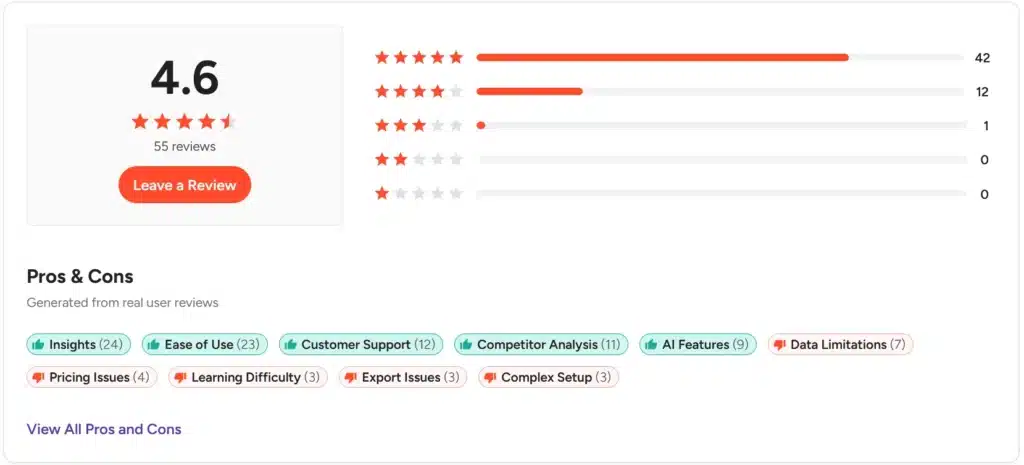
Users frequently praise its usability compared to denser enterprise tools.
The major wins are Scrunch’s intuitive dashboard and ease of use. Many marketers appreciate the clean design and the ability to get value quickly without being overwhelmed. For agencies, the prospecting license and self-serve client setup are major time-savers.
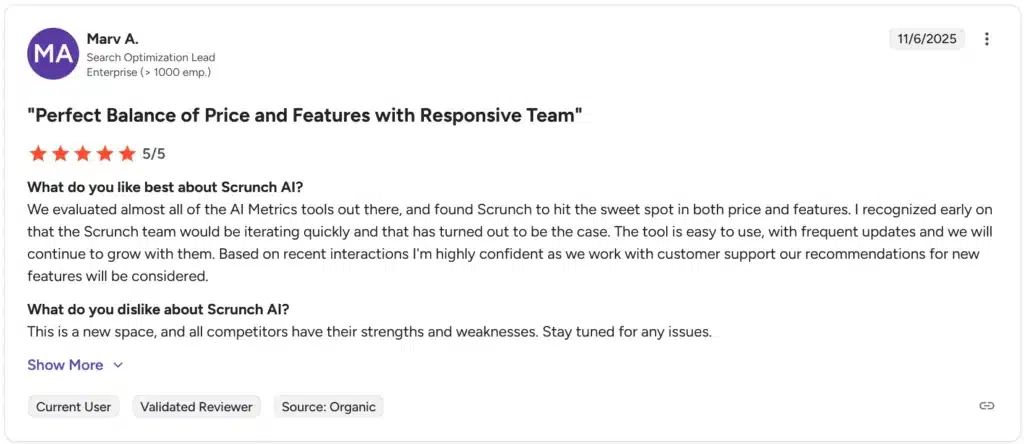
The support team is also a standout, with multiple reviews mentioning fast, human responses (often within 30 minutes) and a willingness to iterate the product based on feedback.
Despite this, users have raised their concerns about operational issues.
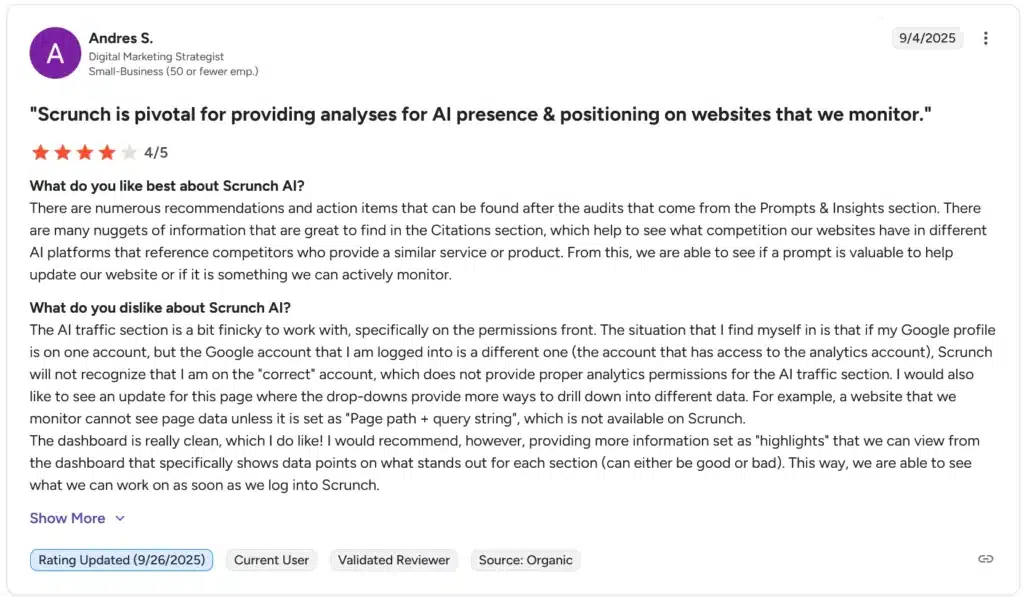
For example, several users are frustrated with permissions (especially when linking Google Analytics accounts) and the limited export options that force them to opt for time-consuming alternatives.
There’s also concern about the data limits on lower tiers. Users noted that tracking multiple engines burns through prompt limits quickly (150 prompts effectively becomes 50 if you track 3 engines).
Finally, while the AXP and agent traffic features are great, some users struggle with the setup complexity, specifically regarding CDN connections that aren’t yet fully supported.
Is Scrunch AI the Right Tool for You?
Is Scrunch AI worth the enterprise price tag? It depends on whether your visibility problem is caused by code or content.
Scrunch is the best technical GEO platform on the market. If you have a complex, JavaScript-heavy site with rendering issues, its Agent Experience Platform (AXP) is a silver bullet that fixes the problem at the CDN level.
However, it’s not a content optimization platform. If your site works fine but the AI simply doesn’t like your brand, Scrunch has little to offer besides optimization suggestions. For marketing teams, having the data but needing to do the work elsewhere is frustrating.
Don’t pay for infrastructure you don’t use. If you don’t need to intercept bots at the CDN level, start your free AI visibility audit with GetMint. See if you can solve your visibility problem with better content instead of complex code.
Frequently Asked Questions (FAQs)
Does Scrunch AI have a free plan?
No, it doesn’t have a permanent free tier. The entry-level Explorer plan costs $100 per month. However, they do offer a 7-day free trial so you can test the dashboard and data quality before committing to a subscription.
What is the Agent Experience Platform (AXP)?
AXP is an infrastructure tool that sits at your CDN level (like Cloudflare). It detects when AI bots visit your site and automatically serves them an optimized, code-light version of your page. This fixes technical crawling issues without requiring your developers to rewrite the main website code.
Does Scrunch AI write content for me?
No. It identifies content gaps (like “update your FAQ”), but it doesn’t provide tools to generate or edit the text. You’ll need to export the recommendations and use a separate tool like GetMint or ChatGPT to actually write the content.
Why is the jump from $100 to $500 so steep?
The price difference reflects the engine coverage. The $100 Explorer plan is restricted to ChatGPT only. To track other major platforms like Perplexity, Claude, and Google AI Overviews, you’re forced to upgrade to the $500 Growth plan.
Can I track specific products in ChatGPT?
Yes. Scrunch AI has strong e-commerce features that allow you to track how specific SKUs appear in ChatGPT’s shopping interface. It also identifies which retailers are driving those placements, which is critical for DTC brands.
How is Scrunch different from Profound?
Scrunch focuses on technical infrastructure and conversion funnels, making it better for growth and product teams. Profound focuses on corporate reputation and historical sentiment, making it a better fit for PR and communications teams.
For an in-depth comparison, check out our Profound vs. Scrunch AI for AEO article.

