


Generative Engine Optimization (GEO) has a metric problem. We can track visibility and sentiment, but when the CFO asks, “How much revenue did ChatGPT drive this quarter?” most marketers have to guess.
AthenaHQ attempts to fix this gap. Unlike tools focused strictly on reputation or infrastructure, it focuses on attribution and automation. It’s one of the few platforms offering direct Shopify and GA4 integrations to connect AI visibility to actual dollars.
But is the “Agent” technology mature enough to trust with your brand voice? And does the $295/month price point make sense for teams just starting out?
In this AthenaHQ review, we dissect the Action Center, the “ACE” engine, and the agency ecosystem to determine if it’s a revenue engine or just another dashboard.
What Is AthenaHQ?
AthenaHQ is an AI visibility platform designed to automate GEO and measure its financial impact. It moves beyond simple rank tracking by using autonomous agents to identify content gaps and draft optimizations at scale.
Most importantly, it connects these visibility metrics directly to business outcomes to quantify exactly how AI search visibility contributes to your brand’s bottom line.
AthenaHQ’s standout features include:
- Action center agents: Autonomous workflows that analyze content gaps and draft optimizations to align with AI ranking factors.
- Revenue attribution: Native integrations with Shopify and Google Analytics to correlate AI visibility with actual sales and traffic.
- Athena Citation Engine (ACE): A proprietary algorithm that predicts citation probability and tracks on-page and off-page signals.
- Agency infrastructure: Dedicated tools for client management, lead routing, and generating white-labeled pitch reports.
Who Is AthenaHQ For?
AthenaHQ is engineered for agencies and e-commerce brands operating at scale.
- For agencies, AthenaHQ provides specific infrastructure for partners, including Pitch Workspaces to close deals quickly and a lead routing program that sends qualified clients directly to certified agencies.
- For e-commerce brands using Shopify, AthenaHQ offers revenue tracking capabilities. It’s essential for DTC teams that need to justify GEO spend to finance departments.
- For enterprise marketing teams, the platform’s agents are designed for volume. If you need to optimize thousands of product pages, the automated workflows offer a scalability that manual teams can’t match.
However, AthenaHQ is likely overkill for early-stage startups or solopreneurs. The $295/mo entry price and credit-based consumption model fit organizations with dedicated marketing budgets, not lean teams looking for an entry-level GEO tool.
AthenaHQ’s AI Visibility Features
AthenaHQ has four main capabilities: prompt analysis, action, e-commerce, and monitoring. We’ll break down each one to see how much value AthenaHQ brings to the table.
1. Prompt Volume (Enterprise Only)
One of the biggest challenges in GEO is the zero-volume problem. Traditional SEO tools give you exact search volumes for keywords, but most AI tracking tools can only tell you if you rank, not how many people are actually asking the question.
AthenaHQ addresses this with a dedicated forecasting module, though it’s currently restricted to the enterprise plans.
Query Volume Estimation Model
Prioritizing your roadmap is difficult when you don’t know which prompts drive traffic. Athena uses a proprietary machine learning model to estimate the monthly queries for specific AI prompts.
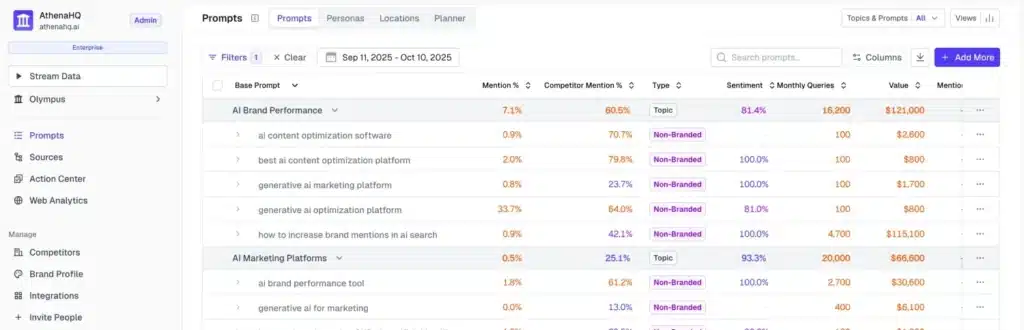
The standout metric here isn’t just the volume; it’s the value. Athena assigns a dollar value to the prompt traffic. This allows you to speak the CFO’s language. Instead of saying, “We need to rank for ‘AI Brand Performance,’” you can say, “We’re targeting a topic worth $121,000 in monthly potential value.”
However, these numbers are estimates based on modeling, not direct server logs from the AI model. Use them as directional signals for prioritization, not as hard financial facts for accounting.
Trending Prompts
AI search patterns shift faster than Google algorithms. This feature helps you spot emerging patterns within your specific vertical before they become mainstream keywords in traditional tools.

It’s essentially a “first mover” advantage. If you identify prompts early, you can create content that satisfies the AI’s information void. Meaning if you answer a question before the internet is flooded with articles about it, you become the primary citation source by default.
Region-Based Analysis
All models behave differently across borders due to variations in training data and regional regulations (e.g., GDPR in Europe vs. US data). Athena breaks down prompt analysis by region.
This is non-negotiable for global brands. A strategy that wins on ChatGPT in New York might fail in London because the model favors different local publishers. However, if you’re a strictly domestic brand, you probably won’t need this feature.
Warning: Because this module is Enterprise only, self-serve users on the $295/mo plan are flying blind regarding volume. They have to rely on third-party tools or guesswork to determine if a prompt is worth targeting.
2. Monitoring
Most GEO tools track the output (what ChatGPT says). AthenaHQ also tracks the input (when ChatGPT visits). It tries to treat AI bots like a distinct segment of website traffic by connecting directly to your infrastructure.
AI Traffic Identification
This feature tracks AI traffic just like you track human visitors in Google Analytics. AthenaHQ integrates with infrastructure providers like Vercel, Webflow, and Cloudflare to identify when AI agents are crawling your site.
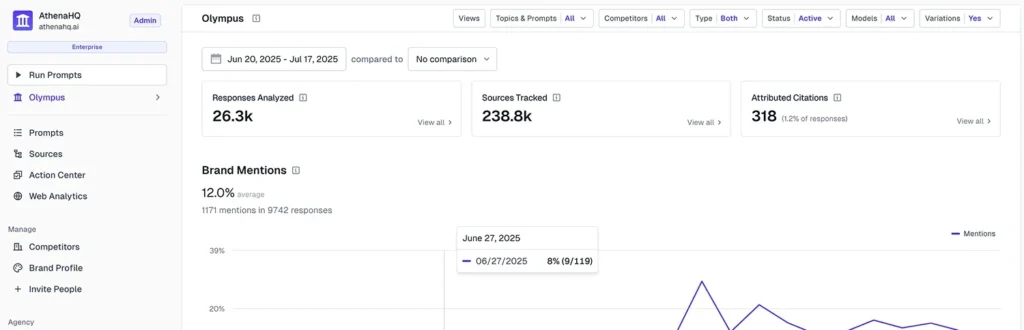
This bridges the gap between technical SEO and content strategy. It tells you if your site is actually being indexed. If you see zero AI traffic from the GPTBot user agent, you know your content isn’t making it into the model’s short-term memory, regardless of how good your writing is.
Note: This requires more technical configuration than a standard rank tracker. You (or your dev team) need to connect AthenaHQ to your CDN or hosting provider to get this data.
Live Shareable Dashboards
This is a specific win for agencies. It makes it easy for clients to check their status anytime without emailing you for a report.
However, real-time data can be volatile. AI rankings fluctuate daily, so a client checking the dashboard every hour might panic over minor variances that are just statistical noise.
Competitor and Citation Monitoring
Like most AI visibility platforms, AthenaHQ tracks who is citing you and how you stack up against rivals. It provides geographical data to show how your visibility shifts across different global markets.
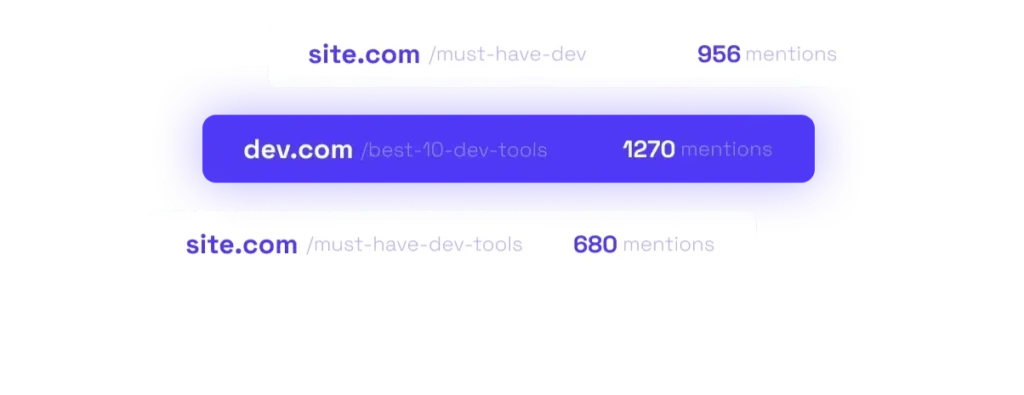
This feature is standard for the industry, but AthenaHQ’s geographical breakdown makes it extremely useful for global brands. AI models are often regionalized; if you don’t track by region, you might think you’re winning globally when you’re actually only visible in North America.
3. Action Center
The Action Center is AthenaHQ’s engine room. It closes the execution gap that plagues passive tools like Scrunch AI. Instead of just flagging a content gap, it uses automated agents to help you fill it.
Custom Recommendations
AthenaHQ analyzes your specific vertical to identify AI knowledge gaps. These are concepts or entities where the AI models lack sufficient data to form an opinion about your brand, not just standard SEO keyword gaps.
This is critical for defensive GEO.
- If an AI doesn’t know your pricing structure, it’ll hallucinate one. AthenaHQ flags these specific informational voids so you can inject the facts before the model makes them up.
- Unlike generic SEO tools that suggest keywords, AthenaHQ suggests narratives (e.g., “The AI doesn’t understand your enterprise security features”).
On-Brand Content Agents
This is the platform’s flagship automation feature. AthenaHQ allows you to draft and refresh content at scale using AI agents.
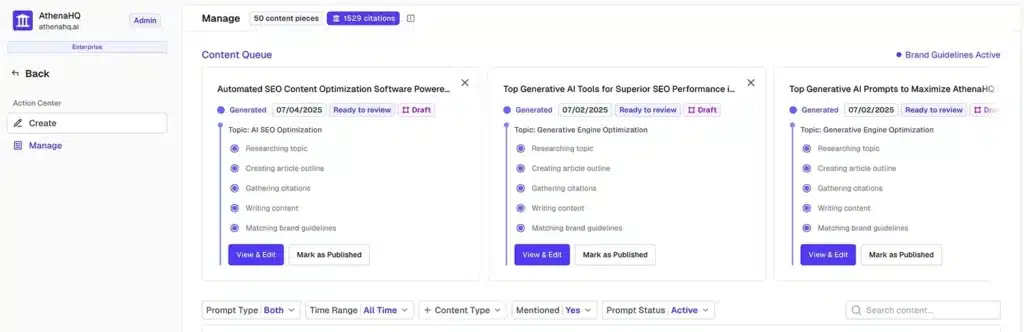
This functions like a refresh engine. You can point an agent at an underperforming page, and it’ll rewrite sections specifically to target the citation logic of models like Perplexity or Claude.
This feature is the primary reason to choose AthenaHQ over a more affordable tool like Writesonic. It wins on scale; if you have 500 product pages that need to be updated for GEO, a human team will take months. AthenaHQ’s agents can do it in days (provided you have the credits).
Note: Automation still requires supervision. While AthenaHQ claims on-brand voice, agent output can drift into generic AI-speak if not rigorously configured. It’s a force multiplier, not a replacement for an editor.
Athena Citation Engine (ACE)
Underpinning these recommendations is the ACE algorithm. This proprietary engine reverse-engineers the probability of a citation. It analyzes on-page and off-page signals to predict why a source is being cited, guiding the agents on how to structure the content to win that specific spot.
This helps move content strategy from guesswork to probability. Instead of writing blindly, you’re optimizing against a specific citation threshold.
4. E-Commerce
This module attempts to solve the single hardest problem in the GEO industry: proving ROI.
For most marketers, AI search traffic is a black box. Because platforms like ChatGPT don’t always pass referrer data (or are zero-click), it’s difficult to tell a finance director that the $300/mo tool is actually generating sales.
AthenaHQ integrates directly with Shopify to bridge this gap.
Revenue Attribution from AI Search
This feature moves GEO from a brand awareness metric to a performance marketing metric. AthenaHQ claims to attribute revenue back to AI search visibility by connecting with your Shopify store data.

This makes it a holy grail for DTC brands; if you can prove that a spike in ChatGPT citations correlated with a spike in sales for a specific SKU, the tool pays for itself immediately.
For finance teams, this closes the loop between GEO visibility and the sales metrics that matter most.
Note: Attribution in the AI era is notoriously difficult. AthenaHQ likely uses a mix of correlative modeling and referrer tracking. It works well, but you should treat it as a directional signal rather than perfect accounting.
Shopify Integration and Publishing
Beyond tracking money, AthenaHQ speeds up the workflow to make it.
This is a game-changer. Shopify’s native blogging tools are basic. Instead of copy-pasting from ChatGPT to a Google Doc to Shopify, you can generate GEO-optimized blogs in AthenaHQ and publish them directly from the platform to your Shopify store.
For e-commerce SEO teams managing hundreds of product collection pages, this removes a major manual bottleneck.
This matters because competitors like Hall AI track if your product appears in the shopping cart, whereas AthenaHQ tracks if that appearance turned into dollars. That’s the distinction C-Suites care about.
AthenaHQ’s Agency Partnerships
Most GEO platforms simply offer multi-seat dashboards for agencies. AthenaHQ goes a step further by building an ecosystem designed to help agencies win new business, not just manage existing accounts.
It facilitates this through Pitch Workspaces (sales enablement) and Lead Routing (demand generation).
Pitch-Ready Workspaces
This feature reduces the cost of acquisition for agencies. You can generate comprehensive visual reports in less than 5 minutes to show a prospect their current AI visibility gaps.
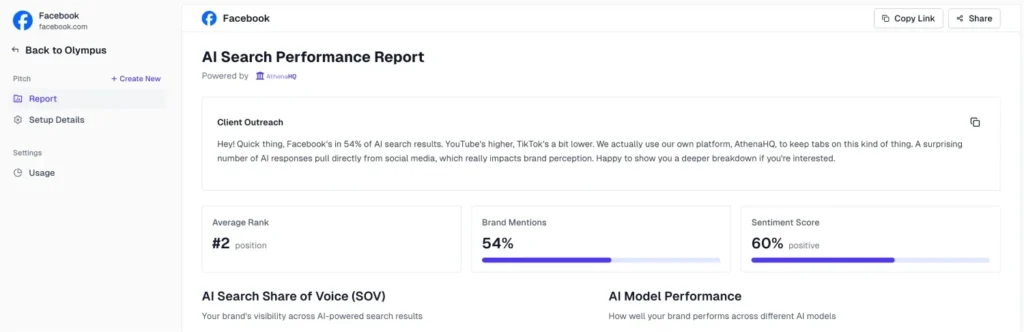
Instead of spending hours auditing a prospect manually to build a proposal, you can spin up a pitch workspace to create a shock-and-awe report that visually demonstrates why they need your services.
Client Lead Routing
This is the killer feature for the agency persona. AthenaHQ claims to route qualified client leads directly to certified partners. If a brand contacts AthenaHQ but needs managed services, it hands that lead to a partner matched by industry focus.
- This changes the match entirely. If AthenaHQ sends you one high-value client, the subscription cost becomes irrelevant. It effectively turns the tool into a lead generation channel.
- However, you need to be a certified partner to qualify, which implies an investment of time and training.
Athena structures its support and benefits based on the volume of brands you manage.
| Tier | Requirement | Benefits |
|---|---|---|
| Bronze | <5 Brands | Certification, Slack Support, Webinar Invites |
| Silver | 5+ Brands | Volume Discounts, On-Demand Support, Monthly Case Studies |
| Gold | 20+ Brands | Dedicated Strategist, White-Glove Integration, Joint Event Sponsorships, Agency Spiffs |
The jump from Silver to Gold is significant. Gold partners essentially get a dedicated strategist (similar to Profound’s enterprise offer) and joint event sponsorships, which hints at a high level of co-marketing support.
However, managing 20+ brands on a premium platform is a high barrier to entry for boutique shops.
AthenaHQ’s Enterprise Features
For large organizations, the ability to deploy software often hinges on security audits rather than feature sets. AthenaHQ has built a compliance stack designed to pass rigorous procurement reviews.
- GDPR Compliance: Fully compliant with EU General Data Protection Regulations.
- NIST Cybersecurity Framework: Implemented at Tier 3 (Repeatable) of the CSF 2.0 standard, meaning the approach to risk management is mature and process-driven.
- SOC 2 Certification: Currently holds AICPA SOC 2 Type 1 certification (October 2025), with the Type 2 observation period underway.
This level of documentation puts it on par with platforms like Profound and seoClarity for enterprise-readiness.
AthenaHQ’s Pricing
AthenaHQ uses a bifurcated pricing model: a credit-based Self-Serve plan for most businesses and a custom Enterprise plan for global organizations.
| Feature | Self-Serve Plan | Enterprise Plan |
|---|---|---|
| Price | $295/mo | Custom |
| AI Engines | 8+ | 8+ |
| Credits | 3,600/mo | Custom |
| Topics | Unlimited | Unlimited |
| User Seats | 3 | Unlimited |
| Revenue Attribution | ✅ (Shopify/GA4) | ✅ (Shopify/GA4) |
| Content Agent | ⚠️ Base Version | ✅ Advanced Version |
| Citation Engine (ACE) | ❌ | ✅ |
| Persona Targeting | ❌ | ✅ |
| Global Tracking | ❌ | ✅ |
| BI Integrations | ❌ | ✅ (Tableau, Looker) |
| Support | Standard | Dedicated Strategist |
Note: AthenaHQ’s introductory offer lets you try the Self-Serve plan for $95 in the first month. The standard renewal price for this plan is $295/mo.
The biggest win for the self-serve is unlimited topics. Most competitors cap you at 50 or 100 keywords and a few topics; AthenaHQ lets you track as many topics as your credit limit allows, giving you broader coverage if you manage your credit burn carefully.
However, the most advanced strategic features (specifically the persona targeting and the ACE engine) are locked behind the Enterprise wall. If you need to segment your data by buyer persona (e.g., “CTO” vs. “Developer”), the $295 plan won’t suffice.
AthenaHQ’s Pros and Cons
After analyzing the platform’s capabilities and pricing structure, here’s where AthenaHQ excels and where it falls short compared to other GEO tools.
Pros
- ✅ Revenue attribution: The Shopify and GA4 integrations solve the ROI problem. Being able to connect AI visibility directly to sales dollars is a massive advantage for e-commerce brands.
- ✅ High-volume automation: The agent workflow allows you to optimize content at a scale that manual tools can’t match. If you have 1,000 pages to fix, this is the most efficient way to do it.
- ✅ Unlimited topics: Unlike competitors who cap your prompts and topics, AthenaHQ lets you track unlimited topics on the base plan, provided you have the credits for them.
- ✅ Agency growth tools: The pitch workspace and lead routing program turn the software from a cost center into a potential revenue generator for agencies.
Cons
- ❌ Credit-based pricing: The consumption-based pricing model makes monthly costs unpredictable. Heavy usage during a launch or audit can burn through your allowance faster than a flat-rate plan.
- ❌ Steep entry price: At $295/month, the starting price is much higher than competitors like GetMint (€99), pricing out smaller teams.
- ❌ Enterprise gatekeeping: Important features like the ACE engine, persona targeting, and global tracking are locked behind the custom Enterprise tier.
- ❌ Setup learning curve: Configuring autonomous agents to match your brand voice requires more technical setup than a simple “click-to-generate” content studio.
What Are Actual Users Saying About AthenaHQ?
AthenaHQ holds a 4.6/5-star rating on G2. Users primarily appreciate the platform’s productivity gains, citing the automated agents and intuitive dashboard as major time-savers. They’re also happy with the responsive and helpful customer support team.
However, several users have noted minor bugs and glitches typical of a fast-moving startup, and some find the frequent feature updates difficult to keep up with.
There are specific complaints about data opacity, with users further requesting better visibility into how prompt volumes and credit usage are calculated.
Is AthenaHQ the Right Tool for You?
AthenaHQ is pushing the boundaries of GEO by turning visibility into a performance channel. If you’re a large agency or Shopify brand needing to prove ROI to a CFO, the $295/mo price tag is easily justifiable.
However, for content teams and SaaS brands, the platform often feels like enterprise overkill. The steep learning curve and credit-based consumption model can complicate simple workflows, creating administrative bottlenecks rather than removing them.
Final Verdict: A Smarter Way to Execute
If you need to move fast without the enterprise overhead, GetMint is the superior choice.
It bypasses the complex agent configuration and credit anxiety, offering a streamlined workflow to identify gaps and generate optimized answers instantly. It’s designed to help you execute, not just analyze.
Don’t let credit limits dictate your strategy. Start your free AI visibility audit with GetMint and turn your visibility into action today.
Frequently Asked Questions (FAQs)
Does AthenaHQ have a free plan?
No. AthenaHQ does not offer a permanent free tier. They offer a free audit and a discounted first month ($95), but the standard renewal price for the self-serve plan is $295/month.
How do Athena credits work?
Athena uses a consumption model. Every time you query an AI model, analyze a prompt, or run a content agent, it costs a specific number of credits. The self-serve plan includes 3,600 credits/month. Heavy users tracking daily keywords often burn through this allowance quickly.
Can I track revenue from ChatGPT?
Yes, if you use Shopify. AthenaHQ integrates with Shopify and Google Analytics 4 (GA4) to attempt to attribute revenue and traffic back to specific AI citations. This is one of its strongest unique selling points.
Does AthenaHQ write content for me?
Yes. The platform uses “Content Optimization Agents” to rewrite and optimize content automatically. While powerful for scale, these agents require configuration to ensure they match your specific brand voice and don’t produce generic AI text.
Can I use Athena for international SEO?
On the self-serve plan, no. The $295/month plan is restricted to a single country. To track multi-region performance (e.g., US vs. UK), you must upgrade to a custom Enterprise contract.

