


AI search requires infrastructure bots can crawl and content worth ranking. Most teams optimize one while ignoring the other.
That’s the fundamental difference between Scrunch AI and AirOps.
Despite both targeting AI visibility, they’re not competitors. Scrunch AI is infrastructure; it fixes technical delivery and monitors rankings. AirOps is production; it scales content workflows at volume.
Feature-for-feature comparisons miss the point entirely. They solve opposite problems.
This guide breaks down what each tool actually does and which bottleneck is killing your visibility.
Scrunch AI vs AirOps: At a Glance
Here’s a direct comparison of the two platforms, focusing on their entry paid tiers and main capabilities.
| Feature | Scrunch AI (Explorer) | AirOps (Solo) |
|---|---|---|
| Entry Price | $100/mo | Usage-Based |
| Primary Focus | Infrastructure and Monitoring | Content Production |
| Unique Feature | Agent Experience Platform | Logic Grids and Workflows |
| Content Creation | ❌ (Recommendations Only) | ✅ (20,000 Tasks) |
| Tech Infrastructure | ✅ | ❌ |
| Tracked Prompts | 100 | 100 |
| Tracked Engines | ChatGPT | ChatGPT |
| User Seats | 1 | 1 |
| User Personas | 1 | 1 |
| Integration Point | Cloudflare/Akamai/Vercel | Webflow |
Which Platform Solves Technical Bottlenecks?
Modern websites, especially those built with heavy JavaScript or complex frameworks, are often difficult for AI crawlers to read. If a bot can’t render your page quickly, it skips you. This technical invisibility can’t be fixed by content.
Scrunch AI’s Edge-Level Optimization
Scrunch AI addresses this with its Agent Experience Platform (AXP). This is a piece of middleware that sits at your CDN level (Cloudflare, Akamai, or Vercel).

Here’s how it works:
- Intercept: It detects when an AI bot (like GPTBot) visits your site.
- Translate: It instantly creates a sanitized, text-heavy version of your page that strips away ads, tracking scripts, and complex styling.
- Serve: It delivers this optimized version to the bot while showing the normal site to humans.
This fixes rendering issues and blocking problems without requiring your engineering team to rewrite the website’s code.
AirOps’ Lack of Infrastructure Tools
AirOps is an application-layer tool. It assumes your website is already technically sound. It can’t modify how your site is served to bots, it doesn’t track server-level bot activity, and it relies on your existing SEO setup (or tools like Moz) to ensure your pages are indexable.
→ If your website has rendering issues, slow load times for bots, or is built on a Single Page Application (SPA) framework, Scrunch AI is the only choice. AirOps can’t fix infrastructure problems.
Which Platform Scales Content Production?
Once you know what content you need, you have to actually create it. This is where the two platforms diverge completely.
AirOps’ Content Operations Engine
AirOps automates the entire editorial lifecycle. It moves beyond simple AI writing by using Workflows and Grids to manage production at scale.
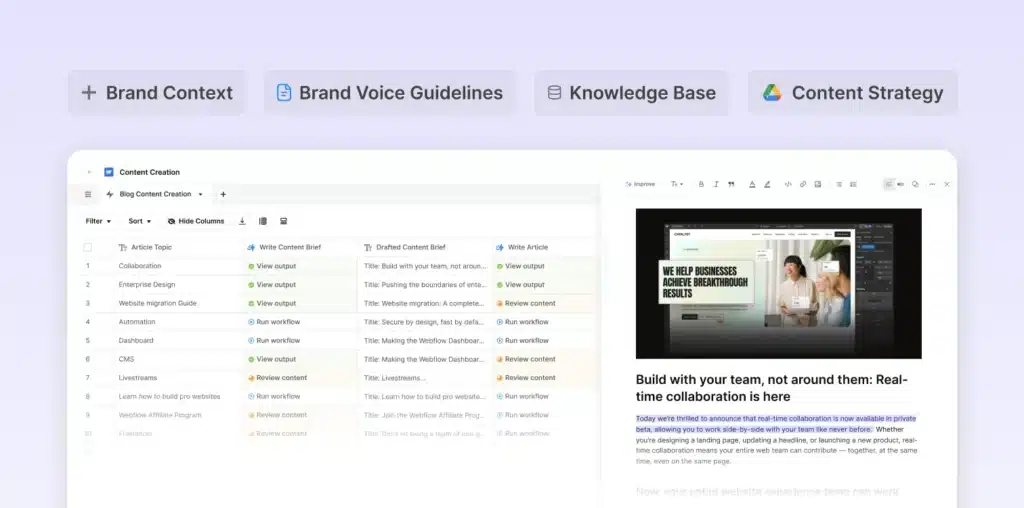
Here are some of its most notable features:
- Grids: A spreadsheet-like interface where you can manage thousands of content rows. You can trigger AI workflows for every row simultaneously (e.g., “Generate 500 product descriptions”).
- Power Agents: Pre-built workflows that handle specific SEO tasks, such as “Content Refresh” or “SEO Blog Post Generation.”
- Human-in-the-Loop: A specific review step that pauses the automation, allowing an editor to approve or tweak content before it’s pushed live to your CMS (Webflow).
Scrunch AI’s Content Insights
Scrunch AI identifies content gaps only. For example, it might tell you to update your pricing page to include enterprise features, but it won’t give you tools to execute that recommendation.

There’s no document editor or drafting tool inside the platform, it doesn’t write or rewrite text, and you must export the insights and hand them to a separate content team to execute manually.
→ AirOps wins decisively on execution. It turns strategy into published pages. Scrunch AI is purely diagnostic; it tells you what’s wrong but relies on you to fix it elsewhere.
How Do Scrunch AI and AirOps Track Visibility?
Both platforms offer “Insights” dashboards that track share of voice, citations, and ranking. However, they visualize the data differently based on their primary goals.
Scrunch AI’s Demand Generation and Funnels
Scrunch AI segments visibility data to help you understand the buyer’s journey.

The three distinct features that set it apart from AirOps are:
- Funnel Stages: It breaks down performance by stage (Awareness, Consideration, and Decision), helping you see if you’re winning informational queries but losing commercial ones.
- Broad Coverage: It tracks 8+ engines (including Claude and Copilot) on the Growth plan, giving you a complete view of the market.
- Shopping: It specifically monitors product SKUs in ChatGPT Shopping, which is indispensable for e-commerce.
AirOps’ Content Inventory and Opportunities
AirOps connects visibility data directly to your specific URL inventory.
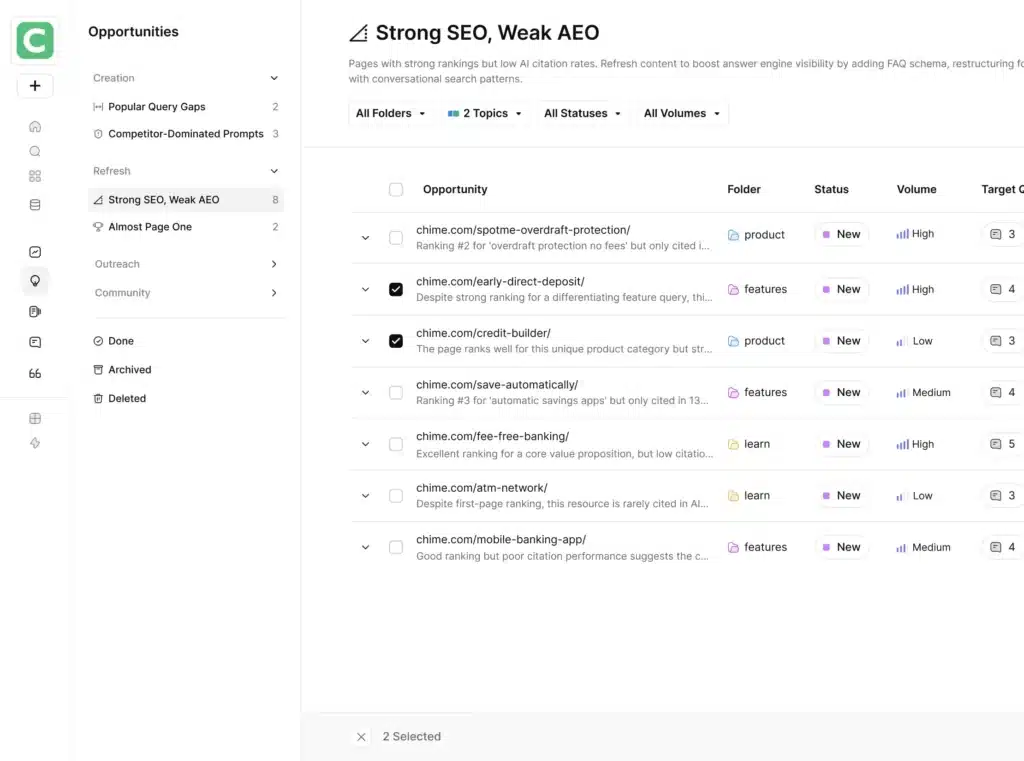
“Opportunities” are a huge plus for AirOps. Its page-centric visibility features let it map visibility metrics to your specific pages, highlighting SEO and AEO opportunities. This allows you to identify high-performing Google pages that are underperforming in AI.
However, even on Enterprise plans, AirOps is currently limited to tracking 4 engines only (ChatGPT, Perplexity, Gemini, and Google AI Mode).
→ Scrunch AI is better for deep market analysis and broad coverage (8+ engines). AirOps is better for operational content audits, provided you only care about the big four engines.
Which Tool Fits Your Role?
Because these tools solve fundamentally different problems, the “better” tool depends entirely on your job title and goal. Here’s a breakdown of which platform wins for specific scenarios.
| Your Goal | Scrunch AI | AirOps |
|---|---|---|
| I need to fix technical SEO and rendering | ✅ (Agent Experience Platform) | ❌ Missing feature |
| I need to write 500 blog posts | ❌ Manual export required | ✅ (Grids) |
| I need to publish directly to my CMS | ❌ No CMS push | ✅ (Webflow) |
| I need a human-in-the-loop review step | ❌ No workflow logic | ✅ (Review Step) |
| I need to track specific buyer personas | ✅ (Persona Filter) | ❌ Standard tracking only |
| I need to debug bot traffic logs | ✅ (Agent Analytics) | ❌ No server data |
| I need to run quick audits for client pitches | ✅ (Prospecting License) | ❌ Requires setup |
| I need to build custom internal apps | ❌ SaaS dashboard only | ✅ (Workflow Builder) |
| I need to track e-commerce/ChatGPT Shopping | ✅ (SKU Tracking) | ❌ Standard tracking only |
AirOps is the best content production solution, whereas Scrunch AI provides the infrastructure for growth and technical performance.
How Do Scrunch AI and AirOps’ Pricing Models Compare?
The cost structure of these tools proves how different their utilities are. Scrunch prices based on access and volume, whereas AirOps prices based on usage and seats.
Scrunch’s Tiered Subscriptions
Scrunch offers a traditional SaaS pricing model. You pay a flat monthly fee for a set number of prompts, engines, and feature access.
- Explorer ($100/mo): 100 prompts, ChatGPT only, 1 topic tracked, 1 user seat. Good for testing.
- Growth ($500/mo): 700 prompts, 8 AI engines, 5 personas, 5 user seats. This is the standard choice for active teams.
- Enterprise: This quote-based tier lets you customize your volume and limits. It also unlocks the Agent Experience Platform (AXP) as an add-on.
The good thing about Scrunch AI’s model is that it’s predictable; you know exactly what your bill will be every month. However, the jump from $100/mo to $500/mo is steep; it leaves a gap for small agencies who need multi-engine tracking but don’t need 700 prompts.
AirOps’ Custom Pricing
AirOps uses a unique model that combines visibility limits (prompts) with work limits (tasks). Unlike Scrunch, which charges for access, AirOps charges for execution.
A “Task” is consumed every time a workflow completes an action (like generating content or extracting data). If you exceed your monthly allotment, you aren’t cut off; you’re charged overage fees (e.g., ~$0.025 per task on Solo plans). This is flexible but makes budgeting difficult for high-volume teams.
The platform also allows you to bring your own API keys on higher tiers, which can help control model costs if you already have enterprise API agreements.
With that out of the way, AirOps offers three plans:
- Solo: You can start for free on this tier, which makes it ideal for testing. It includes 100 tracked prompts (ChatGPT only) and 20,000 Tasks for content production. It matches the prompt volume of Scrunch’s $100 plan.
- Pro: This is the “Growth” equivalent. Available as a free trial, it unlocks multi-engine insights (ChatGPT, Perplexity, and Gemini), bumps monitoring to 250 prompts, includes 75,000 Tasks, and allows unlimited seats.
- Enterprise: This tier is gated behind a sales call. It includes custom prompts and page limits and a dedicated account manager.
The 14-day free trial gives you full access to the Solo and Pro plans’ features, allowing for a deep proof of concept before signing a contract. However, it’s impossible to know your final monthly bill without a sales conversation and a complex estimation of how many “Tasks” your workflow will consume.
→ Scrunch AI offers better budget predictability with flat tiers. AirOps offers a flexible but complex consumption model that requires a sales cycle to unlock GEO features.
The Third Option: Agility Without the Engineering Tax
If you’re a technical SEO, Scrunch AI is your dream tool. If you’re a content operations architect, AirOps is your playground.
But what if you’re just a content marketer?
If you simply want to see where you rank and fix the content immediately, these tools might not match your needs. Scrunch identifies the gap but can’t write the fix. AirOps writes the fix but forces you to build complex Grids and manage Task budgets to do it.
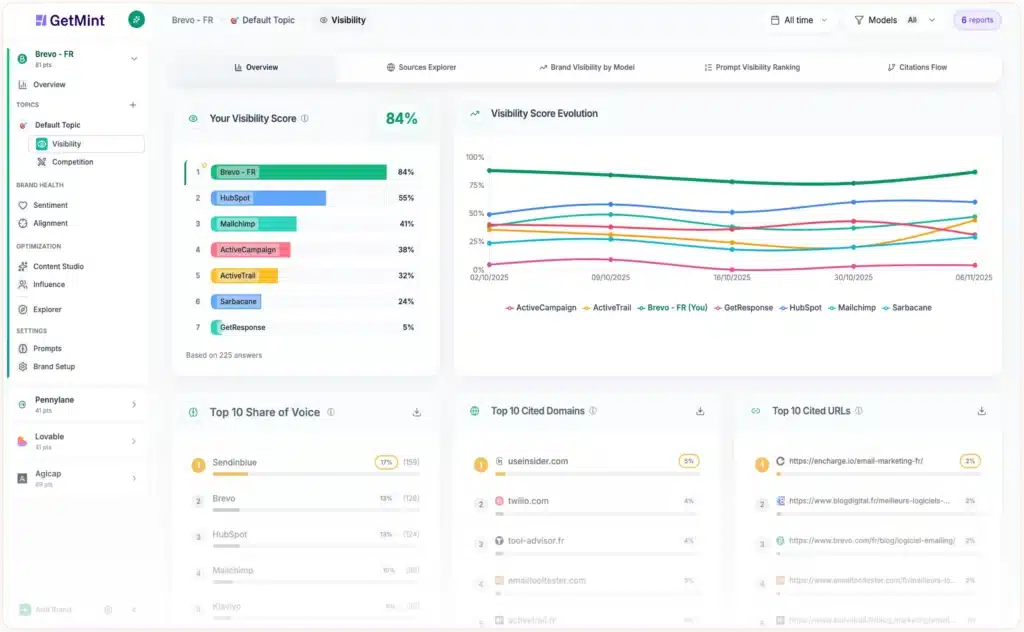
This is where GetMint fits in.
GetMint removes the server-level overhead of Scrunch and the workflow-building burden of AirOps. It’s built for teams that need actionable narrative intelligence out of the box.
1. Generous Engine Access on Starter
- Both Scrunch ($100) and AirOps (Solo) limit their entry plans to ChatGPT only. To see Perplexity or Gemini, you have to upgrade.
- GetMint’s Starter plan (€99) includes access to the three biggest AI engines: ChatGPT, Google AI Overviews, and Perplexity. You get 3x the market visibility for the same entry price.
2. Pre-Built Content Studio
- Scrunch offers no writing tools. AirOps requires you to configure Agents and logic chains.
- GetMint’s Content Studio is pre-configured for Generative Engine Optimization (GEO). You don’t build the workflow; you just click “Generate.” It analyzes the winning sources and drafts a brief or article specifically engineered to displace them.
3. Brand Focus
- Scrunch AI prioritizes your website’s infrastructure and includes a one-of-a-kind feature (Agent Experience Platform) to help you optimize for bots. AirOps prioritizes workflow operations.
- GetMint makes AI brand monitoring easy. It tracks brand health, including brand alignment and sentiment, to ensure the AI understands your value proposition, not just that it indexed your page.
Which Platform Is Right for You?
Here’s how the three platforms stack up when you compare their entry-level capabilities.
| Feature | Scrunch AI (Explorer) | AirOps (Solo) | GetMint (Starter) |
|---|---|---|---|
| Entry Price | $100/mo | Usage-Based | €99/mo |
| Engines Included | 1 (ChatGPT) | 1 (ChatGPT) | 3 (ChatGPT, AI Overviews, Perplexity) |
| Prompts Tracked | 100 | 100 | 50 |
| User Seats | 1 | 1 | 1 |
| Content Tools | ❌ None | ✅ | ✅ |
| Infrastructure Tools | ✅ | ❌ | ❌ |
| Primary Workflows | Diagnostic Dashboard | Logic Builder | Content Strategy |
| Best For | Tech SEO and E-Commerce | Content Operations | Agile Execution |
So, which tool is right for you?
- If you’re a technical SEO and e-commerce lead who needs to fix rendering issues at the CDN level (AXP) or track specific product SKUs in ChatGPT Shopping, choose Scrunch AI. Its infrastructure is your competitive advantage.
- If you’re a content operations manager who wants to build complex, multi-step workflows to generate content at massive scale, choose AirOps. Ensure you’re comfortable configuring logic grids and managing task budgets, though.
- If you’re a content marketer who wants to track the most important AI engines on day 1, and you need a tool that helps you write the winning answer without the setup time, GetMint is the logical choice.
If your website is already technically sound, Scrunch AI’s best feature might not be necessary. You shouldn’t waste your time designing complex workflows to refresh your content either, unless you’re a brand managing thousands of pages.
Over-engineering the solution is not the answer. Skip the setup time and start fixing your AI visibility with GetMint today.
Frequently Asked Questions (FAQs)
Is AirOps actually free?
No, it’s a 14-day free trial. The Solo plan allows you to start for free with 100 tracked prompts (ChatGPT only) and 20,000 task credits. It’s the most accessible entry point for individuals.
Can Scrunch AI write my content?
No. Scrunch AI identifies the opportunity (e.g., “Update your pricing page”) but offers no tools to generate the text. You must export the data and use a separate writer or tool to execute the fix.
Which tool is better for technical SEO?
Scrunch AI is the clear winner. Its Agent Experience Platform (AXP) sits at the CDN edge to fix rendering issues, speed, and blocking. AirOps has no infrastructure capabilities; it assumes your site is already technically sound.
Does GetMint replace AirOps?
For GEO content, yes. If you’re using AirOps solely to write articles for AI visibility, GetMint offers a more streamlined, pre-configured workflow. However, if you use AirOps to build internal apps (like a Slack bot or data summarizer), GetMint doesn’t replace those custom logic functions.
Why do I need to track Perplexity?
Because Perplexity cites and links to sources more frequently than ChatGPT, it’s more likely to send referral traffic to your site.
Both Scrunch (Explorer) and AirOps (Solo) ignore Perplexity on their entry plans. GetMint includes it standard, giving you visibility into the engine that is most likely to send you referral traffic.

