
Apr 29, 2026
5 Best AirOps Alternatives: Write More, Build Less in 2026
AirOps treats content creation like an engineering project. To get a single draft out the door, you often have to configure grids, chain logic steps, and manage workflows that feel closer to software development than marketing.
For technical teams, this control is great. For marketing teams, it’s cumbersome. You end up managing the software instead of focusing on Generative Engine Optimization (GEO).
But automation alone doesn’t guarantee results. To win AI search visibility, you need tools that connect your content strategy directly to what the models are actually seeing, without the setup time.
We tested the market to find the best AirOps alternatives that offer faster execution, clearer pricing, and better visibility data from day one.
Top 5 AirOps Alternatives at a Glance
We evaluated these platforms based on their ability to simplify the content workflow. We looked for tools that offer built-in GEO intelligence, faster setup times, and clearer pricing than AirOps’ custom tiers. For reference, our AirOps review covers the platform’s features in-depth.
Here’s how their entry-level plans compare.
Feature | GetMint | AthenaHQ | Writesonic* | Profound | Semrush |
|---|---|---|---|---|---|
Entry Price | €99/mo | $295/mo | $249/mo | $99/mo | $199/mo |
Unique Feature | Content Studio | Autonomous Agents | Pre-Built Wizards | Enterprise-Grade Analytics | SEO Suite |
Tracked Engines | 3 | 8+ | 3 | 1 | 3 |
Volume | 50 Prompts | 3,600 Credits | 100 Prompts | 50 Prompts | 50 Prompts |
Citation Tracking |  | | | | |
Sentiment Analysis | | |  | | |
Regions | 1 | 1 | 1 | 1 | Global |
Languages | 2 | 1 | 1 | 1 | Global |
Content Optimization | |  (Basic) | (SEO only) | | (Insights only) |
User Seats | 1 | 3 | 2 | 1 | 1 |
Support | Priority Email | ||||
Free Trial | | | | (Growth Tier Only) | |
Note: Writesonic’s GEO functionalities begin at the Professional plan ($249/mo). In our context, this tier effectively serves as the “starter” plan.
Let’s break down the specific strengths and weaknesses of each platform to see which one fits your workflow.
1. GetMint – Best for Content Strategy
The best choice for teams that want to execute high-quality content updates immediately without building complex automation grids is GetMint.
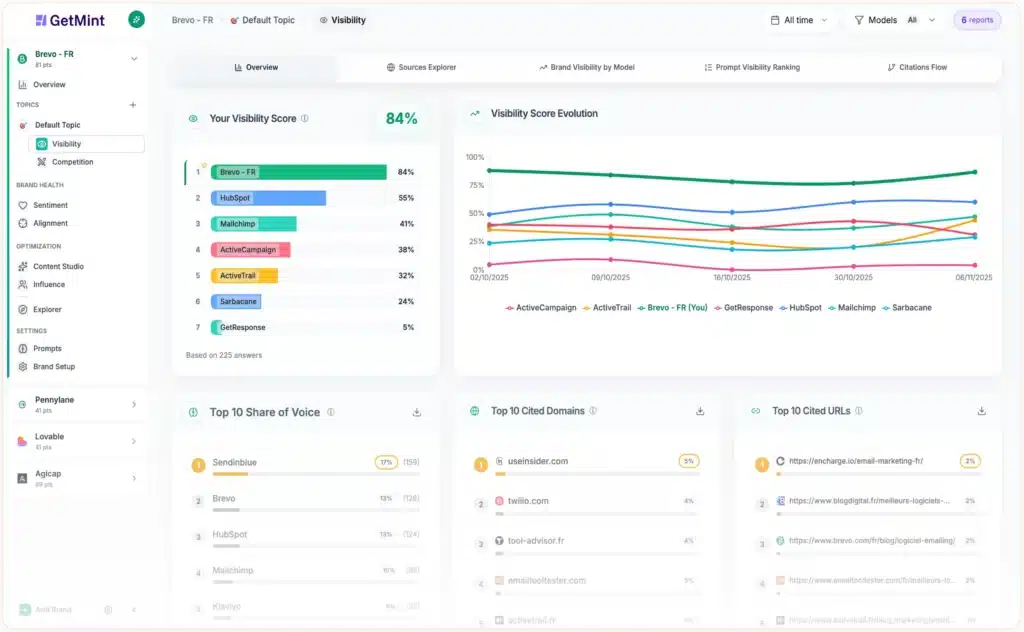
AirOps requires you to be an engineer. There are several hoops you have to jump through before getting an output: chaining steps, configuring models, and building workflows. GetMint removes the no-code complexity and gives you a pre-built engine for GEO.
Instead of managing a “grid,” you work in a Content Studio. When the platform identifies a visibility gap, you can generate a fix instantly. GetMint analyzes the sources currently winning that citation and uses your internal intelligence to draft a brief or article specifically engineered to displace them.
It also solves the black box problem of AirOps’ metrics. While AirOps gives you general AI search visibility insights, GetMint provides a Brand Alignment Score to tell you if the AI understands your value proposition, not just if it mentions you.
Notable Features
Content Studio: Generates content drafts based on the sources that are currently ranking and your uploaded documents and data, ensuring your new content is statistically likely to be cited, congruent with your brand’s claims, and sounds like you.
Expertise Library: Allows you to upload your own technical documentation and whitepapers so the AI references your own data, reducing the need for human-in-the-loop fact-checking steps and robotic outputs.
Brand analysis: Beyond simple positive/negative tracking, GetMint audits how the AI defines your brand and how it describes you. It tells you if ChatGPT associates you with your values or if it misclassifies you.
Pros
Minimal configuration required to start generating optimized content briefs.
Tracks 3 major engines (ChatGPT, AI Overviews, and Perplexity) on the base plan.
Built-inAI search competitor analysisto benchmark your content against rivals instantly.
The dashboard prioritizes readability and brand health over dense technical workflows.
Offers a free trial to audit your brand before subscribing.
Cons
Lacks the complex multi-step custom logic builders found in AirOps for non-content tasks.
Content generation consumes credits (though it avoids AirOps’ tiered usage).
Pricing
Starter: €99/mo (3 engines, 50 prompts, 2 topics, 2 languages, 300 credits)
Growth: €299/mo (4 engines, 200 prompts, 9 topics, 3 languages, 1,000 credits)
Enterprise: From €549/mo (10 engines, custom features)
2. AthenaHQ – Best for High-Volume Automation
The ideal choice for teams that want the scale of AirOps but prefer pre-built Agents over designing custom logic grids is AthenaHQ.
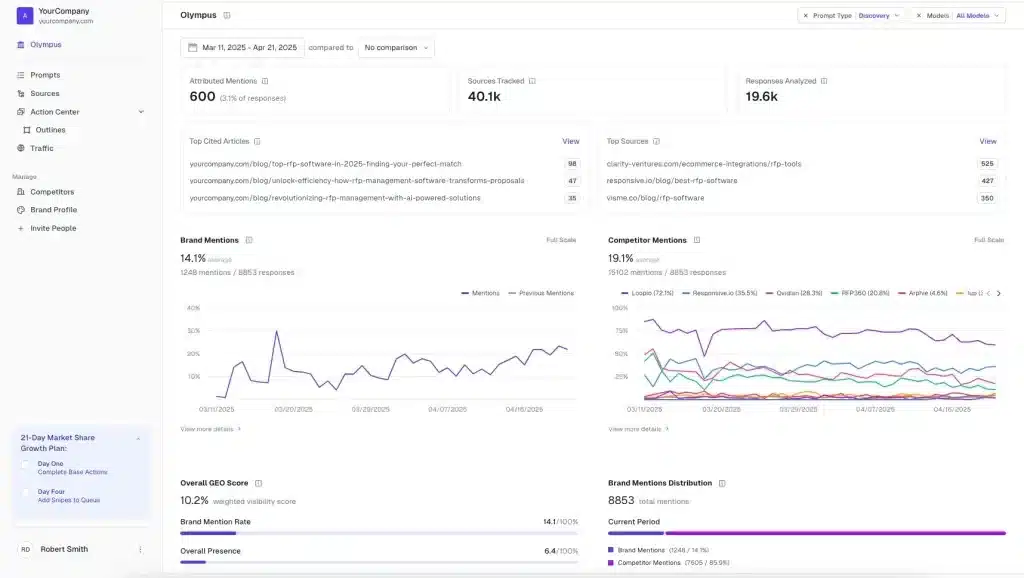
Both AirOps and AthenaHQ rely on automation to scale content, but they approach it differently.
AirOps lets you construct Workflows and Power Steps, whereas AthenaHQ lets you deploy Agents. It’s designed for agencies and large teams that want to automate the optimization of thousands of pages without needing to act as a prompt engineer or workflow architect.
It also offers a special advantage in focus. AirOps started as a generalist content tool that added SEO features later. AthenaHQ is a native AI visibility platform. Its agents are specifically trained on GEO principles, meaning you spend less time tweaking the output to make it sound human and authoritative.
Notable Features
Content optimization agents: These are autonomous workflows that analyze your existing content against AI personas and rewrite it at scale. It replaces the manual grid management of AirOps with a “set it and forget it” approach.
Impersonation tracking: AthenaHQ flags when AI responses misattribute your brand or confuse you with competitors. This is useful for catching brand impersonation issues in AI search.
Extra user seats: The starter plan includes 3 seats with role-based access control, making it easier for large agencies to collaborate without the per-user limitations often found in workflow tools.
Pros
Agents come pre-configured for GEO tasks, removing the need to build complex logic flows from scratch.
Tracks 8+ AI models immediately, offering broader visibility data than AirOps’ custom-priced insights.
Detects brand security risks (impersonation), which protects the brand equity you’re trying to build.
Supports high-volume agencies better via the generous amount of user seats on the lower tier.
Cons
The credit consumption model is opaque; running heavy agent workflows can burn through your monthly allowance faster than expected.
Less flexible than AirOps for non-SEO tasks; you can’t easily build a “custom app” for internal ops like you can in AirOps.
Users report a steep learning curve for configuring the agents to match specific brand voice guidelines perfectly.
Pricing
Self-Serve: $295/mo (8+ engines, 3,600 credits, unlimited topics, 3 user seats, basic AI content optimization)
Enterprise: Custom (8+ engines, custom credits, custom seats, advanced content optimization, self-improving content creation workflows)
3. Writesonic – Best for All-in-One GEO and Content
Writesonic is the integrated alternative for teams that want professional-grade AI tracking and production tools in a single, plug-and-play dashboard.
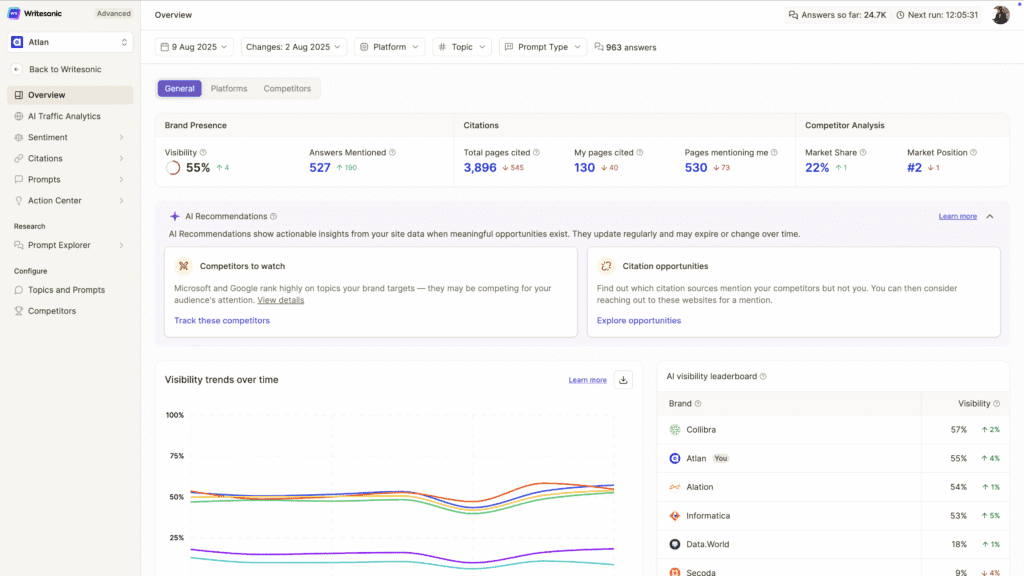
Writesonic provides a complete suite of pre-built tools ready to use immediately to help you remove the setup time associated with constructing AirOps’ logic chains and workflows.
It’s one of the few platforms that effectively combine a robust GEO module with top-tier content creation. The dashboard also tracks analytics such as citation frequency, sentiment analysis, and AI crawler activity at a level that rivals specialized monitoring tools.
This integration solves a major workflow problem. Instead of checking your rankings in one tool (like AirOps Insights) and then moving to a separate grid to execute the work, Writesonic allows you to audit your share of voice and immediately use the AI Article Writer 6.0 to create the content needed to fix the gap, all within the same platform.
Notable Features
GEO module: A comprehensive dashboard that tracks brand mentions, citations, and sentiment across models. It also includes AI Crawler Analytics, allowing you to see bot traffic alongside your ranking data.
AI Article Writer 6.0: A structured writing tool that uses real-time data to generate long-form, SEO-optimized content. It’s a great alternative to manually chaining Power Steps in AirOps.
Chatsonic: An integrated research assistant with live Google access, allowing you to fact-check topics and gather sources instantly without setting up complex API connections.
Pros
Tracks citations, mentions, and sentiment with a depth comparable to specialized tools.
Connects the insights (you lost a citation) to the action (write an article) in a single subscription.
Eliminates the need to build custom logic grids; the optimization workflows are pre-configured for best practices.
Includes AI tools for image (Photosonic) and audio generation (Audiosonic), offering broader content capabilities than AirOps.
Cons
The GEO features are gated behind the $249/mo Professional plan, meaning the lower tiers are strictly for content generation.
Lacks the custom app flexibility of AirOps; you can’t build bespoke internal tools or data processors, you must use their pre-set workflows.
Credit usage for high-end models can be heavy if you’re producing high volumes daily.
Pricing
Lite: $49/mo (SEO + content only, 15 articles per month)
Standard: $99/mo (SEO + content only, 30 articles per month)
Professional: $249/mo (SEO + GEO + content, 3 models, limited GEO features, 100 articles per month)
Advanced: $499/mo (SEO + GEO + content, 4 models, limited GEO features, 200 articles per month)
Enterprise: Custom (SEO + GEO + content, 10 models, full GEO features, AI visibility action center, dedicated GEO strategist)
4. Profound – Best for Enterprise GEO
Profound is the enterprise choice for communications teams that need deep historical data and sentiment analysis rather than production workflows.
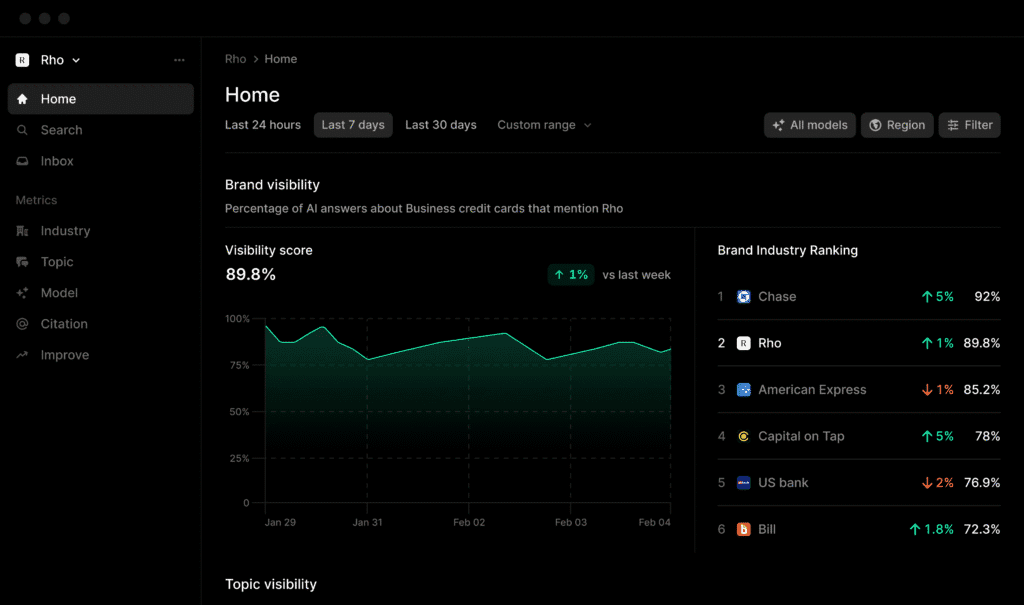
Profound is built to help you define the content strategy that AirOps can execute at scale.
If your primary struggle with AirOps is that the “Insights” dashboard feels secondary to the workflow builder, Profound is the upgrade. It’s a dedicated corporate reputation engine. Instead of focusing on generating thousands of words, it focuses on measuring the exact sentiment, share of voice, and thematic context of your brand across the AI ecosystem.
For enterprise teams, Profound solves the visibility gap better than AirOps does. It offers unlimited historical data retention and complete conversation exploration, allowing you to answer strategic questions that operational tools often struggle to visualize.
Notable Features
Conversation Explorer: This tool tracks the broader market themes and questions that users are asking around your industry. It provides qualitative market research that goes beyond simple keyword tracking.
Thematic sentiment: Instead of a simple positive/negative score, Profound categorizes sentiment by high-level business topics (e.g., “Privacy,” “Pricing,” and “Support”). This helps PR teams isolate specific reputation risks.
All-time history: Profound keeps your data indefinitely on all plans. You can look back to day one to prove long-term ROI. This feature is important for quarterly business reviews that operational tools often lack.
Pros
Unlimited data retention allows for deep year-over-year trend analysis.
Profound’s SOC 2 Type II compliance matches enterprise security requirements.
Enterprise plans include access to a dedicatedAnswer Engine Optimization (AEO)strategist, providing human expertise to guide your strategy.
The interface is designed for high-level executive reporting, making it easier to present data to non-technical stakeholders.
Cons
Profound lacks the advanced content generation workflows found in AirOps. The Starter plan has no content creation features and the Growth plan is capped at 3 articles/mo.
The entry-level plan ($99/mo) is restricted to ChatGPT only, forcing a costly upgrade for multi-agent tracking.
It doesn’t offer the no-code optimization capabilities to build internal apps or logic flows.
Pricing
Starter: $99/mo (ChatGPT only, 50 prompts, 1 user seat)
Growth: $399/mo (3 engines, 100 prompts, 3 user seats, limited content optimization features)
Enterprise: Custom (10 engines, custom features, API access, dedicated AEO strategist)
5. Semrush One – Best for Consolidating Your Stack
Semrush is the logical choice for teams that want to track AI visibility and Google rankings in one place, provided you have the budget for the add-ons and higher-tier content tools.
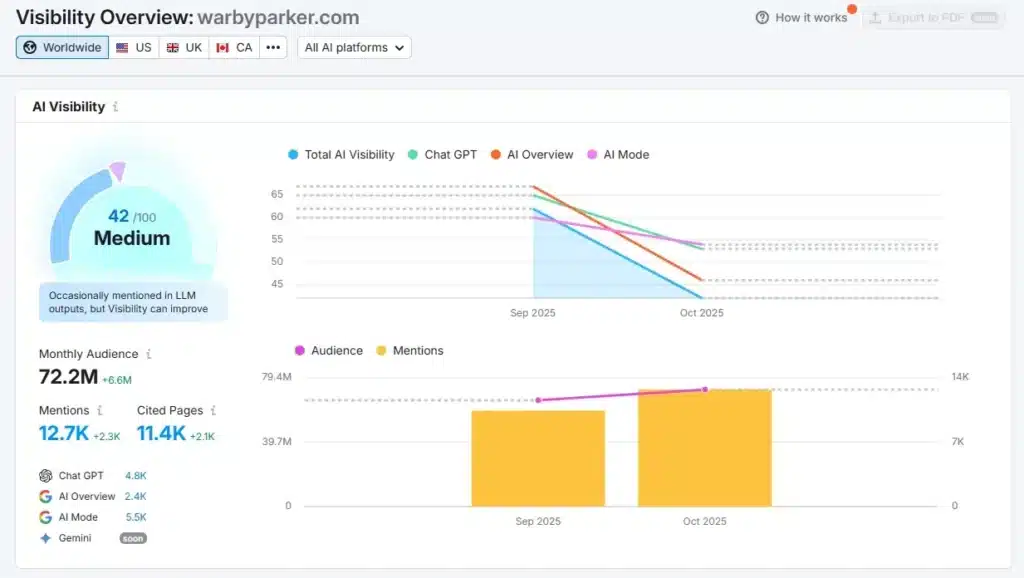
If you’re considering AirOps, you’re looking at adding a specialized content operations layer to your stack. Semrush argues that you don’t need a separate platform for this; you just need to upgrade your existing SEO suite.
Semrush combines its AI Visibility Toolkit with its established SEO data to offer you a unified environment. You can track your rankings in ChatGPT and Google side-by-side to spot where you rank #1 on Google but are invisible in AI results.
However, unlike AirOps or GetMint, the content execution tools aren’t always included in the base price. You often have to pay for separate add-ons, such as the $60/mo content plan, to actually start creating content that fixes your visibility.
Notable Features
Unified search intelligence: Overlay your Google rankings with your AI rankings in a single view. This is the best way to report total search performance to stakeholders.
SEO Writing Assistant: A real-time editor that scores your content on readability, tone, and SEO. It ensures that the content you create is optimized for search intent before you publish. This is available as an add-on.
AI search health audit: Scans for technical issues like llms.txt presence, blocked bots, and non-descriptive anchor text to help you boost your overall search performance.
Pros
Eliminates the need to onboard a new vendor if you can bundle everything into one Semrush invoice.
Offers stable, flat-rate pricing without the caveats of custom enterprise quotes or credit burn anxiety.
Tracks ChatGPT, Google AI Overviews, and Google AI Mode on the base plan, ensuring you see a huge chunk of the search landscape.
Technical audits are more comprehensive; the Site Audit tool checks for llms.txt and bot blocking issues, among many other signals.
Cons
Lacks the no-code flexibility of AirOps; you can’t build complex data processing chains or internal apps.
The dashboard is dense; adding AI features to an already massive suite makes Semrush’s learning curve steeper than that of a dedicated tool.
Traffic attribution metrics for AI are often reported as estimates, as direct measurement remains difficult.
Gatekeeps several useful modules behind paid add-ons, including the content marketing toolkit.
Pricing
Starter: $199/mo (5 websites, 50 prompts, 500 keywords, competitor insights, AI brand insights)
Pro+: $299/mo (15 websites, 100 prompts, 1,500 keywords, content optimization, historical SEO data)
Advanced: $549/mo (40 websites, 200 prompts, 5,000 keywords, share of voice, API access)
How to Choose the Right AirOps Alternative
AirOps is a great platform for a specific type of user: someone who wants to architect their own solutions. If you’re looking for an alternative, it’s likely because you want less configuration and more execution.
Here’s the framework to help you decide which tool replaces it in your stack:
1. Do You Want to Build or Write?
If your goal is to build custom internal tools, such as a text summarizer for your sales team, stick with AirOps. None of the alternatives listed here offer the same level of custom logic building.
If your goal is to produce blog posts, briefs, or landing page copy, choose GetMint or Writesonic. They provide pre-built, SEO-optimized workflows that require minimal setup.
2. Is Your Bottleneck Volume or Quality?
If you need to update hundreds of product descriptions by Friday, AthenaHQ is the best choice. Its agents are designed for programmatic scale.
If you need to write 10 high-impact thought leadership pieces that won’t hallucinate, GetMint is superior. Its Content Studio and Expertise Library ensure the AI sticks to your facts.
3. Do You Need to Track the Results?
If you’re leaving AirOps because its “Insights” features feel underdeveloped, Profound, GetMint, or Semrush are the upgrades. Their historical data and clearer attribution beats AirOps’ secondary analytics features.
Stop Building Workflows and Start Winning Answers with GetMint
AirOps proved that AI can scale operations, but in 2026, you shouldn’t need a no-code certification just to publish a blog post.
The most valuable tool in your stack isn’t the one with the most complex logic builder; it’s the one that gets the content out the door. You shouldn’t have to design the factory just to manufacture the product.
If you want to spend your budget on optimizing your content rather than configuring the software, GetMint is the logical upgrade. It replaces AirOps’ Grid with a Content Studio, unlocks the engines, and gives you the workflow to win the citation immediately.
Don’t build the machine. Just run it. Start your GetMint audit today and turn your visibility into action instantly.
START FREE. NO CREDIT CARD REQUIRED.
Your competitors are already visible in AI. Are you?
See what ChatGPT, Gemini and Perplexity say about your brand. Set up in 5 minutes.

