
Jan 19, 2026
5 Best AthenaHQ Alternatives for 2026 (No Marketing Hype)
AthenaHQ treats every workflow like it needs a PhD in agent orchestration. It doesn’t.
While the platform’s “Autonomous” agents promise sophisticated reasoning and dynamic action, many teams hit a wall: they just want to measure visibility and fix content gaps, not configure digital colleagues.
If you need direct execution over agent architecture, or specific technical data that generalists miss, you have better options.
We tested the top platforms to find the five best AthenaHQ alternatives that prioritize streamlined workflows over complexity.
Top 5 AthernaHQ Alternatives at a Glance
Here’s how the top contenders compare on workflow focus and entry pricing.
Tool | Entry Price | Pricing Model | Starting Engines | Starting Prompts | Content Capabilities | Bot Tracking | Free Trial | API Access |
|---|---|---|---|---|---|---|---|---|
GetMint | €99/mo | Tiered | 3 | 50 Prompts |  |  | | (Enterprise) |
Hall AI | $239/mo | Tiered | 3 | 25 Questions | | Real-Time | | (Enterprise) |
Profound | $99/mo | Tiered | 1 | 50 Prompts |  (Capped) | Agent Analytics | (Growth Only) | (Enterprise) |
Semrush One | $199/mo | Tiered + Add-ons | 3 | 50 Prompts | | Site Audit | | (Advanced) |
seoClarity | ~$3,000/mo | Custom | Custom | Custom | | Traffic Impact | | |
1. GetMint – Best for Content Action and Agility
GetMint is the best choice for content teams that need to fix visibility gaps immediately without configuring complex automation workflows or dealing with credit consumption models.
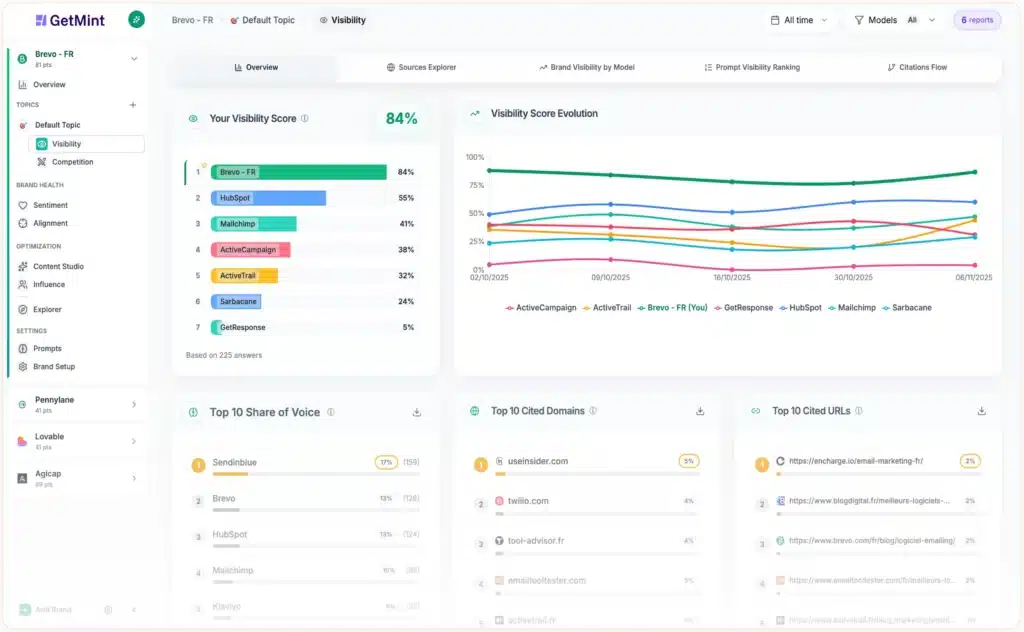
While AthenaHQ focuses on building “digital colleagues” to automate your reporting, GetMint focuses on giving your actual colleagues the tools to do the work. It skips the “Agent” marketing hype to solve the problem you’re currently facing: you’re invisible in AI search, and you need to rewrite your content to fix it.
GetMint replaces the complexity of configuring agents with a direct Content Studio. Instead of setting up a workflow, you simply click “Generate” next to a prompt where you’re not visible. The platform uses RAG (Retrieval Augmented Generation) to analyze the winning sources and draft an accurate brief to help you reclaim the citation.
It also simplifies access. On the Starter plan (€99/mo), you get immediate visibility into ChatGPT, Google AI Overviews, and Perplexity, as well as the ability to track 50 prompts across 2 topics, without having to deal with a complex credit consumption model.
Notable Features
One-click optimization: Instead of configuring an agent to run a task, the optimization workflow is embedded directly next to the analytics. If you see a gap, you fix it instantly.
Narrative drift detection: This tracks if the AI is shifting its opinion of you over time (e.g., from “premium” to “expensive”). It’s a clarity metric that simplifies analyzing data logs.
Source watchtower: It identifies exactly which URLs are feeding the AI negative sentiment, giving your PR team a hit list without needing to dig through complex reports.
Brand health: The brand alignment score audits the AIs’ understanding of your brand, whereas the sentiment heatmaps show you which AI models are exhibiting a positive sentiment about you and which aren’t.
Content studio: Besides the one-click optimization workflow, the dedicated content studio allows you to upload your own expertise (PDFs and text), create personas that match your brand’s voice, and generate briefs and articles in seconds.
Pros
Minimal configuration required to start generating optimized content briefs.
The dashboard prioritizes readability and brand health over dense technical metrics.
The visuals are clean and easy to understand, making it simple for marketers and SEOs to report on the data.
It includes Perplexity and AI Overviews tracking on the Starter plan, which are generally gatekept by many GEO tools, ensuring you see the full conversational landscape.
Offers a free trial to verify data quality before you commit to a subscription.
Cons
The content generation is credit-based, similar to most tools in this space.
Pricing
Starter: €99/mo (3 engines, 50 prompts, 2 topics)
Growth: €299/mo (4 engines, 200 prompts, 9 topics)
Enterprise & Agency: €549/mo (Custom)
2. Profound – Best for Enterprise Reputation and History
Profound is the safe choice for Fortune 500 brands that value deep historical data and rigorous compliance over experimental automation. For a head-on comparison, check out our AthenaHQ vs. Profound article.
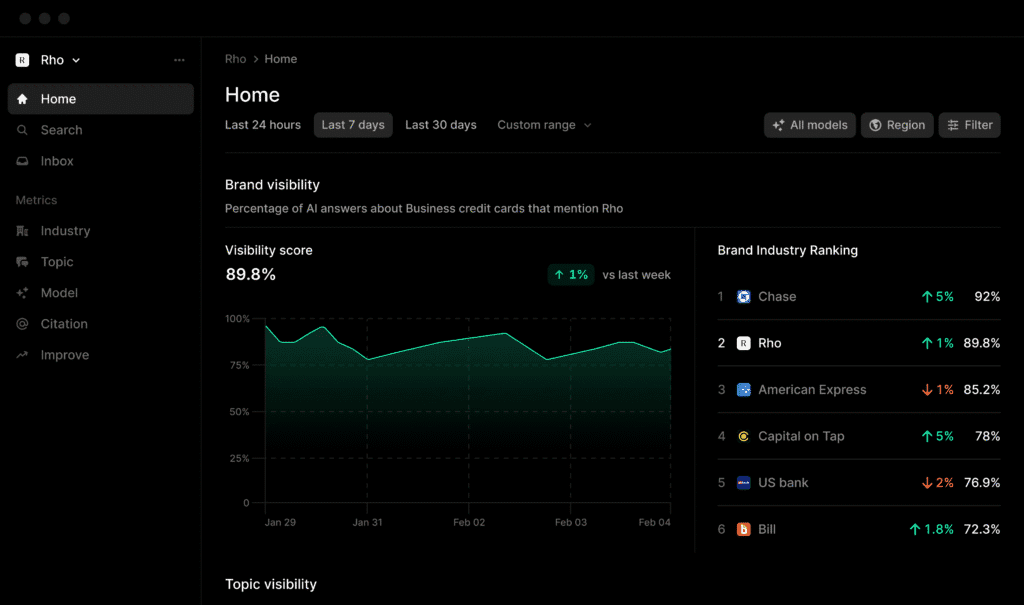
Profound is built for the enterprise executive who needs a stable, audit-proof view of their market position. The platform focuses on delivering rigorous, analyst-grade data that can withstand boardroom scrutiny.
It stands out as a dedicated corporate reputation engine. Instead of tracking keyword rankings, it measures your share of voice and thematic sentiment across the market.
Most importantly, it solves the data retention problem. While many tools limit how far back you can look based on your plan or credits, Profound offers all-time historical data. This makes it the superior choice for brands that need to track year-over-year performance trends without worrying about data expiration.
It’s also built for the procurement team: Profound holds SOC 2 Type II certification, meeting the rigorous security requirements that enterprise IT teams demand.
Notable Features
Conversation explorer: This feature goes beyond brand tracking to analyze the broader market conversation. It identifies what users are asking around your industry (e.g., “Best collaboration platform for remote teams”), helping you spot demand before you spot a competitor.
All-time historical data: Profound keeps your data forever on all plans. You can look back to Day 1 to prove long-term ROI, which is important for quarterly business reviews.
Thematic sentiment: It categorizes sentiment by high-level business topics (e.g., “customer support” vs. “pricing), giving you a strategic view of brand health rather than a simple positive/negative score.
Technical analysis: It includes a module for understanding how AI crawlers access and interpret your content, allowing you to optimize your website for maximum AI search visibility.
ChatGPT shopping: You can see how your products are showing up in ChatGPT shopping, improve their placement, and drive more traffic and conversions.
Pros
Offers unlimited historical data retention, making it essential for long-term trend analysis.
SOC 2 Type II compliance is a basic feature, ensuring it passes strict enterprise procurement reviews.
Enterprise plans include access to a dedicated AEO strategist, providing human expertise to guide your strategy.
The interface is designed for high-level reporting, making it easier to present data to non-technical stakeholders.
Cons
TheStarterplan ($99/mo) tracks ChatGPT only, while AthenaHQ tracks 8+ engines.
It acts primarily as a monitoring tool; content generation is gapped at just 3 articles/month on theGrowthplan ($399/mo) and requires theEnterpriseplan for any meaningful use.
It lacks the high-volume automation capabilities of AthenaHQ’s agent workflows.
Pricing
Starter: $99/mo (ChatGPT only, 50 prompts, 12,000 runs monthly).
Growth: $399/mo (3 engines, 100 prompts, 24,000 runs monthly).
Enterprise: Custom (10 engines, custom prompts and runs, ChatGPT shopping).
3. Hall AI – Best for Technical SEO and E-Commerce
Hall AI is the superior choice for debugging crawlers, tracking product shopping results, and conducting technical diagnostics.
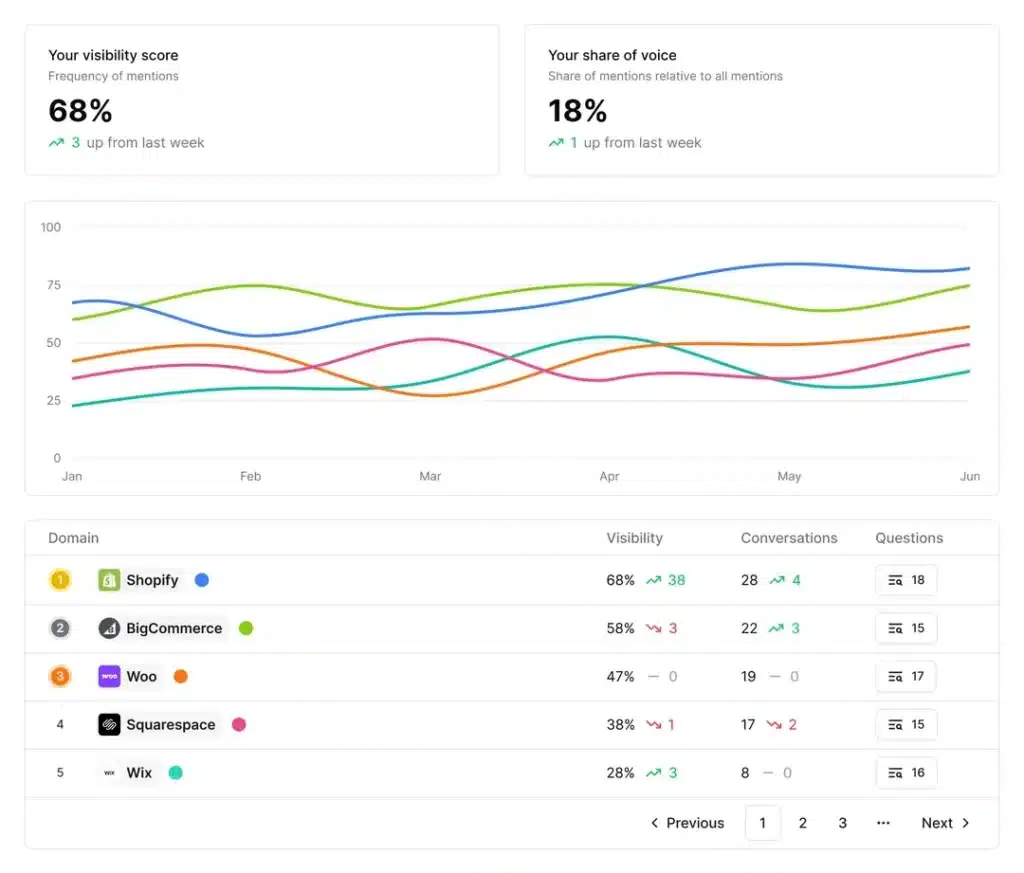
While AthenaHQ focuses on automating marketing tasks, Hall AI focuses on exposing technical data. It’s less of a campaign management tool and more of a diagnostic instrument for your website’s infrastructure.
AthenaHQ tells you that you ranked in a response. Hall AI helps you understand how the AI found you in the first place. It connects directly to your site’s activity to track AI crawlers (like GPTBot and ClaudeBot). This allows technical teams to verify if their pages are actually being indexed or if they’re blocked by firewalls (AthenaHQ’s generalist agents don’t provide this).
For e-commerce brands, Hall AI offers a specific advantage over AthenaHQ: dedicated ChatGPT shopping visibility. Instead of generic brand mentions, it tracks whether your specific products are appearing in ChatGPT’s shopping interface. It’s invaluable for Direct-to-Consumer (DTC) revenue tracking.
Notable Features
Crawler forensics: It goes beyond simple access logs to provide deep agent analytics. It breaks down specific bot activity, allowing you to see exactly which AI crawlers are accessing your content and how frequently they visit.
Product-level tracking: It isolates visibility data for individual SKUs (e.g., “Running Shoe V2”) within conversational shopping results, which is distinct from general brand sentiment tracking.
Lite plan: Unlike AthenaHQ’s $295 starting price, Hall offers a functional free tier that allows developers to run quick technical audits without a contract. However, this plan is extremely limited feature- and usage-wise.
Pros
Delivers real-time, server-level data on how AI bots access your site.
Tracks specific product recommendations in ChatGPT Shopping, a gap in most generalist tools.
Eliminates the credit anxiety of AthenaHQ by using clear prompt limits rather than variable consumption models.
Provides CSV exports and API access on higher tiers for custom data modeling.
Cons
It’s purely diagnostic; it lacks the content optimization agents and writing tools that AthenaHQ provides.
The pricing structure creates a large gap between the free tier and the first paid tier ($239/mo).
Historical data retention is limited on starter plans, whereas enterprise tools often keep data indefinitely.
Pricing
Lite: Free (3 engines, 1 project, 25 tracked questions, weekly updates, 3-month historical data).
Starter: $239/mo (3 engines, 20 projects, 500 tracked questions, 6-month historical data).
Business: $599/mo (8 engines, 50 projects, 1,000 tracked questions, 12-month historical data).
Enterprise: $1,499/mo (API access, enterprise-grade security, unlimited historical data).
4. Semrush One – Best All-In-One Platform
Semrush is the logical choice for teams that want to manage SEO and AI visibility and optimize content within a single, proven ecosystem.
If you’re considering AthenaHQ, you’re looking at adding another specialized tool to your stack. That’s another monthly bill that fluctuates based on credit usage.
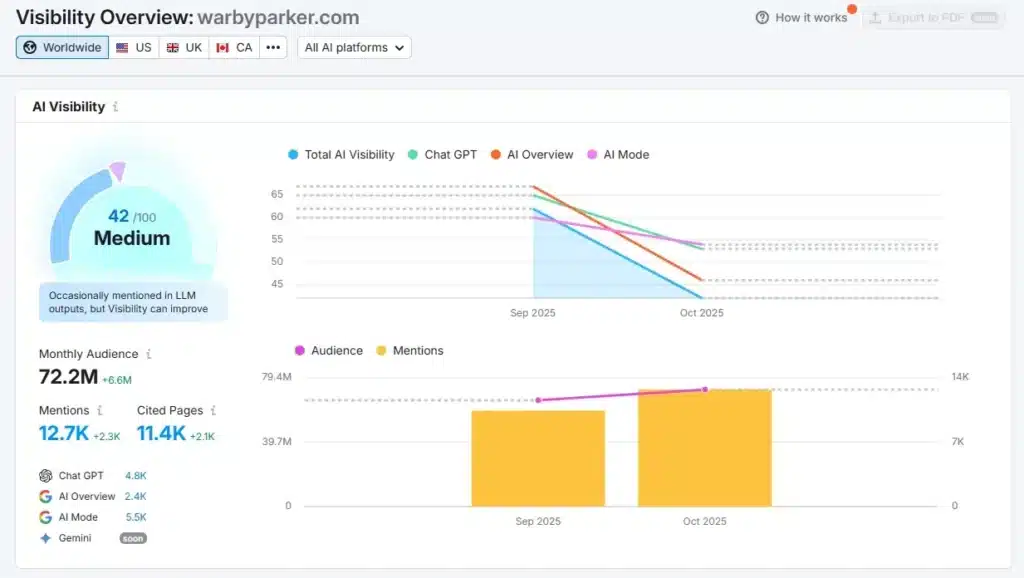
Semrush One argues that you don’t need a niche tool for GEO. It combines its AI Visibility Toolkit with its existing content marketing toolkit to offer a complete loop. You can track your visibility in different AI models and then use the platform’s writing assistant to optimize your pages, all under one login.
Semrush’s infrastructure is proven: it leverages a reported database of 25 billion keywords to provide estimated search volumes for AI prompts, giving you data validity that newer startups like AthenaHQ simply can’t match.
Notable Features
Unified search intelligence: You can overlay your Google rankings with your AI rankings in a single view. This immediately exposes keywords where you rank #1 on Google but are invisible in AI models. It is the clearest illustration of the shift to AI recommendations.
Content marketing toolkit: Unlike “read-only” dashboards, Semrush includes robust writing tools. You can move from the AI visibility report directly to the SEO writing assistant to fix tone, readability, and keyword targeting.
AI search health audit: Semrush applies its famous site audit rigor to GEO. It scans for technical issues like missing llms.txt files or firewall blocks that prevent AI bots from scraping your content.
Pros
Semrush consolidates your stack. It eliminates the need to onboard a new vendor; you get tracking, auditing, and content optimization in one flat fee.
You avoid the credit burn anxiety of AthenaHQ’s consumption model; you know exactly what your bill will be every month.
The platform is backed by the industry’s largest keyword database, offering robust volume estimates for AI prompts.
Semrush tracks performance across Google, ChatGPT, and Perplexity simultaneously, meaning you get a holistic view of search. Each engine still needs its own read, and a dedicated Perplexity visibility tracker is the one most stacks skip.
Semrush’s data visualizations and illustrations are among the best on the market, making it easy to analyze and report on data.
Cons
The dashboard is dense. Adding GEO metrics to an already massive suite creates a steep learning curve compared to AthenaHQ’s focused interface.
While the tools exist, they’re often in different tabs, which further complicates the user experience.
Unlike dedicated GEO platforms, the prompt limits are low on the starter tiers and important functions, like share of voice, are gatekept behind theAdvancedplan.
Metrics for AI traffic are often reported as 0 or estimates, as direct attribution remains difficult foralltools in this class.
Pricing
Starter: $199/mo (50 prompts, 500 keywords, 5 websites).
Pro+: $299/mo (100 prompts, 1,500 keywords, 15 websites, historical SEO data).
Advanced: $549/mo (200 prompts, 5,000 keywords, 40 websites, share of voice).
5. seoClarity (ArcAI) – Best for Heavy Enterprise Data
seoClarity is the uncapped enterprise alternative for brands managing millions of pages that need to prove revenue impact, not just visibility.
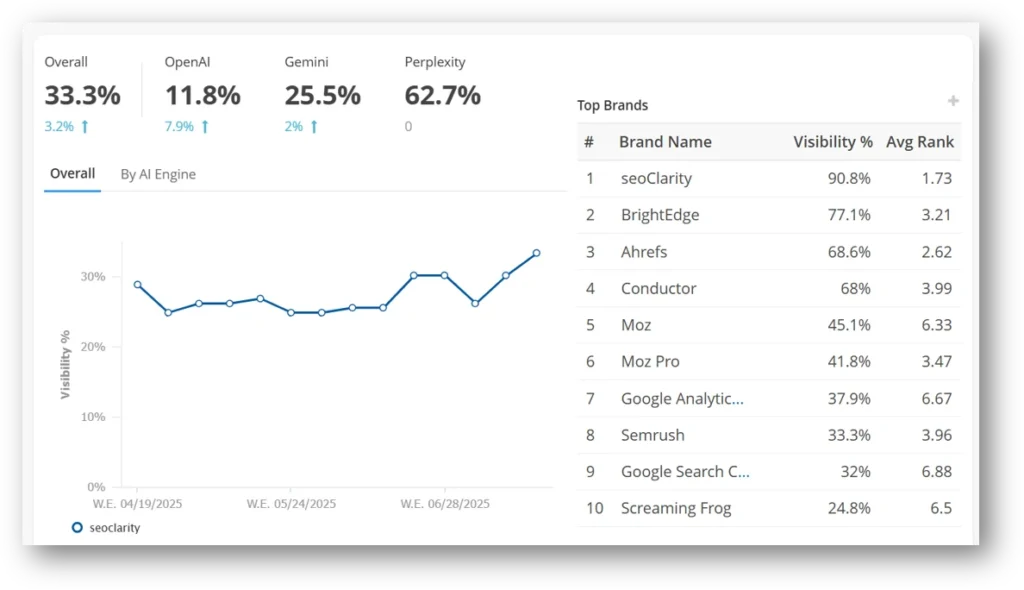
AthenaHQ is built for speed and execution, whereas seoClarity is designed for stability and attribution.
If you’re a Fortune 500 brand, Athena’s credit-based model is a procurement nightmare. You can’t have your bill fluctuate every month based on how many prompts an agent ran. seoClarity solves this with a true enterprise model: unlimited scale, flat pricing, and infrastructure designed to handle millions of pages without crashing.
Where AthenaHQ focuses on “Did we rank?” seoClarity focuses on “Did we make money?” Its Traffic Impact Analysis connects AI visibility data directly to revenue and traffic metrics. It answers the CFO’s question, “What’s the financial impact of this AI Overview?”
Notable Features
Financial attribution: It connects GEO data to your actual traffic and conversion metrics (Adobe/GA4). This moves the conversation from share of voice to the financial impact your current AI visibility has.
Google AI mode tracking: While many tools track the AI Overview snippet and Gemini, seoClarity explicitly tracks the conversational AI mode in Google, ensuring you aren’t blind to users who switch tabs.
Clarity content: An enterprise-grade content optimization suite that rivals Athena’s agents. It allows for optimization at scale but within a controlled, compliant workflow rather than an autonomous agent loop.
Pros
seoClarity’s pricing is predictable, as contracts are negotiated based on your company’s needs and are typically flat-rate, eliminating the worries of credit usage Athena’s consumption model brings.
seoClarity is the best platform for connecting visibility to revenue/traffic thanks to its ROI focus.
The platform is designed for sites with millions of URLs; it handles data loads that would crash smaller agency tools.
The platform includes enterprise-grade SLAs and managed services, providing a human safety net that software agents can’t match.
Cons
seoClarity’s pricing typically starts around $2,500 per month, making it inaccessible for anyone but large corporations.
There’s no self-serve or free trial with seoClarity. You must go through a demo, contract negotiation, and onboarding process.
The interface is dense. Unlike AthenaHQ’s dashboard, you’ll need professional data analysts to make sense of most of seoClarity’s data.
Pricing
Pricing is tailored to enterprise requirements but typically starts in the $2,500/month range for the research and content tiers, with extra capabilities costing upwards of $4,000/mo.
How to Choose the Right AthenaHQ Alternative
You’re likely looking for an alternative because AthenaHQ is either too complex to set up, too expensive to scale (due to credits), or simply overkill for your needs.
Here’s the decision framework to find the right replacement:
1. Do You Want Agents or Action?
AthenaHQ bets on “Agents” to do the work. The problem is that they require configuration.
If you want to skip the configuration, choose GetMint. The platform’s content studio and different AI visibility tools don’t require hours of setup. They’re faster and require zero prompt engineering.
If you want human strategy, choose Profound. You get deeper, human-verified insights rather than automated outputs.
2. How Do You Want to Pay?
AthenaHQ’s credit model is flexible but unpredictable.
If you want flat-rate predictability, choose GetMint or Semrush. You pay a fixed subscription fee, and you know exactly how many keywords or topics you can track. No surprise overage bills.
If you have an enterprise budget, choose seoClarity. You pay a high premium but you get unlimited scale and custom SLAs that remove the nickel-and-dime feeling of credit consumption.
3. What Is Your Technical Requirement?
If you need to debug the infrastructure, choose Hall AI. AthenaHQ tracks the result (the ranking); Hall AI tracks both the result and the cause (the crawler). If your issue is technical indexing rather than content relevance, Hall is the only tool that gives you the server logs to prove it.
If you need to audit the site health, choose Semrush. Its site audit tool (with the new AI health check) is far more rigorous than AthenaHQ’s generalist diagnostics.
Stop Configuring Agents Today with GetMint
AthenaHQ sells the dream of “autonomous agents,” but for many teams, that dream translates into mischievous marketing that brings forth complex configuration and unpredictable credit bills.
You shouldn’t have to spend your time managing the software or rationing your daily queries to avoid overage fees; the best tool is the one that helps you fix the problem fastest.
If you want to spend your budget on optimizing your content rather than managing credits, GetMint is the logical upgrade. It strips away the agent hype, gives you predictable flat-rate pricing, and puts the tools to rewrite the narrative directly in your hands.
Don’t let credit limits dictate your strategy. Start your GetMint audit today and turn your visibility into action without the complexity tax.
START FREE. NO CREDIT CARD REQUIRED.
Your competitors are already visible in AI. Are you?
See what ChatGPT, Gemini and Perplexity say about your brand. Set up in 5 minutes.

