


The nature of search has changed for good. With Google AI Overviews appearing in a majority of results and nearly 56% of all searches ending without a click, the old rules are broken. This creates a serious problem for your team: How do you win if you can’t even get the user to your website?
You need a focused strategy to become the answer itself, and that strategy is Answer Engine Optimization (AEO). It’s how you structure your content to provide the direct, definitive answers that AI platforms are designed to extract and feature.
What Is Answer Engine Optimization (AEO)?
Answer Engine Optimization (AEO) is the practice of preparing your content to be featured as the direct answer by AI-powered search engines, chatbots, and voice assistants.
It’s how your content gets displayed directly in:
- Google’s AI Overviews
- Featured Snippets (”Position Zero”)
- “People Also Ask” boxes
- Voice search responses (from Siri, Alexa, etc.)
AEO is the evolution of what many SEOs used to call “featured snippet optimization.” It’s a shift from writing long, narrative articles to creating concise, fact-based content that a machine can easily parse and present as a trusted answer.
What Is The Difference Between AEO, GEO, and SEO?
The easiest way to understand these acronyms is to think of them as layers in your search strategy. They don’t compete; they build on each other, and each has a specific job to do.
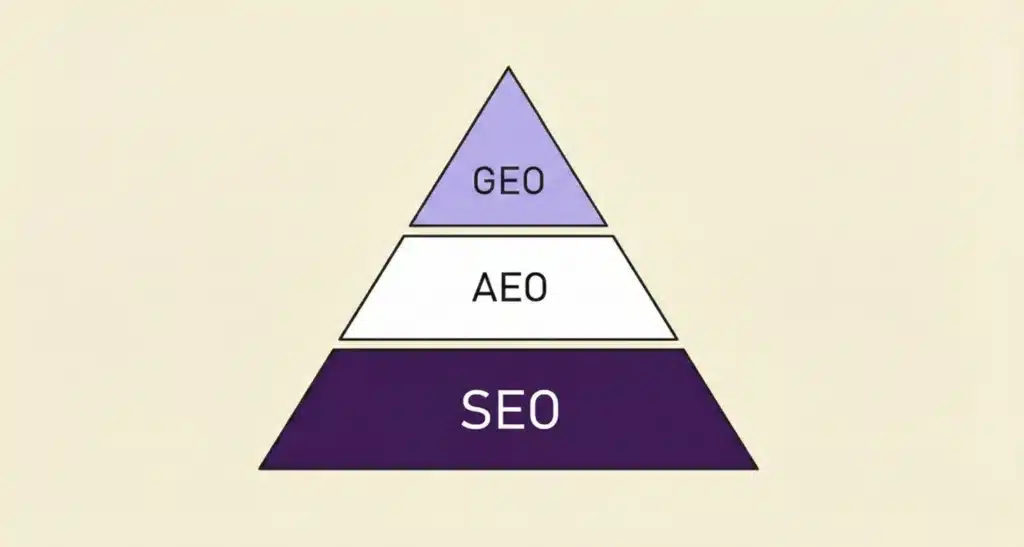
- Search Engine Optimization’s (SEO) job is to build the foundation. It ensures your site is technically sound and has the authority to be considered a trustworthy source in the first place. Its goal is to win the click. We explain the differences in more detail in our AEO vs SEO guide.
- Answer Engine Optimization’s (AEO) job is to capture direct answers. It uses that foundational authority to structure content that can be easily extracted for featured snippets and AI overviews. Its goal is to become the answer.
- Generative Engine Optimization’s (GEO) job is to influence conversations. This is an advanced strategy where you focus on building deep, comprehensive content that can be cited in the synthesized answers of platforms like ChatGPT. Its goal is to be cited or mentioned in the conversation.
| Factor | AEO | GEO | SEO |
|---|---|---|---|
| Goal | Become the direct answer | Be cited or mentioned by AIs | Rank higher in search engine results pages and win the click |
| Focus | Concise, factual extraction | Comprehensive, topical authority | Ranking a webpage |
| Target | Google AI Overviews, Snippets | ChatGPT, Perplexity, Claude, Grok, Gemini | Google, Bing search results |
| Content Style | Q&A format, 40—60 word answer blocks. | In-depth guides, original research | Keyword-focused articles |
| Metrics | Zero-click impressions, snippet ownership | Citation frequency, Share of AI Voice | Organic traffic, rankings, click-through rate |
The takeaway is that you don’t choose one.
You optimize for all of them. SEO builds your authority, AEO uses that authority to capture immediate answers, and GEO uses both to build long-term influence in conversational AI.
Why Is AEO Important Today?
The old model of measuring SEO success by organic traffic is officially broken. In 2014, NerdWallet’s revenue grew by over 35%, while their website traffic fell by 20%.
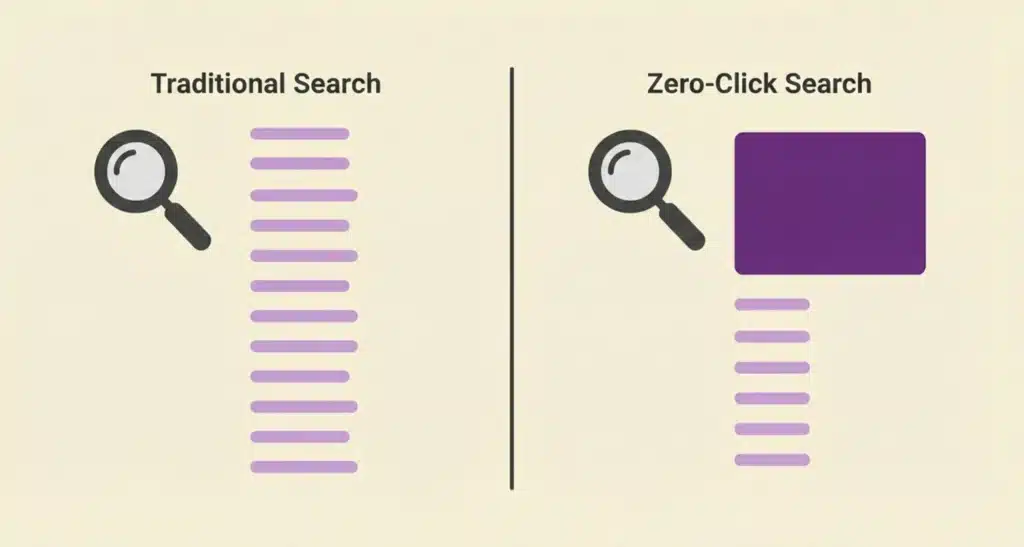
The reason is simple: Users who do click through from an answer-focused result are often much further along in their buying journey and have higher intent.
Traffic from AI search converted a staggering 23 times higher than their traffic from traditional organic search.
This trend is only accelerating. By 2026, 25% of all organic search traffic could have shifted to AI chatbots and virtual agents.
AEO is how you capture that high-quality traffic, become the default answer for voice search queries, and own the moments that actually drive revenue.
How Answer Engines Pick the Best Answer
There’s no mystery to how an answer engine picks a winner. They follow a surprisingly simple checklist.
The engine is an impatient fact-checker, and it’s looking for the path of least resistance to a credible answer.
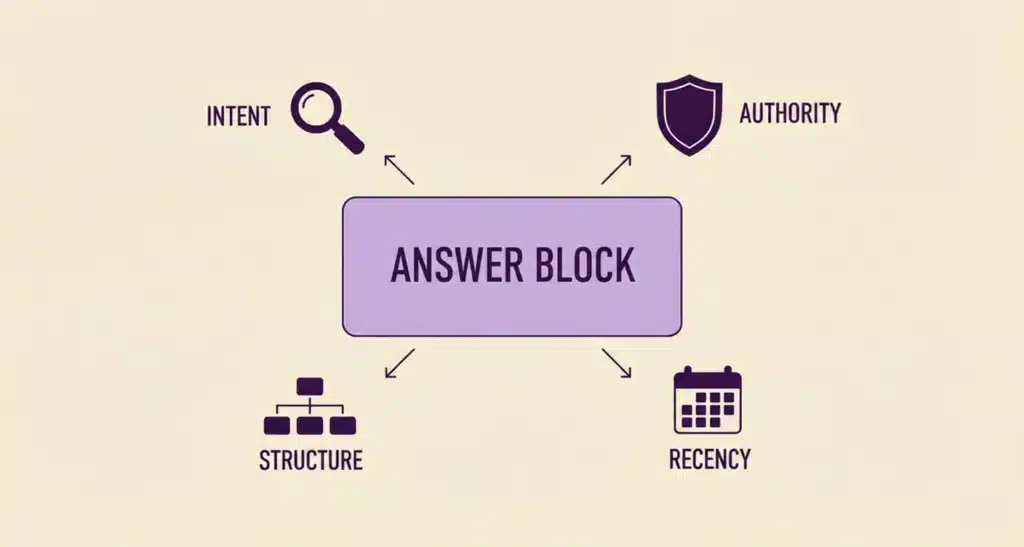
To get your content featured, you have to tick all of these boxes.
- The answer must be a perfect match for the user’s intent. Answer engines aren’t just matching keywords; they’re focused on resolving the specific question a user asked. Your content needs to provide that direct answer, not just touch on the general topic.
- The answer must be packaged as a clear “answer block.” The engine is looking for a ready-made, “grab-and-go” piece of text. This is almost always a single, concise paragraph of 40 to 60 words that sits directly under a heading that asks the user’s question. If the engine has to work to piece your answer together from multiple sentences, it’ll move on to a source that has done the work for it.
- The answer must come from a verifiable and trustworthy source. The engine is skeptical by design. It cross-references sources and defaults to brands with strong E-E-A-T signals, but it also looks for external validation like backlinks and mentions from other authoritative sites. If the rest of the web doesn’t see you as an expert, the answer engine won’t either.
- The answer must be structured for a machine to read. The clearest answer in the world is useless if the machine can’t parse it. The engine needs a clean roadmap to the information. That’s achieved using a strict hierarchy and Schema Markup.
- The answer must be up-to-date. For any topic that changes, recency is a massive advantage. An answer from last week almost always beats an answer from last year. A simple fix is to display a “Last Updated” date.
In essence, answer engines are looking for the most authoritative, current, and precisely structured content that provides the perfect, immediate answer to a user’s question. We covered these principles in more detail in our guide on how to optimize for AI search.
5 Steps to Optimize for Answer Engines
This is where your strategy turns into action. The principles of trust and structure are universal, but AEO requires a specific, targeted approach.
Your goal isn’t to build a comprehensive library for an AI to study (that’s GEO); it’s to write the perfect, concise “soundbite” that an engine can grab and feature immediately.
Step 1: Start with a Technical Audit
Before you write a single word, you have to make sure an answer engine can actually see your content. These technical blockers are the most common and damaging mistakes in AEO.
- Check your robots.txt file: This file tells bots what they can and cannot look at. Make sure you’re allowing Googlebot to crawl your website. While you’re there, confirm that GPTBot (OpenAI) and PerplexityBot (Perplexity) aren’t blocked for GEO. If you block them, you’re invisible on their platforms.
- Avoid client-side JavaScript rendering: Many modern websites rely on the user’s browser to “draw” the content on the page. AI crawlers don’t wait for this to happen. They take a snapshot of the initial (usually blank) HTML and move on. Make sure your important content is rendered on the server.
Step 2: Find Questions People Actually Ask
The entire game of AEO revolves around identifying the specific questions your audience is already asking. Your first job is to find the exact phrasing they use when searching for quick, definitive answers, not just broad keywords.
The best place to start is your Google Search Console.
Look for queries where you get tons of impressions but very few clicks. That’s a huge signal that people are finding their answer on the search page itself, and you should be the one providing it. These are your prime AEO targets.
Beyond GSC, dig through online communities like Reddit and Quora. The unfiltered language used there is exactly what you should be targeting in your content.
Step 3: Write the Answer First
Answer engines are impatient.
They’re designed to find the answer now, without digging. Your content needs to serve it to them on a silver platter. This means you need to adopt the “Bottom Line Up Front” (BLUF) principle by crafting the perfect answer block. This is a concise, factual paragraph of 40 to 60 words that sits directly under the heading that asks the question.
The difference between a standard paragraph and a great answer block is clarity and directness.
Weak Example (Before AEO):
When people think about the purpose of AEO, it’s a practice that involves structuring your content in various ways. Its goals are related to getting featured in different kinds of search results, which is important for brand visibility.
This is vague and passive and doesn’t provide a direct definition.
Strong Example (AEO-Optimized):
What Is the Purpose of AEO?
Answer Engine Optimization (AEO) is the practice of structuring your content to provide direct answers to specific questions. Its main goal is to get your content featured in zero-click results like featured snippets and AI Overviews, which makes your brand the source for the answer itself.
This block looks like a prepackaged answer that’s perfectly formatted for the AI to grab and go.
Step 4: Structure Your Content for Machines
One study on AI overviews found that AI-generated answers use lists 78% of the time. So, creating content that’s logical and can be scanned easily is a requirement.
There are two non-negotiable elements here:
First, stick to a strict heading hierarchy.
Always use a single H1, followed by a logical flow of H2s and H3s. It’s a simple rule, but it’s the primary way an AI understands the map of your content.
Never skip levels (e.g., going from H2 to H4). For example:
Why Manga Captivates Readers Worldwide (H1)
The Origins of Manga (H2)
Important Milestones in Manga History (H3)
Modern Genres and What They Reveal About Japanese Culture (H2)
Conclusion (H2)
Second, use Schema Markup to label your content.
Schema is code that tells an answer engine exactly what your content is about.
For AEO, the most powerful types are FAQPage Schema (for Q&A sections) and HowTo Schema (for step-by-step guides).
Pro Tip: Before you publish, always run your page through a tool like the Schema Markup Validator. A small error in the code can make your structured data invisible to answer engines.
Step 5: Prove Your Trustworthiness
When an answer engine finds two similar answers, it has a choice to make. It’ll almost always choose the source it deems more credible. Your job is to make sure that source is you.
This comes down to proving your E-E-A-T (Experience, Expertise, Authoritativeness, and Trustworthiness).
- Cite your sources. Every stat or major claim should link out to the original report or study.
- Keep your content fresh. An answer from last week is often more valuable than one from last year. An easy fix is to display a “Last Updated” date to signal recency.
- Show off your expertise. Have detailed author bios and a clear “About Us” page that establishes who’s behind your content and why they’re qualified to speak on the topic.
- Encourage reviews on third-party websites. Have your users (if you’re a SaaS/business) talk about their experience on websites like G2 and Capterra.
- Keep your social media profiles active. Regular posts and engagement signal credibility to both users and AI systems, especially when your content is shared, cited, or discussed publicly.
How to Measure AEO Performance and Its Business Impact
So, how do you prove any of this is working? Your standard analytics dashboard, which focuses on clicks and traffic, won’t show you the full story. To measure AEO, you must track visibility metrics in Google Search Console (GSC) and connect them to real business outcomes (there are sales metrics to track if you need to prove your strategy’s ROI!).
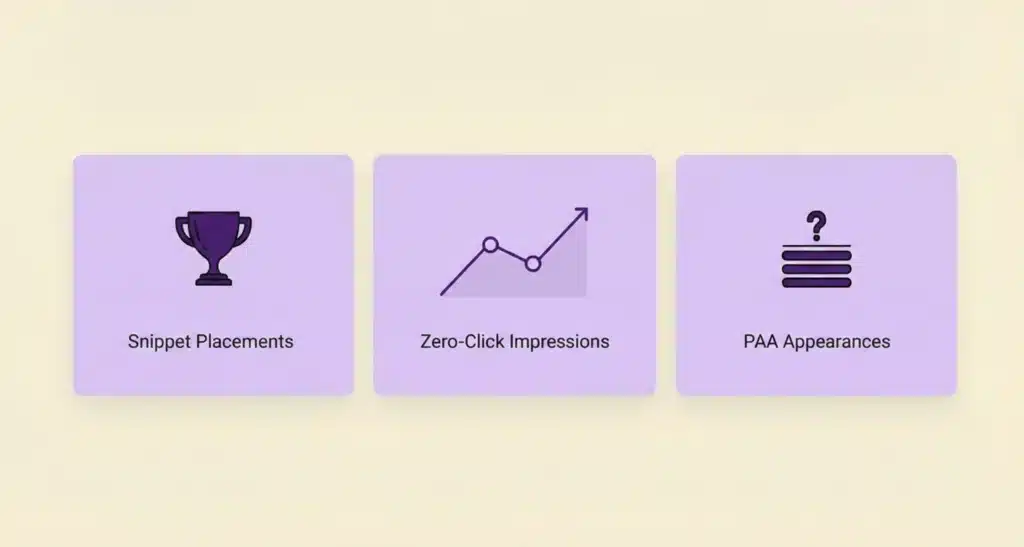
First, track the AEO-specific metrics in GSC:
- Featured snippet placements: This is the most direct measure of success. Use a rank tracking tool to monitor how many of your target queries you own in “position zero.”
- Zero-click impressions: In GSC, track the queries where you have a high impression count but a low click-through rate (CTR). A rising number of impressions for these terms means your answer is satisfying users directly on the search page.
- “People Also Ask” (PAA) appearances: Showing up in these boxes means your content is being seen as a direct, relevant answer to related questions.
These metrics will give you a clear picture of your AEO performance, and the value of this visibility shows up over time in business results:
- Increased branded search volume: When users repeatedly see your brand as the answer, they begin to trust you. This builds brand recall, leading to more users searching for you directly by name.
- Higher customer trust and conversions: Being the featured answer establishes you as the authority. This builds trust before a user ever visits your site, making them more likely to convert when they do.
Start Winning the Zero-Click Search Today
The fight for visibility has changed. AEO is how you win today’s zero-click results by taking the foundational authority you’ve built with SEO and turning it into the direct, featured answer. It’s the new baseline for any serious search strategy.
As you master this, the next frontier is already here: Generative Engine Optimization (GEO). This is how you’ll win tomorrow’s AI-generated conversations inside platforms like ChatGPT. The smartest brands are building their authority for both now.
If you want to see how visible your brand is in these emerging AI results, tools like GetMint can provide that data in minutes.
Frequently Asked Questions (FAQs)
Are AEO and GEO the same thing?
No. They’re different disciplines with different goals.
AEO focuses on creating a perfect, concise “soundbite” that an engine can extract to answer a specific question. GEO is about building a deep, comprehensive library of knowledge that a conversational AI uses to synthesize a more complex answer.
Does AEO replace SEO?
No. AEO builds on the foundation of good SEO. Answer engines still rely on traditional authority signals, like a healthy backlink profile and a technically sound website, to decide which sources to trust. SEO is the first step, whereas AEO is the next strategic layer for winning zero-click searches.
Where is the best place to start with AEO?
Start with your existing data. The most actionable first step is to go into your Google Search Console and identify queries that get a high number of impressions but a low click-through rate.
These are your prime opportunities, i.e., pages where users are likely getting their answer directly on the results page. Optimize these pages first.
How does AEO provide value if it doesn’t drive clicks?
AEO provides value by building brand authority and influence at the very top of the funnel. You position your brand as the definitive expert in your space by becoming the source of the answer itself. This builds trust and awareness before a purchasing decision is even made, which ensures you’re part of the consideration set.
Do I need to create all new content to optimize for AEO?
Not at all. The best approach is to start by auditing your existing high-performing content.
Identify your important pillar pages and blog posts that already target important customer questions and enhance them. Focus on improving the structure, adding clear “answer blocks,” and implementing schema markup on your most valuable assets first.
Can small businesses compete with large brands in AEO?
Yes, absolutely. Answer engines are designed to find the best and most direct answer, not just the answer from the biggest brand.
A small business with deep niche expertise can often provide a clearer, more specific answer than a large, generic competitor. That’s where the advantage lies.

