


You’re likely looking for the best Ziptie.dev alternatives because you need a platform that supports multi-user collaboration, higher optimization volume, or direct content generation, not just diagnostic advice.
While Ziptie.dev is a fantastic entry-level tool for individual SEOs, offering transparent access to major AI engines starting at just $69/mo, its strict limit of 1 user seat and content optimization caps quickly become bottlenecks for growing marketing teams trying to scale their Generative Engine Optimization (GEO) strategy.
Here are five platforms that solve those scaling challenges and give teams the flexibility Ziptie.dev can’t
Top 5 Ziptie.dev Alternatives at a Glance
We evaluated these platforms based on their ability to remove the seat and volume caps that Ziptie.dev imposes.
We’re comparing the most affordable plans offering GEO features, so note the differences in some features (e.g., GetMint and AirOps’ entry plans offer 1 user seat, while higher-tier plans offer more).
| Feature | GetMint | AirOps | Semrush | Scalenut | SurferSEO |
|---|---|---|---|---|---|
| Best For | Strategy and Execution | Content Scale | Stack Consolidation | Team Value | Content Quality and Semantics |
| Entry Price (GEO) | €99/mo | Custom | $199/mo | $103/mo | $219/mo |
| Free Trial | ✅ | ✅ | ✅ | ✅ | ❌ |
| User Seats | 1 Seat | Unlimited | 1 Seat | 2 Seats | 4 Seats |
| AI Engines | 3 | 4 | 3 | 2 | 3 |
| Volume | 50 Prompts | 250 Prompts + 75,000 Tasks | 50 Prompts + 500 Keywords | 20 Prompts | 5 Prompts/Day |
| Content Workflow | Content Studio (Drafting) | Logic Grids (Automation) | Writing Assistant (Grading) | Cruise Mode (Wizard) | Content Editor (Grading) |
| Writing Aid | ✅ Generative | ✅ Programmatic | ⚠️ Grading | ✅ Generative | ✅ Generative |
| Unique Feature | Brand Health + Sources Watchtower | Logic Grids + Power Steps | Unified Data | Traffic Insights + Social UpReach | Content Score |
Note: Semrush gates useful features, such as the SEO writing assistant, behind add-ons. AirOps’ Solo plan was excluded because it tracks ChatGPT only; the table reflects its Pro plan’s offerings. Similarly, SurferSEO’s Scale plan is listed because it offers better value and GEO features.
1. GetMint – Best for Strategy and Execution
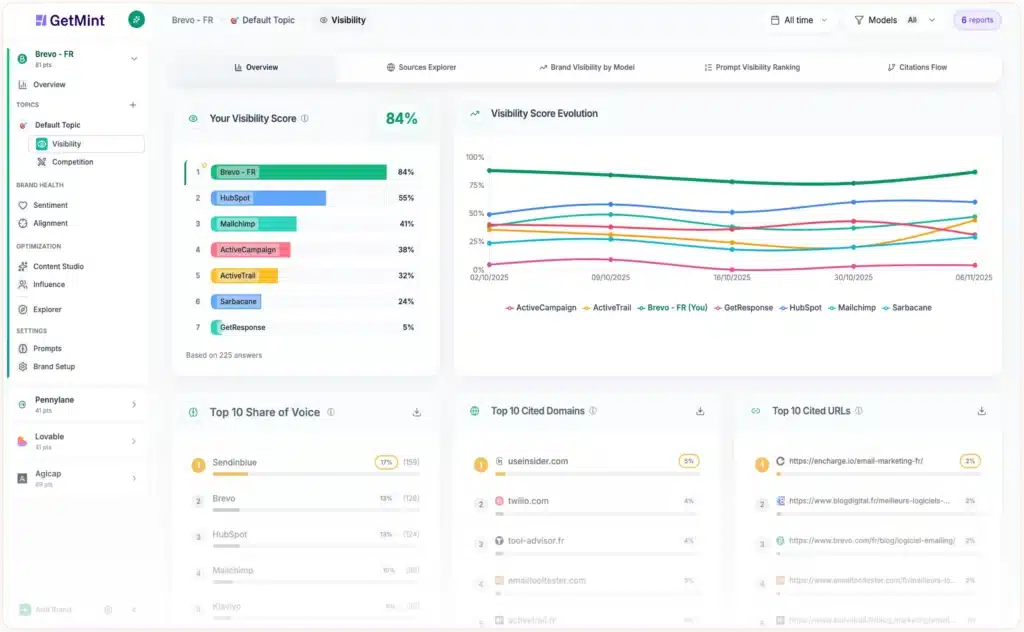
GetMint is the superior choice for content teams that need to close the loop between finding the gap and publishing the fix without leaving the platform.
Ziptie.dev is brilliant at analyzing your content and giving you a prioritized list of changes (e.g., “Add coverage on X topic” or “Fix this structural issue”). However, you still have to go into your CMS, brief a writer, and execute the work.
GetMint automates this process. It diagnoses the problem and provides you with the workspace to fix it. Its Content Studio analyzes the competitor’s winning answer and helps you generate specific content needed to steal the AI citation. Instead of telling you what to fix, GetMint helps you write the fix.
It also solves the volume bottleneck found in Ziptie.dev’s entry-level pricing. The platform’s $69/mo plan caps you at 10 optimizations per month. GetMint’s model is built for agile teams that need to refresh content at scale, offering significantly higher throughput for strategy and execution on its base tier.
Notable Features
- Content studio: Bridges the gap between SEO data and the writer. It generates detailed briefs and drafts based on the sources currently ranking in Perplexity and ChatGPT, moving you from analysis to creation instantly.
- Brand alignment score: ZipTie.dev focuses on tracking your brand’s AI search visibility score. GetMint builds on that by adding brand alignment tracking. It reveals how AIs describe you and whether they understand your value proposition or hallucinate features you don’t offer.
- Sources watchtower: A dedicated view to see exactly which third-party sites are feeding the AI about your brand. This allows you to target PR and guest posts to influence the training data directly.
Pros
- ✅ You don’t need to leave the platform to write the fix; the creation tools are built-in.
- ✅ It goes beyond rank, citations, and trends to measure brand sentiment and accuracy.
- ✅ It tracks ChatGPT, AI Overviews, and Perplexity on the entry-level plan, matching Ziptie’s core engine focus.
- ✅ Unlike Ziptie.dev’s strict 10-page limit on the Basic plan, GetMint focuses on prompt/topic limits, giving you more flexibility in how you use your data.
Cons
- ❌ Content generation uses credits, which requires management for heavy users compared to unlimited manual writing.
- ❌ It requires a shift in mindset from technical gap analysis (Ziptie.dev’s style) to narrative control (GetMint’s style).
Pricing
- Starter: €99/mo (3 engines, 50 prompts, 2 topics, 1 brand).
- Growth: €299/mo (4 engines, 200 prompts, 9 topics, 1 brand, 2 countries).
- Enterprise: From €549/mo (10 engines, custom features, dedicated support).
2. AirOps – Best for Content Scale
AirOps is the ideal alternative for technical teams who need to execute content optimizations across hundreds of pages rather than manually updating them one by one.

Ziptie.dev excels at granular analysis. It looks at a single URL and tells you exactly what’s missing (”Add a section on pricing”). But if you’re managing a site with 500 pages, a “prioritized list of changes” becomes a bottleneck. You simply don’t have enough writers to execute Ziptie.dev’s advice manually.
AirOps solves this volume problem. It allows you to build Logic Grids. These are custom workflows that can run their own audits and programmatically rewrite content at scale (or you can simply create new applications for your team by chaining steps).
It also destroys the collaboration barrier. Ziptie.dev restricts its plans to 1 user seat, forcing teams to share a login. AirOps offers unlimited users on its Pro plan, making it the superior choice for large operations teams that need to collaborate on content refreshes without access issues.
Notable Features
- Logic builder: Instead of a static report, you build a workflow. You can chain steps (e.g., Analyze Top Ranking Answers → Identify Gaps → Draft New Section) to automate the very process Ziptie.dev asks you to do manually.
- Human-in-the-loop: AirOps allows you to insert a review step in the automation. A human edit approves the AI’s changes before they go live, ensuring you maintain brand voice while moving at speed.
- Direct CMS publishing: Ziptie.dev gives you text to copy-paste. AirOps integrates with Webflow, WordPress, and many others to push the optimized content directly to your site.
Pros
- ✅ The Pro plan includes unlimited user seats, fixing Ziptie.dev’s single-seat bottleneck plaguing all of its plans.
- ✅ Even the entry-level Solo plan includes 20,000 tasks that, with careful optimizations, can result in many more content optimizations compared to Ziptie.dev’s 10-pages hard cap on the Starter plan.
- ✅ You aren’t stuck with Ziptie.dev’s specific audit criteria; you can build your own grading logic based on your internal SOPs.
- ✅ The platform connects directly to your tech stack (Notion, Airtable, and HubSpot) to pull data in, rather than operating as a standalone dashboard.
Cons
- ❌ Ziptie.dev is a plug-and-play platform. In contrast, for many features, AirOps requires you to build the “factory” before you can run it (e.g., content optimization, SOPs-specific grading, etc.).
- ❌ The self-serve Solo plan is restricted to ChatGPT only. To track Google and Perplexity, you must upgrade to the Pro plan.
- ❌ AirOps doesn’t have Ziptie.dev’s proprietary indexing data; it relies on LLMs to do the analysis.
Pricing
AirOps offers a three-week free trial for its Solo and Pro plans, after which you must complete a sales call and receive a quote based on your expected volume and usage. Here’s how the plans compare:
- Solo: Custom (100 prompts, 20,000 tasks, ChatGPT only, 1 user seat)
- Pro: Custom (250 prompts, 75,000 tasks, 4 engines, unlimited seats)
- Enterprise: Custom (custom features, dedicated account manager)
3. Semrush One – Best for Stack Consolidation
Semrush is the best alternative for teams that want to stop buying niche tools and consolidate their AI visibility tracking into their existing SEO stack.
Ziptie.dev asks you to pay a separate subscription just to track AI rankings. But if you’re an SEO professional, you likely already have a tool for Google Rankings. Semrush argues that you don’t need a specialist tool; you just need to upgrade your generalist platform.
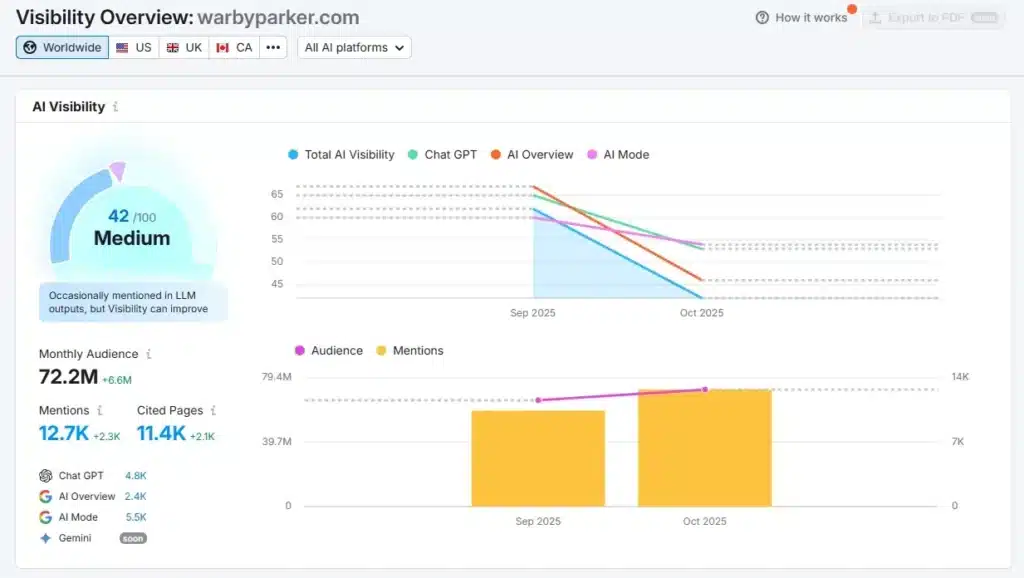
With the AI Visibility Toolkit, Semrush tracks major AI engines (ChatGPT, AI Overviews, and AI Mode) and creates a unified view: you can see your traditional Google rank right next to your AI rank. This exposes keywords where you rank #1 in Google but are invisible in AI.
Most importantly, it offers a direct rival to Ziptie.dev’s optimization module: the SEO Writing Assistant (SWA). While Ziptie.dev gives you a list of edits, SWA scores your content in real-time against top competitors (either as a web extension or on Semrush itself). It helps you fix readability, tone, and keyword gaps as you write, solving the 10-page limit problem of Ziptie.dev’s entry plan.
Notable Features
- Unified search intelligence: The only tool on this list that lets you overlay GEO data on top of traditional SEO data. It prevents the data silo problem that Ziptie.dev creates.
- SEO writing assistant: A real-time content editor that grades your draft. It integrates directly into Google Docs, fitting better into existing writer workflows.
- AI search health audit: A technical scanner that checks for issues like llms.txt presence and blocked bots. It provides the technical indexing insights Ziptie.dev is known for, but as part of a broader site audit.
Pros
- ✅ Eliminates the need for a separate $159/mo Ziptie.dev subscription if you can bundle it into your SEO suite.
- ✅ Semrush’s tiered plans are generally more seat-friendly for agencies than Ziptie.dev’s strict 1-seat policy on standard plans.
- ✅ Backed by a 25B+ keyword database, offering far more robust search volume accuracy than Ziptie.dev’s estimated metrics.
- ✅ The SWA Google Docs plugin allows writers to optimize content without logging into a dashboard (though it’s also available on Semrush itself).
Cons
- ❌ Ziptie.dev is built exclusively for AI. Semrush is an SEO tool with AI features added. Ziptie’s insights may sometimes be deeper than Semrush’s.
- ❌ Several important features (including the SWA) are sold as separate addons, meaning a single subscription may not unlock all the functionalities you might need.
- ❌ Semrush is complex. Ziptie.dev is focused. If you just want a simple AI score, Semrush’s cockpit of features can be overwhelming.
Pricing
This is the pricing of Semrush One, the solution for traditional SEO, AI search, and GEO.
- Starter: $199/mo (50 prompts, 500 keywords, 5 websites, AI visibility toolkit)
- Pro+: $299/mo (100 prompts, 1,500 keywords, 15 websites, content optimization)
- Advanced: $549/mo (200 prompts, 5,000 keywords, 40 websites, share of voice)
4. Scalenut – Best for Team Optimization
Scalenut is the most logical swap for growing content teams that need Ziptie.dev’s visibility data but can’t work within the strict 1-seat limit.
Ziptie.dev is an excellent tool for solo SEO. But if you have a writer and an editor, it becomes a bottleneck regardless of the plan because it only allows 1 user seat. You’re stuck sharing passwords.
Scalenut’s Growth Max plan ($103/mo) includes 2 user seats and 30 articles/mo straight out of the box. While the entry price is higher than Ziptie.dev’s base tier, the value per user is far better.
Functionally, it mirrors Ziptie.dev’s primary value. The latter has the “optimization module;” Scalenut has Cruise Mode. Both analyze top-ranking pages to tell you what to fix. But Scalenut goes a step further by using AI to generate the first draft for you, solving the “blank page” problem that Ziptie.dev leaves behind.
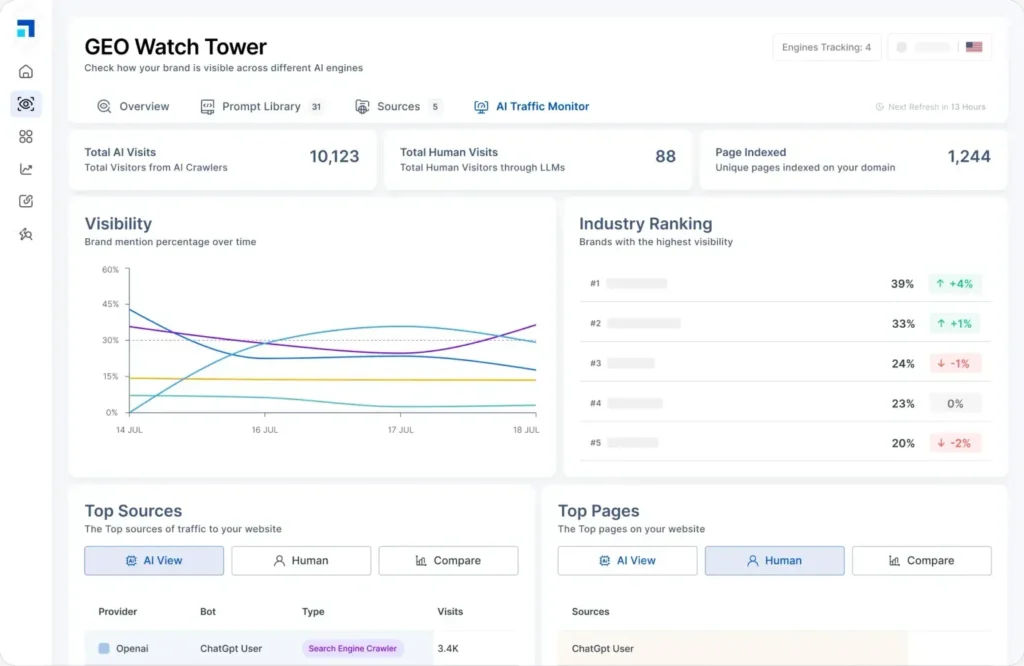
It also includes Traffic Insights, giving you a technical view of which AI bots are actually hitting your site.
Notable Features
- GEO watchtower: Tracks your visibility across ChatGPT, Perplexity, Claude, and AI Overviews. It matches Ziptie’s coverage and adds Claude to the mix.
- Traffic insights: A technical feature that connects to your analytics to show exactly which AI crawlers are visiting your site. This rivals Ziptie.dev’s indexing expertise by giving you hard data on bot behavior.
- Cruise mode: An AI writer that builds a 5-minute blog post based on the top-ranking results. It ensures content is structurally optimized for AI citations before you even hit publish.
Pros
- ✅ Includes 2 user seats on the main GEO plan (Growth Max), beating Ziptie.dev’s single-user restriction.
- ✅ You don’t just get a list of missing keywords; you get a tool that writes the paragraphs for you.
- ✅ Includes AI social listening features to track what users are saying on Reddit, Google, and Quora, which is a key source for Google’s Gemini.
- ✅ Includes several neat extra features, including an AI image generator, auto-optimization, cannibalization detector, AI text humanizer, AI link manager, and more, depending on your plan.
Cons
- ❌ You must pay $103/mo to unlock GEO features. Ziptie.dev allows you to start tracking for $69/mo, though with lower limits.
- ❌ Scalenut tries to do everything (SEO, AI, and social), making the dashboard feel dense compared to Ziptie.dev’s clean, focused interface.
Pricing
- Essential Max: $49/mo (GEO Core: 5 articles/mo, 5 page optimizations/mo, 5 keyword clusters/mo)
- Growth Max: $103/mo (GEO Watchtower: 20 prompts, 2 engines + Social UpReach + GEO Core with higher limits)
- Pro Max: $193/mo (GEO Core + GEO Watchtower + Social UpReach with higher limits)
5. SurferSEO – Best for Content Quality and Teams
SurferSEO is the premium alternative for teams that need to combine AI visibility tracking with high-volume content production.
Ziptie.dev is a diagnostic tool. It tells you what to fix, but it caps your ability to fix it and caps your team. If you’re running a content operation, these limits are suffocating.
SurferSEO solves the volume and collaboration problem, but at a premium price. The Scale plan ($219/mo) unlocks 4 team seats immediately, allowing your writers and editors to work in the same dashboard. It also includes 100 content editor credits per month, plus 20 auto-generated AI articles.
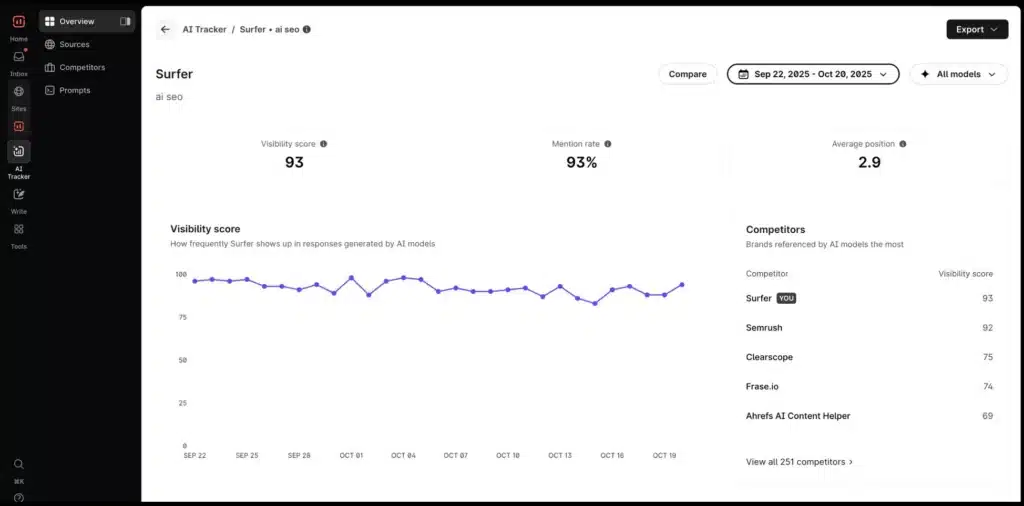
While Ziptie.dev focuses on indexing, Surfer focuses on semantics. Its content score is the industry standard for ensuring your content covers the topical entities that AI models look for. Plus, on the Scale plan, it includes an AI tracker to monitor your visibility on Google AIO, ChatGPT, and Perplexity, and more, alongside your content workflow.
Notable Features
- Content editor: The industry-standard writing interface. It grades your content in real-time against top competitors. Unlike Ziptie.dev’s static report, this is a live workspace that integrates with Google Docs and WordPress.
- AI article generator: SurferSEO writes for you. The Scale plan includes 20 ready-to-rank articles per month, solving the execution bottleneck that Ziptie.dev ignores.
- Team collaboration: The Scale plan includes 4 seats and live collaboration features, whereas Ziptie.dev restricts you to 1 seat even on its $159 Pro plan.
- AI tracker: Monitors your brand visibility on the major AI engines. Note: This is included in the Scale plan but is a paid add-on ($95/mo) for the Essential plan.
Pros
- ✅ 100 optimizations/mo on the Scale plan beats Ziptie.dev’s limits significantly.
- ✅ 4 seats allow for a real editorial workflow, unlike Ziptie.dev’s single-user restriction.
- ✅ Includes AI writing tools that generate the actual draft, not just a list of missing keywords.
- ✅ Connects with Contentful, WordPress, and Google Docs for seamless publishing.
Cons
- ❌ To get the AI tracker included, you must jump to the $219/mo Scale plan. Ziptie.dev offers tracking for $69/mo.
- ❌ If you stay on the cheaper Essential plan ($99/mo), AI tracking costs an extra $95/mo, making it far more expensive than Ziptie.dev for pure monitoring.
- ❌ The AI tracker on the Scale plan monitors 5 prompts daily. High-volume tracking requires further upgrades.
Pricing
- Essential: $99/mo (30 articles/mo, 5 AI articles/mo, 1 user seat)
- Scale: $219/mo (100 articles/mo, 20 AI articles/mo, 5 prompts/day, 4 user seats)
- Enterprise: From $999/mo (Custom features, unlimited user seats)
How to Choose the Right Ziptie.dev Alternative
Ziptie.dev is an excellent tool for the solo technical SEO. If you work alone and just need diagnostic data, the $69/mo plan is a steal.
However, if you’re managing a team or a high-volume content roadmap, the 1 seat and content caps on the lower-tier plans become dealbreakers. Here’s how to choose from these best Ziptie.dev alternatives based on your specific bottleneck:
1. Do You Need to Analyze or Execute?
- If you have a team of writers waiting for instructions, Ziptie.dev is fine. It gives you the to-do list.
- If you need the tool to actually help you write the content, choose GetMint, Scalenut, or SurferSEO. These platforms include a content studio/editor that takes the optimization data and applies it to the draft, bridging the gap between SEO and the writer.
2. Is Your Bottleneck Seats or Price?
- If you simply need more people in the dashboard, Scalenut is the best value. For $103/mo, you get 2 seats, whereas Ziptie.dev requires you to share a login and limits all of its plans to a single seat only.
- If you have a large team (3+), SurferSEO’s Scale plan ($219/mo) or AirOps (unlimited users) becomes the most cost-effective way to collaborate without paying per-seat penalties.
3. Do You Want to Consolidate Your Stack?
- If you’re buying Ziptie.dev, you’re adding another niche tool to your billing.
- If you already use Semrush for SEO, it’s often smarter to use their AI visibility and SEO writing assistant tools. You get most of Ziptie.dev’s functionality without adding a new vendor or learning a new interface.
Stop the Audit Loop and Start Publishing
Ziptie.dev proves that you have a problem. It tells you exactly where your content is failing to win AI citations. But knowing the problem isn’t the same as fixing it.
In 2026, the competitive advantage belongs to teams that can publish optimized answers faster, not just analyze them deeper. You don’t need another audit; the right editor will help you beat the competition.
If you want to move from “diagnostic” to “done,” GetMint is the logical upgrade. It helps you track your brand’s AI visibility, removes the optimization caps, invites your team, and gives you the studio to start winning the answer.
Don’t just find the gap. Fill it. Start your GetMint audit today and turn your visibility into action.
Frequently Asked Questions (FAQs)
Does Ziptie.dev write content for you?
No. Ziptie.dev is a diagnostic tool. It analyzes your content and provides a prioritized list of changes (e.g., “Add a section on pricing”). You must then take that advice and manually write the content in your CMS. Alternatives like GetMint and Scalenut include AI writing tools to generate the text for you.
Why is Ziptie.dev considered restrictive?
While affordable ($69/mo), the entry-level plan allows for only 1 user seat and 10 content optimizations per month. This makes it difficult for agencies or content teams to use without hitting a hard wall immediately.
Is SurferSEO cheaper than Ziptie?
No, it’s generally more expensive for tracking. Ziptie.dev includes tracking for $69/mo. SurferSEO charges $99/mo for the editor plus an extra $95/mo for the AI tracking add-on (on the Essential plan). You choose Surfer for the writing quality, not for the budget.
Can I track AI rankings in Semrush?
Yes. Semrush’s AI visibility toolkit tracks ChatGPT, Google AI Overviews, and Google AI Mode. It allows you to see your AI rank alongside your Google rank in a single dashboard, which Ziptie can’t do.
Which tool is best for non-SEOs?
GetMint. Ziptie and SurferSEO are data-heavy tools designed for SEO professionals. GetMint focuses on AI search visibility, brand health, and content fixes, making it easier for content marketers and brand leads to understand without needing to analyze technical “indexing” scores.

