



Your rank tracker is lying to you. You might rank #1 on Google for a high-volume keyword, but if ChatGPT answers the user’s question without citing you, your visibility is effectively zero.
This is the zero-click crisis. With 58% of searches now ending without a click, the metric for success has shifted. It’s no longer about where you rank on a list of blue links; it’s about whether you’re the primary entity in the generative answer.
To survive this shift, marketing teams are moving away from organic market share and toward AI share of voice. This metric reveals exactly how often AI models recommend your brand over competitors.
What Is AI Share of Voice?
AI share of voice (SoV) is the percentage of generative AI responses for a specific topic in which your brand is cited or mentioned as a primary solution.
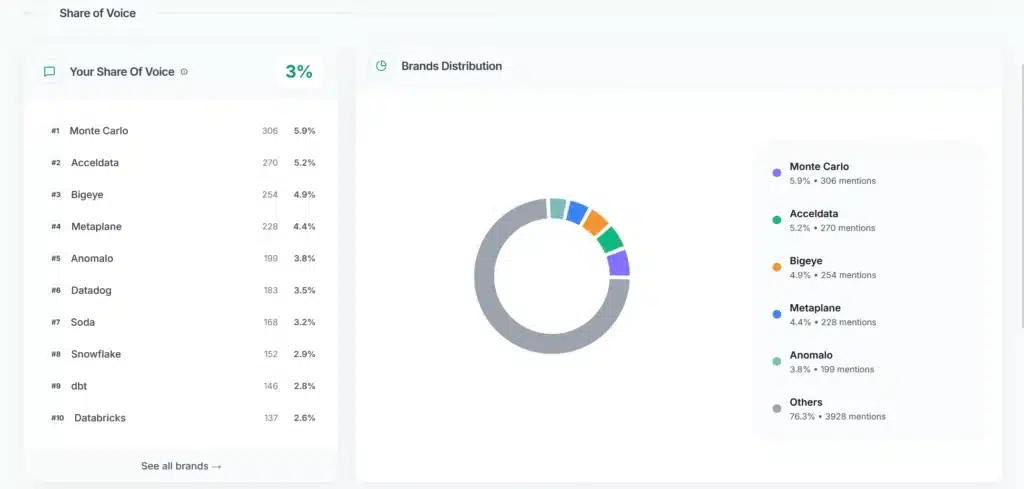
Unlike traditional SEO visibility (which tracks ranking position), AI share of voice measures narrative dominance. It calculates how often models like ChatGPT, Perplexity, and Google AI Overviews reference your brand compared to the total number of times they reference your competitors.
It’s the definitive metric for Generative Engine Optimization (GEO) because it accounts for the “winner take all” dynamic of LLMs.
What Is the Difference Between AI Share of Voice and SEO Market Share?
While SEO tracks links, AI share of voice tracks citations and mentions. The difference determines whether you’re optimized for a search engine or an answer engine.
| Feature | SEO Market Share | AI Share of Voice |
|---|---|---|
| Primary Unit | Keyword Rankings (1–10) | AI Citations and Mentions |
| Visibility Goal | Win the Click (Traffic) | Win the Answer (Trust) |
| Measurement | Click-Through Rate (CTR) | Prominence Weighting |
| Bias | Backlink Authority | Semantic Authority |
| Outcome | Traffic Volume | Conversion Intent |
Why Raw Mentions Are Not Enough for AI Share of Voice
Most marketers calculate their share of voice by simply counting AI mentions. This is dangerous because not all mentions are equal.
A “first position” recommendation in ChatGPT has significantly higher value than being listed fifth in a “See Also” bullet point. In other words:
- First position bias: Brands recommended in the opening sentences of an AI response receive significantly more attention and click-through than those mentioned later in the answer.
- Buried mentions: Brands mentioned late in the response or without a link receive less value compared to the primary citation.
To get an accurate number, you must calculate the weighted share of voice, assigning higher points to primary recommendations and lower points to passive mentions.
How to Calculate AI Share of Voice
To calculate AI share of voice accurately, you must track your brand’s citations across multiple AI engines and apply a prominence weight to each mention.
The basic formula is [Your Weighted Mentions ÷ Total Weighted Market Mentions] x 100.
Simply counting raw mentions leads to inaccurate data because it ignores position bias. A brand recommended in the first sentence has significantly higher authority and click-through potential than a brand listed in a footer citation.
To get a number that reflects reality, apply a scoring system to your AI search competitor analysis.
| Mention Type | Description | Weight |
|---|---|---|
| Primary Recommendation | The AI explicitly names you as the best solution. | 3 Points |
| Comparative Citation | You’re listed alongside competitors (e.g., a list of 3 or 5) | 1 Point |
| Passive Mention | You’re mentioned in passing or in a “Sources” dropdown. | 0.5 Points |
Note: This weighting approach is one of many methodologies for calculating prominence. Different AI visibility platforms may use varying point systems, but the principle remains: primary recommendations are more valuable than passive mentions.
Calculating AI Share of Voice Across AI Engines
You can’t measure AI share of voice on a single platform. Large-scale audits confirm that generative answers diverge significantly across engines.
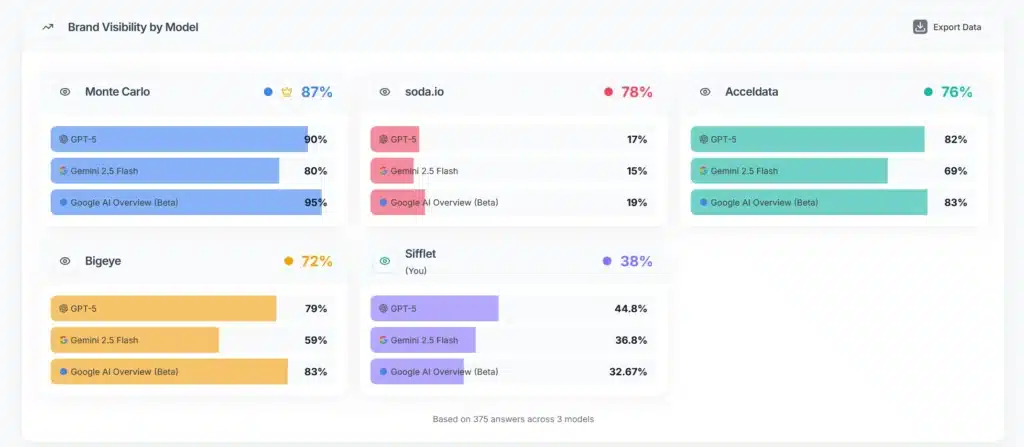
A brand might dominate ChatGPT (which relies heavily on training data stability) but be invisible on Perplexity (which relies on live web index freshness).
To get a true picture of your AI brand performance, you must segment your share of voice by engine:
- ChatGPT SoV: Measures brand strength in general knowledge queries.
- Perplexity SoV: Measures visibility in research and citation queries.
- Google AI Overviews SoV: Measures dominance in commercial intent queries.
Tip: If you see a high share of voice on Perplexity but a low share of voice on ChatGPT, it usually means you have strong recent content (news/blogs) but weak historical brand authority.
What Is a Good AI Share of Voice Score?
Across most industries, an AI share of voice in the 15–20% range is emerging as a strong benchmark. Brands above 25% are generally seen as category leaders.
These figures are based on early platform data and should be viewed as directional estimates, since GEO tracking is still developing.
Benchmarks also differ by sector: SaaS brands often show lower averages because of higher competition, while large enterprise players in more consolidated markets can reach higher shares.
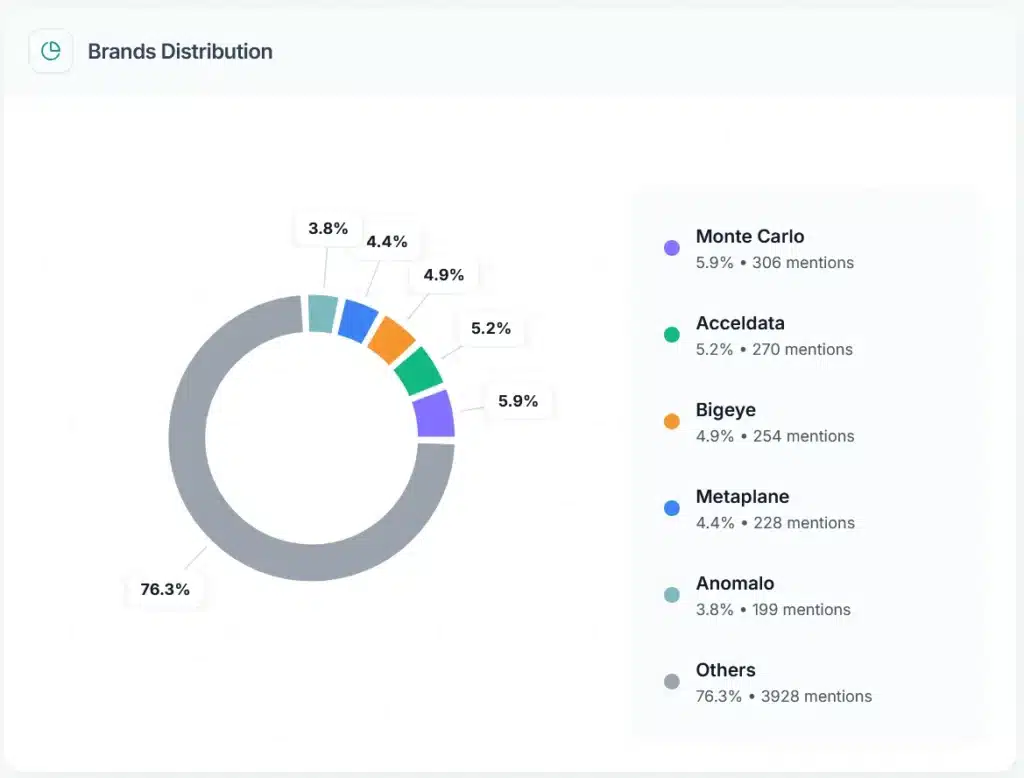
Because AI models often provide synthesized answers citing multiple sources, achieving 100% SoV is virtually impossible. The goal is not total dominance, but relative superiority over your direct rivals.
Why Does Having a Good AI Share of Voice Score Matter?
In AI search, visibility follows a power law of distribution similar to traditional market dynamics. Leading brands usually capture a disproportionate share of voice compared to competitors, leaving a “long tail” of smaller brands fighting for the remaining scraps.
- If you’re a leader (25%+), the AI treats you as the default entity. You’re mentioned in “Best of” lists and often cited as the primary definition of the category.
- If you’re a contender (10–15%), you’re visible but often compared against the leader. The AI knows you exist but requires a more specific prompt to recommend you first.
- If you’re invisible (<5%), the AI likely confuses your brand with generic terms or competitors. You’re rarely cited without a direct brand search.
If your SoV is below 5%, you’re likely suffering from entity confusion. The model doesn’t view you as an authority yet, regardless of your traditional SEO traffic.
Note: The exact percentages vary by sector. In SaaS, even brands with a relatively modest share of voice (around 5–7%) can still surface at the top of AI answers if they’re strongly associated with the category. That’s because the model doesn’t only weigh raw SoV; it also factors in entity authority, topical relevance, and query context.
How to Increase Your AI Share of Voice
Increasing your AI share of voice requires a fundamental shift in how you publish. Traditional SEO focuses on ranking a specific URL for a specific keyword. GEO focuses on associating your brand entity with the category entity.
To win the citation, you must convince the model that your brand is the most probable, authoritative answer to the user’s answer. Here are the three most effective levers to pull:
1. Build Entity Clarity Into Your Pages
AI models don’t “read” content like humans; they extract meaning from explicit structure. They look for clear connections between entities (your brand, your category, and your value proposition) stated directly rather than inferred.
If your content is vague or filled with marketing fluff, the model can’t form a strong association. You need to explicitly define who you are and what you do in simple, declarative sentences. Here’s how:
- Define your brand explicitly: Ensure your Homepage and About page contain clear, subject-verb-object statements like “GetMint is a GEO platform for enterprise brands,” rather than vague slogans like “We help you win the future.”
- Use clear subject-verb-object sentences: Write declarative statements that explicitly connect your brand to your category. Example: “GetMint is a GEO platform for enterprise brands” rather than “GetMint helps you win the future.”
- Update your knowledge graph: Ensure your Wikipedia, Wikidata, and Crunchbase profiles are consistent, as maintaining accurate structured data helps establish clear entity definitions that AI systems may reference.
The objective is to reduce entity confusion. When the AI clearly understands your specific value proposition, it’s statistically more likely to cite you as the solution for relevant queries.
2. Force Co-Occurrence with Market Leaders
If you’re not yet the market leader, one strategic route to visibility is to be mentioned alongside them.
This works because AI models learn from patterns: when brands appear together frequently, the model begins to weight them as peers in the same consideration set.
- Target “Best Of” lists: Actively pitch your product to the third-party listicles and comparison articles that already rank in the top 10 results for your target queries.
- Create comparison assets: Publish high-quality “Brand vs. Competitor” pages. While these are bottom-of-funnel conversion plays, they also force the AI to process your brand name in direct proximity to the industry leader.
- Use Reddit and forums: LLMs heavily weight user-generated content for “authentic” recommendations. Ensure your brand is being discussed in the same threads as your top rivals.
This strategy drives comparative citations. Even if you aren’t the primary recommendation yet, getting listed as a “top alternative” helps you move from less than 5% visibility to over 10% visibility quickly.
3. Send Clear Technical Signals
You can’t be cited if the bot can’t read you. While LLMs are smarter than old SEO crawlers, they’re still software. They prefer structured data that explicitly tells them what a piece of information represents.
- Implement schema markup: Use specific schema types (e.g., SoftwareApplication, FAQPage, TechArticle) to explicitly label your pricing, ratings, and features.
- Optimize for the zero-click format: Structure your answers using the BLUF (Bottom Line Up Front) method, a proven framework where 90% of top-cited sources answer the main question within the first 100 words. Answer the question directly in the first 30-50 words, then expand.
- Deploy an llms.txt file: This proposed standard acts as a curated content map for AI systems. While major AI platforms have not officially confirmed support, early adopters are positioning themselves for potential future integration. Check out our llms.txt guide for more details.
Technical GEO is about reducing the computational cost of understanding your content. The easier you make it for the AI to parse your data, the more likely it is to use that data in an answer.
Note: These tactics represent current best practices based on empirical testing and industry research as of early 2026. For an in-depth GEO optimization guide, check out our post on how to optimize for AI search.
How to Track AI Share of Voice
Knowing the formula is one thing, but getting the data is another. Because AI answers are non-deterministic (they change slightly every time), getting a statistically significant sample is difficult.
You have two options to track this metric: the manual or automatic approach.
Option 1: Tracking AI Share of Voice Manually
You can track AI share of voice manually, but it requires a rigorous process to avoid pollution from your own browser history.
- Build a query universe: Create a list of 50 bottom-of-funnel prompts (e.g., “Best enterprise CRM” or “Alternatives to Salesforce”).
- Clean your environment: Use a fresh incognito window and a VPN for every single query to prevent the AI from using your previous chat history to bias the answer.
- Run the simulation: Input each prompt into ChatGPT, Perplexity, and Google Gemini.
- Score the output: Copy the answers into a spreadsheet. Apply the weighted formula (3 points for primary, 1 for secondary).
- Do this weekly.
This process takes 10 to 15 hours per month. Worse, it’s often inaccurate because a single user’s IP address doesn’t represent the aggregate reality of thousands of customers.
Option 2: Tracking AI Share of Voice Automatically
The modern approach is to use a dedicated AI visibility platform like GetMint. Here’s what makes it the ideal solution for tracking your brand’s share of voice:
- Real-time sampling: The platform runs your prompts continuously across multiple engines, averaging the results to remove statistical noise.
- Automatic scoring: You don’t count mentions; you just look at the share of voice percentage in the dashboard.
- Competitor benchmarking: It tracks your rivals simultaneously, showing you exactly when a competitor steals a citation so you can react immediately.
If you’re tracking fewer than 10 keywords, manual tracking is acceptable. But if you’re a brand that needs to report reliable data to stakeholders, manual tracking is a liability. You need a tool that runs 24/7.
You wouldn’t rely on guesswork for the best sales metrics to track your revenue; don’t rely on it for your market presence.
Your AI Share of Voice Is Your Market Dominance
For two decades, marketing success was measured by your position on a list of blue links. In 2026, that metric is obsolete. With 58% of searches ending without a click, your goal is to be the answer, not just drive traffic.
AI share of voice is the only metric that accurately reflects this new reality. It tells you if the tools users trust for recommendations view your brand as the primary solution or just another footnote.
If you’re not tracking this, you’re risking losing high-intent customers before they ever visit your site. Don’t let the AI decide your narrative for you. Measure it, optimize it, and control it.
Turn citations into revenue. Run your free AI share of voice audit with GetMint and see exactly where you stand against your competitors today.
Frequently Asked Questions (FAQs)
What is a good AI share of voice score?
Based on early GEO tracking data, 15-20% appears to represent strong performance, with 25%+ positioning brands as category leaders. However, as industry benchmarks are still emerging, these should be treated as directional guides rather than absolute standards.
SaaS brands typically see lower baseline percentages due to market fragmentation, while consolidated industries may see higher leader concentration. Below 5% generally indicates entity confusion issues.
How is AI share of voice different from SEO market share?
SEO market share measures rankings and clicks (traffic potential). AI SoV measures citations and mentions (brand authority). You can have high SEO share but low AI SoV if your content is optimized for keywords but lacks the semantic authority that LLMs prioritize.
Can I track AI SoV with Google Search Console?
No. Google Search Console only tracks clicks and impressions from traditional Google Search. It does not provide data on ChatGPT, Claude, or Perplexity, nor does it tell you how your brand was mentioned inside an AI Overview. You need a dedicated GEO tool to see this data.
Why is my AI SoV different on Perplexity vs. ChatGPT?
They use different indexes. Perplexity relies on a live web index, meaning it favors recent news and up-to-date sources. ChatGPT relies heavily on its training data, favoring long-standing historical authority. It’s common to have a high score on one and a low score on the other.
Does being mentioned in the “Sources” list count?
Yes, but it’s worth less. In a Weighted SoV model, a passive mention in the sources dropdown is worth significantly less (e.g., 0.5 points) than a primary recommendation in the text (e.g., 3 points). The primary text drives the user’s perception; the source link validates it.

