

Free AI Brand Visibility Checker

Find out if AI search engines are recommending your brand or sending customers to competitors.
No credit card required No account needed Results in under 10 seconds
Introduction

Most brands have no idea how AI search engines perceive them. While you’re tracking Google rankings, millions of users are asking ChatGPT, Perplexity, and Gemini for recommendations, and your competitors might be the ones getting cited.

Our free AI Brand Visibility Checker shows you exactly how your brand performs across all major AI platforms.

Enter your brand name and industry and get a comprehensive AI search visibility score, per-platform breakdown, and actionable insights to improve your AI search presence.

How to Use the Free AI Brand Visibility Checker

AI brand visibility checker step 1 showing brand name, website URL, industry dropdown, and country selection fields for Shopify e-commerce analysis

Type your company, product, or service name in the first field. This is the brand that’ll be analyzed across all AI platforms.

In the second field, enter your brand’s website URL. This helps the tool understand your positioning and generate relevant prompts.

Next, choose your industry from the dropdown menu. This determines which types of queries the tool will test. For example:

  • E-commerce / Retail generates prompts like “best e-commerce platforms for small businesses”
  • SaaS / Software generates prompts like “top project management tools for remote teams”
  • Marketing / Advertising generates prompts like “best SEO tools for agencies”

Don’t forget to choose your target market. This ensures the AI platforms are queried with location-appropriate context.

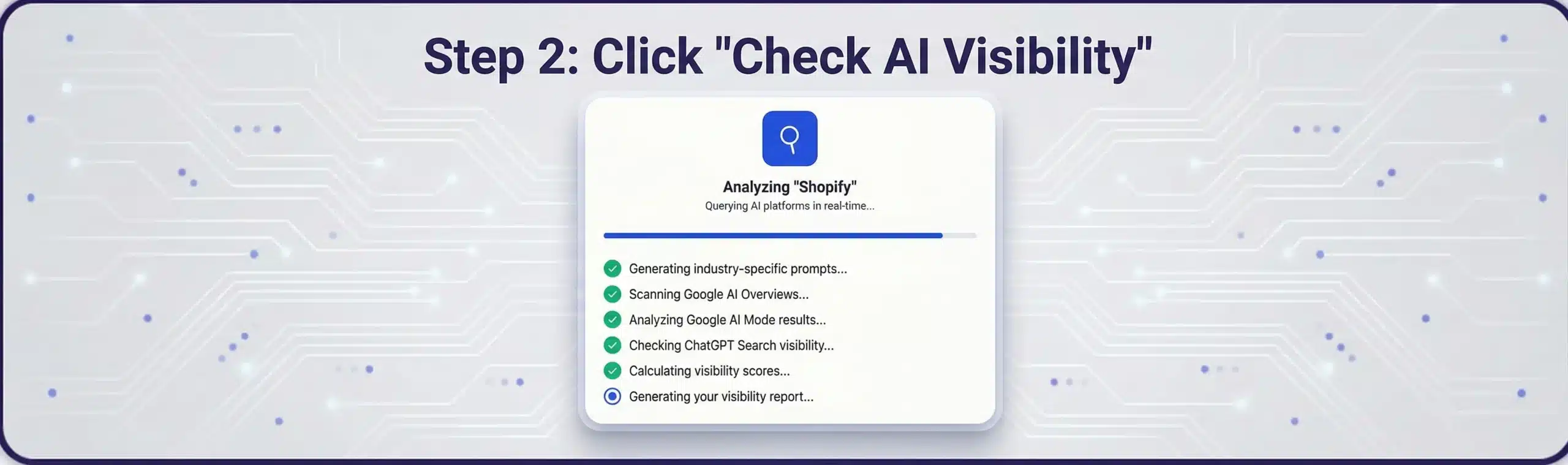
AI brand visibility checker step 2 analyzing Shopify across ChatGPT, Google AI Overview, and Google AI Mode with progress indicators for visibility report generation

The tool will analyze your brand across multiple AI platforms. You’ll see a loading screen showing:

  1. Generating industry-specific prompts
  2. Scanning Google AI Overviews
  3. Analyzing Google AI Mode results
  4. Checking ChatGPT Search visibility
  5. Calculating visibility scores
  6. Generating your visibility report
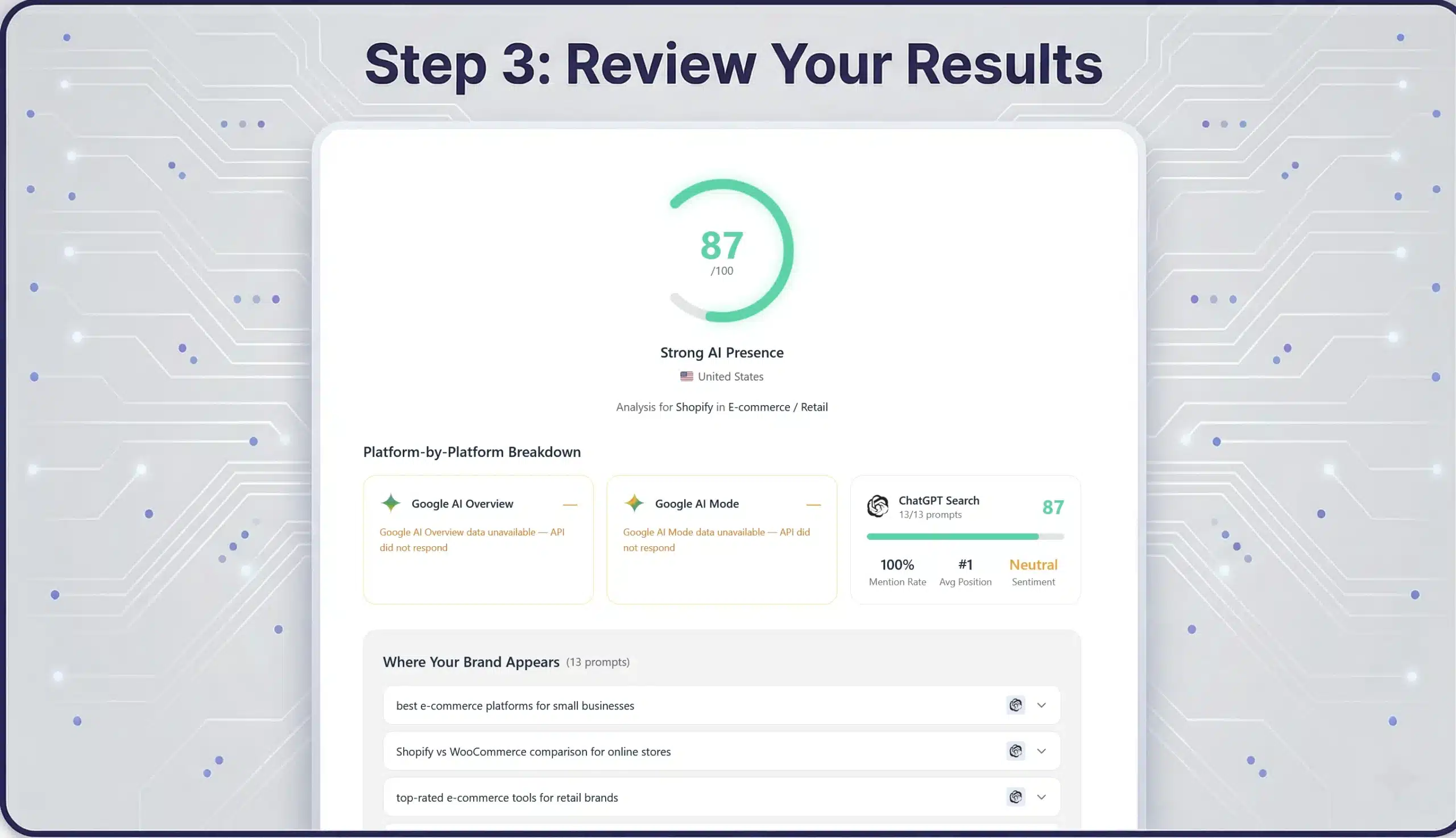
AI brand visibility checker results showing Shopify with 87/100 strong AI presence score, platform-by-platform breakdown with ChatGPT mention rate at 100% and #1 average position

Once complete, you’ll receive your AI Visibility Score (0–100) with a status label like “Strong AI Presence.”

How it Works

What the AI Brand Visibility Checker Does

The AI Brand Visibility Checker measures your visibility across three platforms: ChatGPT, Google Gemini, and Google AI Mode. Three things to pay attention to:

1. Platform-by-Platform Breakdown

The top of the file starts with your brand or company name in markdown heading format:

For each platform, you'll see:

  • Overall score (0–100): Your visibility strength on that platform
  • Mention rate: Percentage of prompts where your brand appeared (e.g., "13/13 prompts = 100%")
  • Average position: Your typical ranking when mentioned (e.g., "#1")
  • Sentiment: How AI describes your brand (Neutral, Positive, or Negative)

For example, ChatGPT Search might show:

  • Score: 87
  • Mention Rate: 100% (mentioned in all 13 prompts)
  • Average Position: #1
  • Sentiment: Neutral

Here's what the scores mean:

80–100

Strong AI Presence

Your brand dominates AI recommendations in your niche. You're consistently mentioned across all platforms.

60–79

Good

Solid visibility, but there's room to improve ranking positions or capture more prompt variations.

40–59

Average

You're appearing in AI results, but competitors are outperforming you consistently.

20–39

Weak

Low visibility. AI platforms rarely mention your brand, even for highly relevant queries.

0–19

Critical

You're essentially invisible to AI engines. You urgently need to optimize for AI search.

2. Where Your Brand Appears

Below the platform breakdown, you’ll see the exact prompts the tool tested, such as:

  • “best e-commerce platforms for small businesses”
  • “Shopify vs WooCommerce comparison for online stores”
  • “top-rated e-commerce tools for retail brands”

Click the expand arrow next to any prompt to see:

  • Your mention status: “Mentioned #1,” “Mentioned #5,” or “Not mentioned”
  • The full AI response: The complete list of brands the AI recommended, showing where you ranked

This lets you identify which prompts you’re dominating and which ones you’re missing.

3. AI Visibility Action Plan

At the bottom of your report, you’ll receive a prioritized action plan with 2–4 recommendations based on your results. These are color-coded by urgency:

  • 🟠 Important (high-priority fixes for weak platforms)
  • 🟢 Opportunity (growth areas where you’re already performing well)

Example recommendations:

  • Improve Google AI Overview Presence: “Your weakest platform is Google AI Overview with a score of 0. Focus on structured data, FAQ content, and authoritative backlinks to improve visibility on this platform.”
  • Optimize for Conversational Queries: “AI search engines favor content that directly answers questions. Create comprehensive FAQ pages, how-to guides, and detailed product comparisons that match natural language queries.”
  • Build Technical Documentation: “AI models heavily weight structured, authoritative documentation. Create detailed knowledge bases, API docs, and technical resources that AI can easily parse and reference.”
  • Get Featured in Industry Roundups: “AI search results frequently pull from listicle-style articles and industry comparisons. Pursue inclusion in ‘best of’ lists, industry awards, and expert recommendation articles.”

Each recommendation explains why it matters and what specific actions to take.

How the AI Brand Visibility Checker Analyzes Your Brand

The tool tests your brand’s visibility across three major AI platforms:

  1. ChatGPT Search: The most widely used AI search platform with over 200 million weekly users
  2. Google AI Overview: The AI-powered snippet that appears at the top of Google search results
  3. Google AI Mode: Google’s conversational AI search interface

For each platform, the tool generates 13 industry-specific prompts tailored to your niche. For example, if you’re in the “E-commerce / Retail” space, it might test:

  • “best e-commerce platforms for small businesses”
  • “Shopify alternatives for online selling”
  • “top-rated e-commerce tools for retail brands”
  • “Shopify vs WooCommerce comparison for online stores”
  • “Shopify reviews from real users 2023”

The tool then checks:

  1. Does your brand appear in the AI’s response?
  2. What position does your brand hold? (#1, #3, #10, etc.)
  3. How is your brand described by the AI?
  4. Which competitors are mentioned alongside you?

This gives you a complete picture of your AI search footprint.

Usefulness

See Who's Competing for Your AI Visibility

When you expand any prompt in the “Where Your Brand Appears” section, you’ll see the full AI-generated response. This reveals:

  • Which brands the AI recommended
  • What order they appeared in
  • How the AI described each brand

For example, if you expand “best e-commerce platforms for small businesses,” you might see:

  1. Shopify
  2. WooCommerce
  3. BigCommerce
  4. Wix eCommerce
  5. Squarespace
  6. Magento
  7. Weebly
  8. PrestaShop
  9. Ecwid
  10. Volusion

This shows you exactly who you’re competing against in AI search results and where you rank compared to them. If your brand appears at #1, you’re dominating that prompt. If you’re at #8 or not listed at all, you know exactly which competitors are outperforming you.

Rationale

Why AI Brand Visibility Matters

Traditional SEO focuses on ranking in Google’s blue links, but user behavior is shifting dramatically.

Instead of clicking through 10 websites, users now ask ChatGPT or Perplexity a single question and get a synthesized answer citing 3 to 10 brands.

If you’re not one of those brands, you’re invisible. Here’s what’s at stake:

1. AI Search Is Already Massive

ChatGPT alone has over 200 million weekly active users. Perplexity processes millions of queries daily. Google’s AI Overviews appear on billions of searches. This shift in user behavior is happening now.

When someone asks, “What’s the best project management tool for remote teams?” and your competitor is cited while you aren’t, you’ve lost that customer before they even visit your website.

2. First-Mover Advantage Exists

AI platforms develop preferences based on training data, user feedback, and source reliability. Brands that establish strong AI visibility early create a compounding advantage.

Essentially, the more often you’re cited, the more “authoritative” you appear to AI models. This creates a reinforcement loop.

Waiting to optimize for AI search means fighting an uphill battle against competitors who are already training AI platforms to recognize them as category leaders.

3. Citations Mean Credibility

Being mentioned by ChatGPT or Claude carries massive social proof. Users trust AI-generated recommendations similarly to how they trust personal referrals. A brand cited by AI gains instant credibility that traditional advertising can’t buy.

Conversely, if competitors are consistently mentioned and you’re not, it signals to potential customers that you’re not a serious player in the space.

4. You Cannot Optimize What You Do Not Measure

Most brands have no visibility into their AI search performance. They’re optimizing blindly, hoping their traditional SEO efforts carry over. This tool gives you concrete data:

  • Which AI platforms favor you (and which ignore you)
  • What prompts trigger brand mentions
  • How your competitors are positioned
  • Where your biggest opportunities lie

Without this data, you’re guessing. With it, you can build a systematic Generative Engine Optimization (GEO) strategy.

How AI Platforms Choose What to Cite

To optimize for AI search strategically, you need to understand why AI platforms mention certain brands and ignore others. Here are the 5 factors that influence their decisions:

📚

Training Data Quality

AI models are trained on publicly available web data. Brands with high-quality, frequently referenced content (news articles, reviews, case studies, technical documentation, etc.) appear more often in training data and thus get cited more frequently.

🏆

Source Authority

Content from trusted sources (major publications, government sites, academic institutions, and well-established brands) carries more weight. If your brand is mentioned on authoritative sites, AI platforms are more likely to cite you.

💡

Content Clarity

AI platforms struggle with vague or marketing-heavy language. Clear, specific descriptions of what you do, who you serve, and how you solve problems make it easier for AI to understand and cite your brand appropriately.

🕐

Recency Signals

Some AI platforms have access to real-time or recent web data. Fresh content, recent news mentions, and updated documentation can improve your visibility on these platforms.

🔄

User Feedback Loops

When users interact with AI responses (clicking links, asking follow-ups, or providing feedback), it signals which recommendations are valuable. Brands that generate positive user engagement gradually improve their AI visibility over time.

Next actions

What to Do After Getting Your Score

A score is only useful if you act on it. Here’s your optimization roadmap based on your results:

If Your Score Is 70+

You're already performing well. Focus on:

  • Defending your position: Monitor competitor movements and respond to new threats.
  • Expanding coverage: Identify the prompts where you're still missing.
  • Improving rankings: Move from #4–5 positions to #1–2 for maximum visibility.
  • Content optimization: Ensure your best content is easily discoverable via llms.txt files.
If Your Score Is 40–69

You have moderate visibility but significant room for improvement. Here's what you need to do:

  • Target missed opportunities: Focus content creation on prompts where competitors appear but you don't.
  • Fix brand perception: Update how AI platforms describe your brand by optimizing your most important landing pages.
  • Build topical authority: Create comprehensive content around your core use cases.
  • Implement structured data: Help AI platforms understand your product features, pricing, and use cases.
If Your Score Is Below 40

You're essentially invisible in AI search. This requires urgent action:

  • Audit your AI crawlability: Ensure AI bots can actually access your website.
  • Create foundational content: Build comprehensive, citation-worthy resources about your product.
  • Fix technical issues: Implement llms.txt, ensure proper schema markup, optimize for AI parsing.
  • Study top performers: Analyze how competitors with 80+ scores structure their content and positioning.

Regardless of your score, these strategies improve your AI visibility:

1. Implement llms.txt: Create an llms.txt file that guides AI crawlers to your most important pages. This file points AI platforms directly to your features page, pricing, documentation, and use cases.

2. Optimize for AI-friendly content: AI platforms favor certain content formats, including comparison tables, feature lists, use case documentation, and FAQ sections. Include these in your content.

3. Monitor competitor movements: Use this tool regularly (monthly recommended) to track changes in your AI score over time, new competitors entering your space, shifts in how AI platforms describe your brand, and emerging prompt patterns where you’re losing ground.

4. Combine GEO with SEO: AI visibility and traditional SEO reinforce each other. Content that ranks well in Google and gets cited by AI creates compounding authority. Use insights from this tool alongside traditional SEO tools for maximum impact.

Why now

AI Search Is the New Gatekeeper of Discovery

If you’re invisible in AI answers, your competitors are capturing customers you’ll never reach.

1.6B
People use AI search monthly
More than the population of Europe and North America combined
50%
Of consumers rely on AI
To do their purchases
73%
Of B2B buyers consult AI
Before contacting vendors

Risk of being invisible

When prospects ask AI "What's the best [your category]?", your competitors appear in responses while you don't exist.

Speed of market shift

Every day you're not visible in AI search, your competitors capture qualified prospects who will never discover you.

Data blackbox

You have no visibility into how AI models perceive your brand, what they say about you, or when they recommend competitors instead.

Revenue leakage

50% of your potential customers are using AI to research purchases. If you're invisible there, you're losing half your market.

Get started

Ready to turn AI search into growth?

With GetMint, monitor your presence, capture opportunities, improve visibility, and fuel your pipeline with AI-driven growth.
FAQS

Frequently Asked Questions

Learn more about using an AI Brand Visibility Checker in 2026
Looking for more free AI search visibility tools?
What's the difference between AI visibility and traditional SEO? Plus icon

Traditional SEO focuses on ranking in Google's organic search results, the blue links users click through. AI visibility measures how often your brand is cited directly in AI-generated answers across platforms like ChatGPT, Gemini, and Perplexity.

In traditional search, users see 10 options and choose. In AI search, users see 3 to 10 pre-selected recommendations and rarely look beyond them. AI visibility determines whether you're one of those chosen few.

How often should I check my AI brand visibility? Plus icon

Monthly checks are ideal for tracking trends and catching competitive shifts early. Run additional checks whenever you:

  • Launch new products or features
  • Rebrand or change positioning
  • Notice competitor activity in your space
  • Publish major content pieces
  • Make significant website changes
Can I improve my score without paying for tools? Plus icon

Yes. The score identifies where you're weak; the actual optimization work is free:

  • Create better content targeting missed opportunity prompts
  • Fix your website's AI crawlability
  • Implement an llms.txt file
  • Add structured data to key pages
  • Update your brand descriptions to be clearer and more specific

Paid GEO tools can accelerate the process and provide deeper insights, but the fundamental tactics are accessible to anyone.


Why do different AI platforms show different results? Plus icon

Each AI platform has different training data, algorithms, and biases:

  • ChatGPT favors well-documented, frequently referenced brands.
  • Gemini prioritizes sources already ranking well in Google.
  • Perplexity emphasizes recency and real-time information.
  • Claude tends toward technically detailed, accurate sources.

A comprehensive GEO strategy optimizes for all platforms rather than focusing on just one.


Does a high AI visibility score guarantee more customers? Plus icon

Not automatically. AI visibility gets you in front of potential customers, but conversion still depends on your product quality, pricing, positioning, and sales process.

However, brands that appear in AI recommendations consistently see the following:

  • Higher organic traffic as users search for them after AI mentions
  • Increased brand awareness and credibility
  • Shortened sales cycles due to the trust AI citations provide
  • Better conversion rates from pre-qualified, high-intent visitors
How is this different from the AI Crawlability Checker? Plus icon

The AI Crawlability Checker tells you if AI bots can access your website. The AI Brand Visibility Tool tells you if AI platforms actually mention your brand in their responses.

Crawlability is the foundation (AI bots must be able to read your site). Visibility is the outcome (are you being cited?). You need both. If bots can't access your site, you'll never achieve visibility. But even with perfect crawlability, you need strong content and positioning to get cited.

Can I check competitors without entering my own brand? Plus icon
  • Studying how top performers describe themselves
Still have questions?
The latest from GetMint
Get all the latest updates about GetMint and insights into AI search.
Reach millions of consumers who rely on AI to discover new products and brands
Get ready to grow
your IA visibility