



Writesonic is built for scale. It generates SEO-optimized content quickly. But in 2026, publishing more articles isn’t enough to win AI citations; you need to know if they’re working.
The problem is the gatekeeper, not the writer. Writesonic treats Generative Engine Optimization (GEO) as a premium feature, locking the essential visibility data behind a steep $249/mo paywall.
For many teams, this is a dealbreaker. If you’re looking for Writesonic alternatives, it’s probably because you need a tool that helps you write faster and track your AI search visibility without paying enterprise prices.
Here are the top five platforms that offer comparable content workflows with deeper, more accessible visibility data.
Top 5 Writesonic Alternatives at a Glance
We evaluated these platforms based on their ability to replace Writesonic’s primary value (content + SEO) while offering insights that are as good as, if not better than, Writesonic’s “Professional” GEO plan.
Here’s how their entry-level plans compare:
| Feature | GetMint | Scalenut | AirOps | AthenaHQ | Semrush One |
|---|---|---|---|---|---|
| Best For | Strategy and Action | Direct Replacement | Workflow Operations | Automated Scale | Stack Consolidation |
| Entry Price (GEO) | €99/mo | $103/mo | Custom | $295/mo | $199/mo |
| Primary Workflow | Strategic Studio | Cruise Mode | Logic Builder | Agents | Content Optimizer |
| Tracked Engines | 3 | 2 | 1 | 8+ | 4+ |
| Tracked Prompts | 50 | 20 | 100 | Usage-Based (3,600 Credits) | 50 |
| Citation Tracking | ✅ | ✅ | ✅ | ✅ | ✅ |
| Sentiment Tracking | ✅ | ⚠️ (Limited) | ⚠️ (Limited) | ✅ | ✅ |
| Bot Forensics | ❌ | ⚠️ (Traffic Insights) | ❌ | ❌ | ✅ |
| Content Limits | 300 Credits | 30 Articles | 25,000 Tasks | 3,600 Credits | ❌ (Requires Upgrade/Add-On) |
| User Seats | 1 | 2 | Custom | 3 | 1 |
| Unique Feature | Sources Watchtower | Social UpReach | Internal Apps | Impersonation Tracking | Unified Data |
If you want a 1:1 replacement for Writesonic’s workflow, Scalenut is the closest match. If you want to fix the quality issues that made you leave Writesonic, GetMint gives you the tools that generic wizards lack.
1. GetMint – Best for Strategy and Action
GetMint is the superior choice for teams that want to fix visibility gaps using strategic, data-backed content rather than high-volume generation.
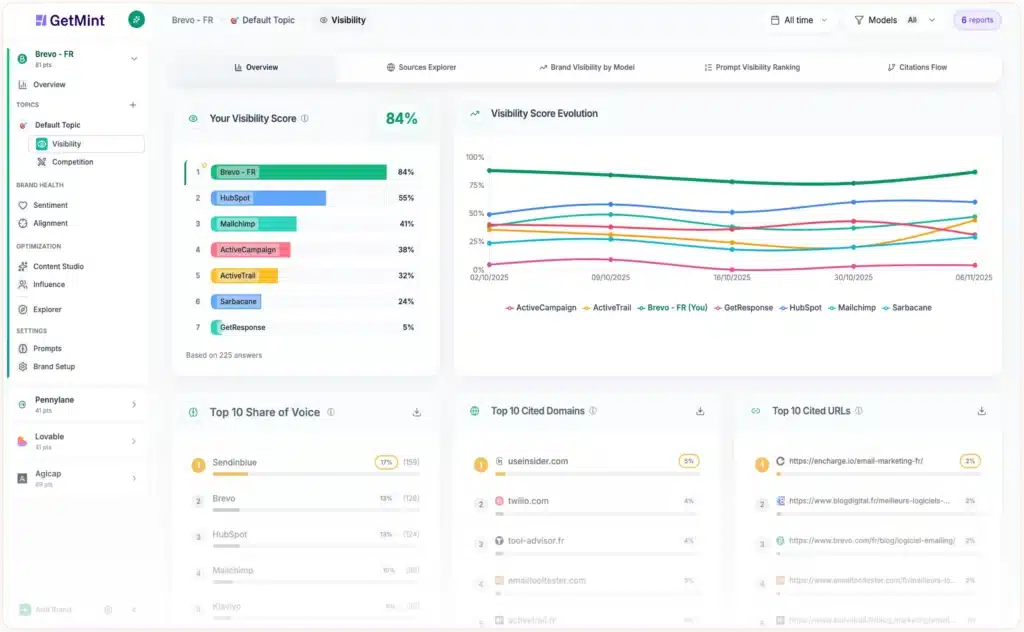
Writesonic treats content creation and visibility tracking as two separate steps: you track the data in one tab, and you generate the article in another. GetMint unifies them into a single workflow.
If you’re leaving Writesonic, it’s likely because Article Writer 6.0 is producing generic, SEO-optimized content that fails to win the AI citation. GetMint solves this with its Content Studio.
Instead of simply asking an AI to write a blog post, GetMint analyzes the sources currently ranking for your target prompt. It then builds a brief based on why those sources are winning and uses your internal data to draft an answer engineered to displace them.
It also beats Writesonic on access. Writesonic gates its GEO features behind the $249/mo Professional plan. GetMint lets you track major engines (ChatGPT, AI Overviews, and Perplexity) on its €99/mo Starter plan, making it a far more accessible entry point for Answer Engine Optimization (AEO).
Notable Features
- Content studio: Unlike generic writers, GetMint’s content studio generates a draft based on the specific sources that are currently ranking. It ensures your content is statistically likely to be cited.
- Brand alignment score: Writesonic checks if your grammar is good; GetMint checks if your brand is accurate. It audits the AI to ensure it understands your core value proposition and isn’t hallucinating features you don’t have.
- Expertise library: You can upload your own technical documentation and internal data. The AI references your ground truth when creating content, preventing the generic “GPT-wrapper” feel of mass-produced articles.
- Content personas: You can create a content persona, give it a name, and adjust its formality, politeness, emotion, and assertiveness levels until it fits your brand voice.
Pros
- ✅ Moves you from monitoring to content creation in a single, cohesive workflow.
- ✅ Tracks 3 major engines on the base plan, avoiding the heavy $249/mo gatekeeping of Writesonic.
- ✅ Prioritizes narrative control and AI brand monitoring (how the AI describes you) over simple keyword volume.
- ✅ Includes a Sources Watchtower to identify which third-party sites are feeding the AI about your competitors.
- ✅ Offers a free trial to audit your brand before committing.
Cons
- ❌ Lacks the multi-model generation tools (AI images/voice) that Writesonic offers; it’s strictly text/strategy focused.
- ❌ Content generation consumes credits, though it avoids the strict tiered caps of some competitors.
Pricing
- Starter: €99/mo (3 engines, 50 prompts, 2 topics, 1 brand)
- Growth: €299/mo (4 engines, 200 prompts, 9 topics, 1 brand)
- Enterprise: From €549/mo (10 engines, custom features)
2. Scalenut – Best for Direct Replacement
Scalenut is the most logical swap for teams that love Writesonic’s workflow but refuse to pay $249/mo just to unlock visibility data.
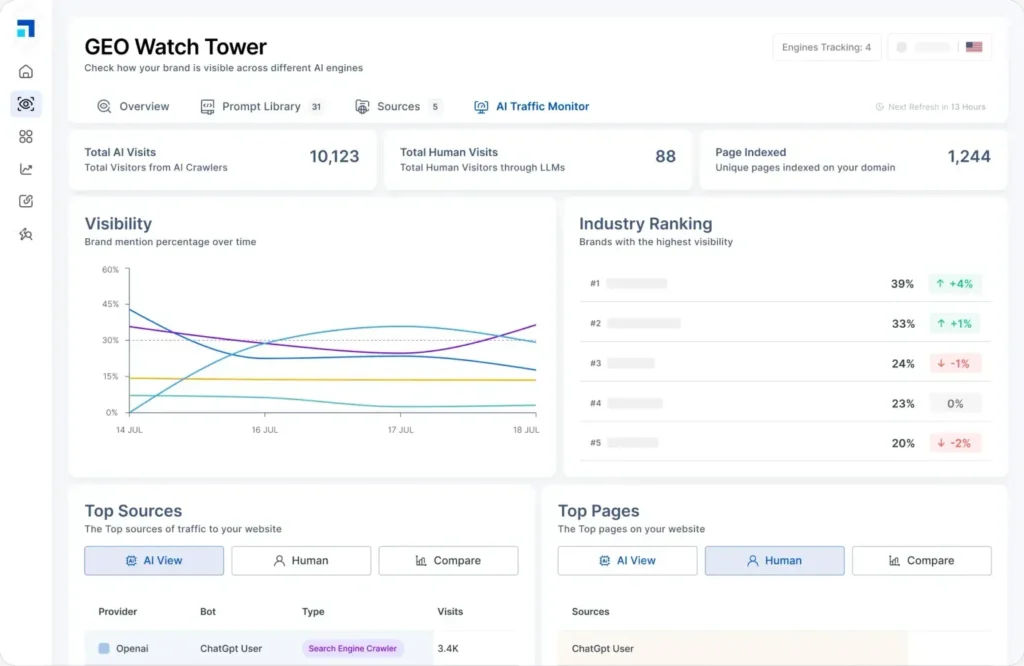
Functionally, Scalenut is Writesonic’s twin. Writesonic has Article Writer 6.0; Scalenut has Cruise Mode. Both are designed to take a keyword and generate a long-form, optimized blog post in minutes. If your team is used to the Writesonic interface, moving to Scalenut requires almost zero retraining.
The difference lies in access to data. To see if your content is winning AI citations in Writesonic, you must upgrade to the $249/mo Professional plan. Scalenut unlocks its GEO Watchtower and GEO Core features on the $103/mo Growth Max plan.
For small teams, this is a massive operational difference. You get the same “Create + Track” feedback loop (monitoring your AI search visibility and instantly fixing it with AI writing) at a much lower entry point.
Scalenut also provides you with bot traffic insights. While it’s not a deep server-log analyzer like dedicated technical tools, it connects with your analytics to show you which AI crawlers are visiting your site, helping you verify if your content is even being indexed by the models.
Pros
- ✅ The value is significantly better; Scalenut unlocks full GEO tracking at $103/mo, undercutting Writesonic’s $249/mo entry point.
- ✅ Includes bot traffic analytics, which is usually a unique feature among technical GEO suites, like Scrunch AI. However, the insights aren’t as comprehensive as those of a dedicated tool.
- ✅ “Cruise Mode” offers the same “Wizard-style” content creation experience as Writesonic, reducing the learning curve.
- ✅ Tracks specific competitive gaps in prompt coverage, helping you find questions your rivals answer but you don’t.
- ✅ Includes an AI image generator similar to Writesonic’s Photosonic.
Cons
- ❌ It’s still gated; you can’t access GEO features on the cheapest ($49/mo) plan. You’re still forced into a mid-tier upgrade, albeit a cheaper one.
- ❌ The dashboard packs a lot of data (SEO + GEO + Social), making it feel more cluttered than Writesonic’s cleaner, linear interface.
Pricing
- Essential Max: $49/mo (AI content suite, no GEO tracking, low limits)
- Growth Max: $103/mo (AI content suite + AI visibility tracking + Reddit engagement, higher limits)
- Pro Max: $193/mo (AI content suite + AI visibility tool + Reddit engagement, highest limits)
3. AirOps – Best for Content Operations
AirOps is the ideal alternative for technical teams who find Writesonic’s pre-built workflows too rigid and want to build their own content factory.

Writesonic lets you input a keyword into Article Writer 6.0 to quickly get an SEO-optimized article, but you have very little control over how it thinks. AirOps is the complete opposite; it gives you the logic blocks to construct your own custom content applications.
You’re likely unsatisfied with that level of control, hence your need for an alternative. You might want a workflow that scrapes a URL, summarizes it using Claude, and then rewrites it using ChatGPT, all in one sequence. Writesonic can’t do this; AirOps can.
However, this flexibility comes at a cost of simplicity. Writesonic is designed for marketers who want a finished product in 5 minutes. AirOps is designed for operators who want to build internal tools.
AirOps was initially positioned as a workflow and content production tool. It now includes AI search visibility features, meaning it can serve as a dedicated AI visibility platform, provided you have the budget to handle your task volume and specific needs.
Notable Features
- Logic grids: You can chain multiple steps (e.g., Search > Summarize > Draft > Edit) into a single workflow. This offers granular control that Writesonic’s linear wizards lack.
- Model playground: Unlike Writesonic, which defaults to its own fine-tuned models, AirOps lets you swap between AI models at any step in the chain. You may also bring your own API keys on the Enterprise plan.
- Internal apps: You can turn a complex prompt chain into a simple form (an “App”) for your marketing team to use, standardizing output without exposing them to the code.
Pros
- ✅ Unrivaled flexibility for building custom content workflows.
- ✅ Allows you to bring your own API keys (Enterprise plan only) or mix and match LLMs to find the best output quality.
- ✅ Excellent for programmatic SEO tasks where you need to process thousands of rows of data.
- ✅ The human-in-the-loop steps allow for manual review in the middle of an automated chain.
- ✅ Offers a 14-day free trial for the Solo and Pro plans to test its features before committing.
Cons
- ❌ The learning curve is steep. It requires a “builder” mindset, whereas Writesonic is plug-and-play.
- ❌ Setting up the equivalent of “Article Writer 6.0” from scratch requires significant setup time.
- ❌ Pricing is usage‑based, depends on your task volume and specific needs, and may incur overcharges if you exceed your allotted tasks.
Pricing
- Solo: Custom (100 prompts, 20,000 tasks, 1 engine)
- Pro: Custom (250 prompts, 75,000 tasks, 4 engines)
- Enterprise: Custom (custom features)
Note: AirOps offers free trials of its Solo and Pro plans (14 days), after which pricing becomes custom and requires talking to sales for a tailored quote based on your task volume and needs.
4. AthenaHQ – Best for Automated Scale
AthenaHQ is the best choice for agencies and large teams that want to optimize content at scale using autonomous agents rather than manual wizards.
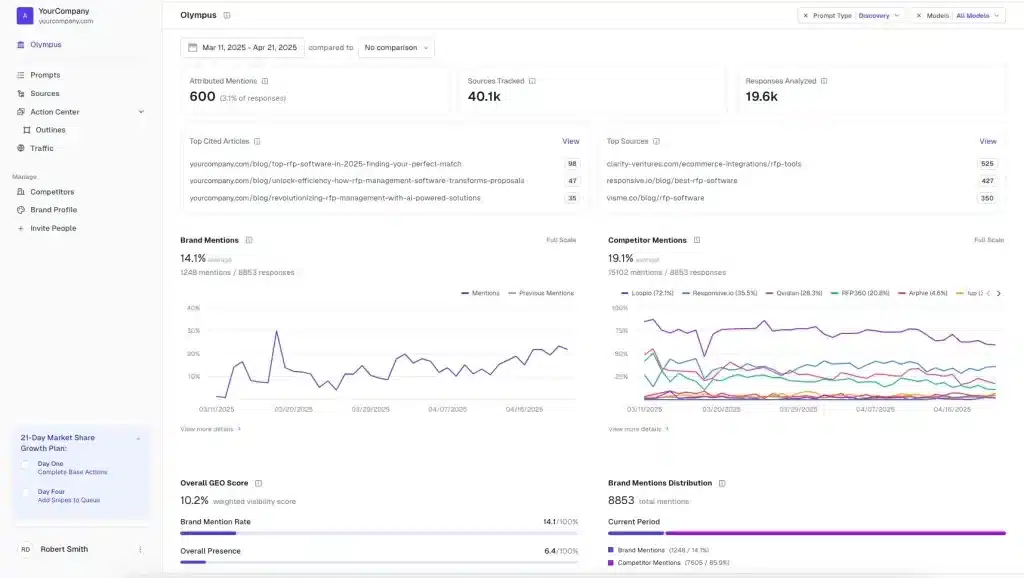
Writesonic is an assistive tool. You log in, choose a topic, and it helps you write an article. AthenaHQ is an agentic tool. It works in the background.
Instead of manually generating content one piece at a time, you deploy Content Optimization Agents that analyze your existing pages against AI personas and rewrite them automatically.
Perhaps Writesonic’s manual workflow, even with AI assistance, is too slow for your volume. You don’t have time to click “Generate” for 500 pages. AthenaHQ solves this by treating content optimization as a programmatic task, not a creative one.
It also beats Writesonic on engine coverage. While Writesonic tracks the basics, AthenaHQ connects to 8+ AI models (including Gemini, Claude, and Meta Llama) on its entry-level plan. This ensures you aren’t blind to niche engines that Writesonic ignores.
Notable Features
- Autonomous agents: These are set-and-forget workflows that audit and rewrite content to match AI preferences without constant human intervention.
- Impersonation tracking: This security layer detects if an AI is hallucinating fake information or scams associated with your brand. This is a defense feature that Writesonic completely lacks.
- Broad engine access: You get data from virtually every major LLM on the market immediately, avoiding the single-engine restrictions of other tools.
Pros
- ✅ Automates repetitive optimization tasks, acting as a force multiplier for small teams.
- ✅ Tracks 8+ AI models on the base plan, offering superior visibility data to Writesonic.
- ✅ Detects security risks and brand impersonation, protecting your reputation.
- ✅ Excellent for agencies managing large portfolios of client content.
Cons
- ❌ The agent model consumes credits rapidly. Unlike Writesonic’s predictable article limits, complex agent runs can result in variable costs.
- ❌ Setting up agents requires a technical understanding of prompts and logic that’s harder to master than Writesonic’s simple interface.
- ❌ The content output can sometimes feel over-optimized and may require a human strategist to polish the narrative.
Pricing
- Self-Serve: $295/mo (3,600 credits, unlimited topics, 3 seats)
- Enterprise: Custom (unlimited seats, custom features, dedicated support)
5. Semrush One – Best for Stack Consolidation
If you want to eliminate tool fatigue by merging your SEO, GEO, and content workflows into a single dashboard, Semrush is the logical choice.
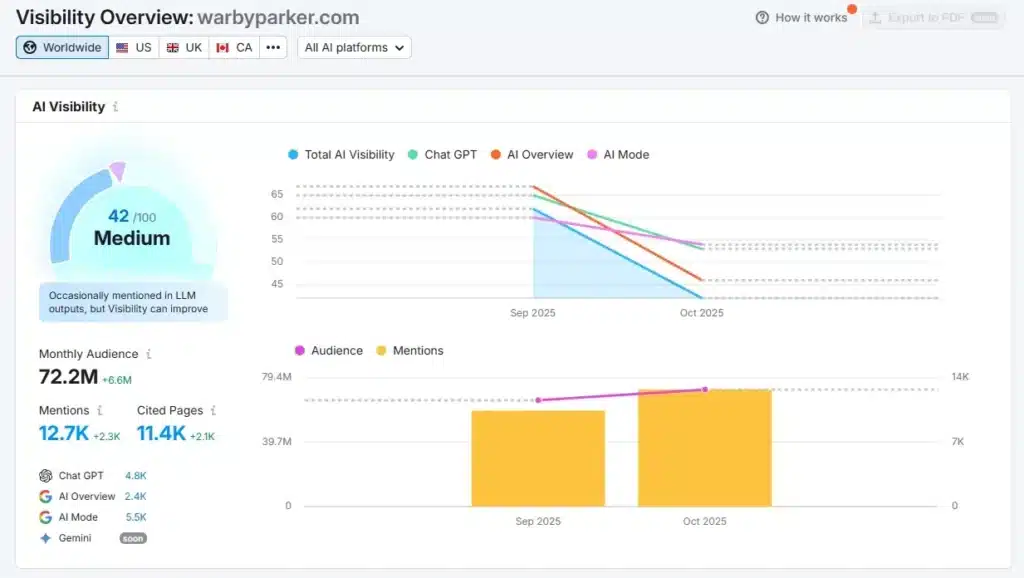
Writesonic is good at writing content. But if you’re managing a broader search strategy, having your writing tool isolated from your data source is inefficient. You find a keyword in Semrush, export it, import it to Writesonic, write, and then check rankings back in Semrush.
Semrush closes this loop. With its new AI Visibility Toolkit, you can track your standings in ChatGPT and Google AI Overviews directly alongside your traditional SEO rankings. This allows you to spot keywords where you rank #1 on Google but are invisible in AI quickly.
While Semrush doesn’t have a one-click blog generator as fast as Writesonic’s, it offers the SEO Writing Assistant as an add-on. This tool writes for you and grades your content against the top-ranking competitors for readability, tone, and keywords so that every piece you publish is actually engineered to rank.
Notable Features
- Unified search intelligence: Semrush is one of the few tools that let you overlay AI search visibility data on top of traditional Google rankings. It provides a holistic view of your total search performance.
- SEO writing assistant: This integrated editor scores your content in real-time. It acts as a guardrail that ensures you don’t publish fluff, whereas Writesonic prioritizes speed over substance.
- AI search health audit: This technical scanner checks for issues like llms.txt presence and blocked bots, ensuring your site is actually crawlable by the new wave of AI agents.
Pros
- ✅ It eliminates the need for a $249/mo specialized GEO tool if you can bundle it into your existing SEO budget.
- ✅ It’s backed by the largest keyword database in the industry (25B+), offering far superior search volume accuracy than Writesonic.
- ✅ It uniquely separates Google’s AI Overviews from the conversational AI Mode, giving granular insight into Google’s ecosystem.
- ✅ There’s no credit burn anxiety for data; pricing is flat and predictable compared to agent-based tools.
Cons
- ❌ It’s not content-focused. If you need to generate 50 articles from scartch in an hour, Semrush can’t do it. It’s an optimizer, not a generator.
- ❌ Semrush locks many useful features (such as the Content Marketing Platform) behind add-ons or higher tiers. Semrush One’s content optimization feature, for example, is unlocked at the mid-tier plan.
- ❌ The learning curve is steep. Writesonic is simple; Semrush is a cockpit with hundreds of buttons.
Pricing
- Starter: $199/mo (AI Visibility Toolkit, 50 prompts, 500 keywords, brand insights)
- Pro+: $299/mo (Historical SEO data, 100 prompts, 1,500 keywords, content optimization)
- Advanced: $549/mo (AI share of voice, 200 prompts, 5,000 keywords, API access)
Note: These reflect the pricing of the Semrush One subscription, which bundles SEO, AI search, and GEO.
How to Choose the Right Writesonic Alternative
Writesonic is a great tool for volume, but volume isn’t visibility. If you’re looking to switch, it’s likely because you have hit a ceiling where creating more content isn’t generating more traffic.
Here’s the decision framework to find the right replacement for your specific bottleneck:
1. Do You Need to Write or to Win?
- If your team is already producing great content but the AI simply ignores you, you don’t need another writer. You need a strategy tool. Choose GetMint. It identifies the specific citation gap and gives you the brief to fix it.
- If you simply need a cheaper way to produce 50 blog posts a month with basic tracking, choose Scalenut. It offers the closest experience to Writesonic’s Article Writer 6.0 but unlocks the visibility data at a much lower price point ($103 vs. $249 per month).
2. Do You Want a Wizard or a Workshop?
- If you want to click one button and get a result (like Writesonic), stick to Scalenut or AthenaHQ. They’re designed for done-for-you workflows.
- If you want to build custom internal tools, like a specific product description generator that uses your brand guidelines and connects to your PIM, choose AirOps. It allows you to engineer the workflow step-by-step.
3. Are You an SEO or a Content Marketer?
- If you live in Google Search Console and Ahrefs, choose Semrush. It allows you to consolidate your AI search visibility tracking into the ecosystem you already pay for.
- If you’re a content lead who needs to prove to your boss that your articles are working, choose GetMint. Its brand alignment score and AI mention tracking provide the qualitative metrics that pure SEO tools often miss.
Stop the Content Mill Madness Today
Writesonic proved that AI can write fast. But in 2026, speed is a commodity. The competitive advantage isn’t how fast you write. Rather, it lies in how accurately you answer.
You don’t need to generate another 50,000 words of generic content. You need to identify the three missing paragraphs that will win you the citation in Perplexity.
If you want to spend your budget on winning the answer rather than just filling the blog, GetMint is the logical upgrade. It moves you from generation to optimization.
Don’t just generate words. Engineer the answer. Start your GetMint audit today and turn your content into citations.
Frequently Asked Questions (FAQs)
Does GetMint write the article for me like Writesonic?
Yes, but with more control. GetMint first builds a data-backed brief based on live competitor sources. You can then use that brief to generate the full article inside the Content Studio, ensuring the output is optimized for citations before you even start editing.
Is Scalenut actually cheaper than Writesonic?
Yes, for GEO features. To track AI citations on Writesonic, you’re forced into the $249/mo plan. Scalenut unlocks similar tracking features on its $103/mo plan, saving you over $1,700 a year.
Do these alternatives include AI image generation?
Mostly no. Writesonic bundles image (Photosonic) and audio tools. Scalenut is the only alternative that includes image generation. GetMint and Semrush focus strictly on text and search visibility.
Can I use ChatGPT Plus instead of these tools?
For writing, yes. For tracking, no. ChatGPT Plus can’t tell you your share of voice compared to competitors, and it won’t track how your visibility changes over time. You need a dedicated GEO tool to capture that data.
Can I optimize existing content with these tools?
Yes. AthenaHQ and GetMint excel at this. They scan your existing URLs against the current top AI answers and tell you exactly how to rewrite them to win the citation. You don’t have to start from scratch.
Do I still need an SEO tool if I buy GetMint?
It depends. If you need deep backlink analysis and technical site audits, yes, keep Ahrefs or Semrush. If you care more about AI mentions and brand reputation than backlinks, GetMint can replace your rank tracker.
Which tool is best for agencies?
AthenaHQ. It’s built for volume. Its agent-based workflow allows you to optimize thousands of client pages programmatically, which is much harder to do with manual “wizards” like Writesonic or Scalenut.

